Florida Mortgage with Assignment of Rents and Promissory Note
County Specific Legal Forms Validated as recently as October 22, 2026 by our Forms Development Team
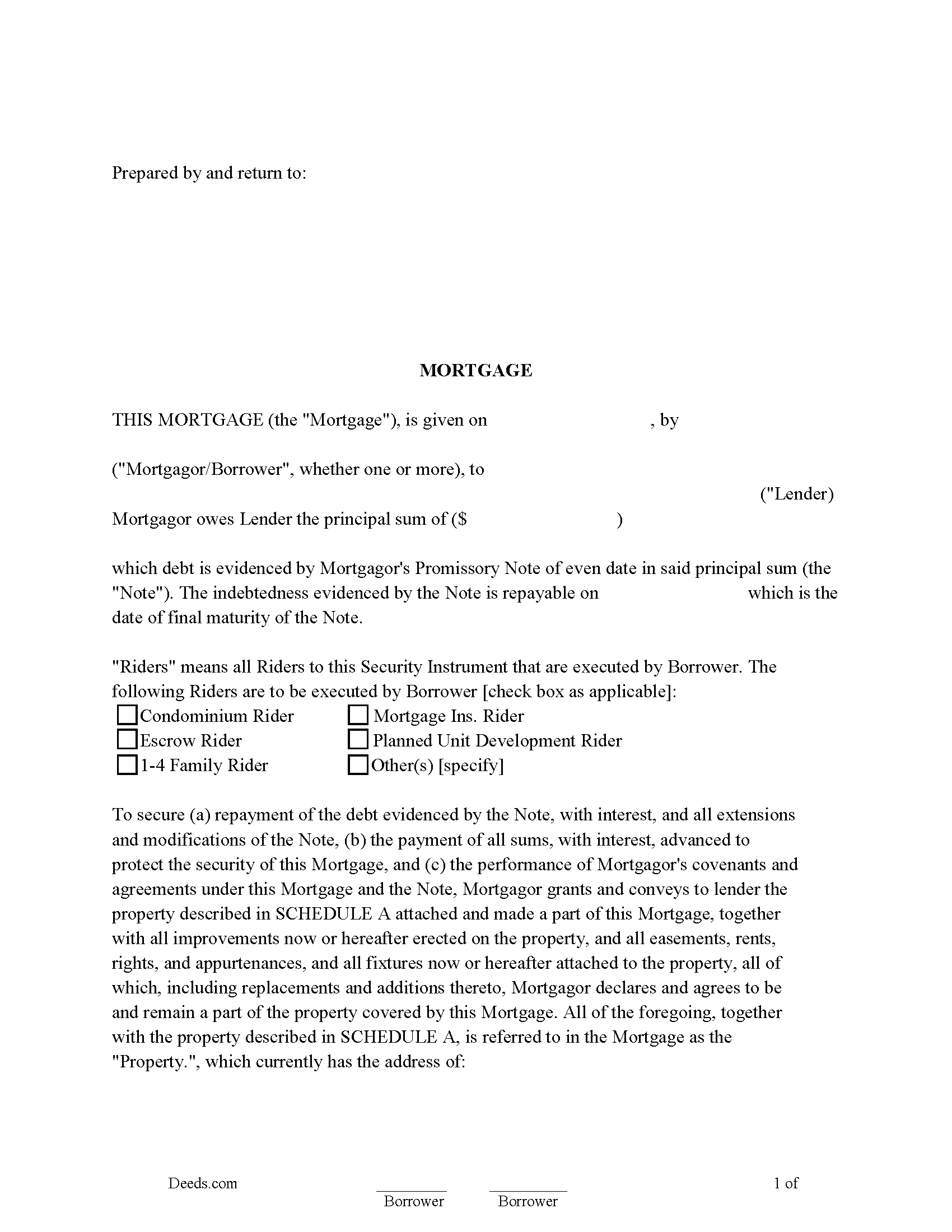
About the Florida Mortgage with Assignment of Rents and Promissory Note
How to Use This Form
- Select your county from the list
- Download the county-specific form
- Fill in the required information
- Have the document notarized if required
- Record with your county recorder's office
What Others Like You Are Saying
"Special Warranty Deed I can't seem to type all my info in the blank spaces. It won't allow me to typ…"
"Consistent and quick. This site saves me so much time away from my desk. It's a great resource for m…"
"Got what I needed and it all was good according to the County Recorder."
"Easy way to get forms that I needed. Would buy again from you if needed."
"Reliable and fast. A great assest."
4.8/5 from 4,836 reviews. Read all
The Florida Mortgage with Assignment of Rents and Promissory Note is built for the way Florida actually treats secured real estate financing: as a lien on the property rather than a transfer of title, enforceable only through judicial foreclosure, and subject to a small but specific set of disclosure and tax obligations that catch out-of-state lenders by surprise. Because Florida is a lien theory state under Fla. Stat. § 697.02, the borrower keeps title and the lender's interest is recorded as a security interest only. Layered onto that are Florida's statutory rules for assigning rents (§ 697.07), balloon mortgage disclosure (§ 697.05), documentary stamp tax on the promissory note (§ 201.08), and the nonrecurring intangible tax on the obligation (§ 199.133). This package addresses each of those points and pairs the mortgage with a matching promissory note so the security instrument and the underlying debt fit together.
When this mortgage is commonly used in Florida
This instrument is most often used by private lenders and sellers financing rental or investment property in Florida — single-family rentals, small multi-unit buildings, and seller-carried transactions where the parties want a recordable mortgage and a separate note rather than an all-cash close. The assignment-of-rents clause gives the lender a way to reach the income stream from a tenant-occupied property after default without waiting for the foreclosure judgment, which is particularly useful when the property's primary collateral value is its rent roll.
Florida lien theory and judicial foreclosure
Florida treats a mortgage as a lien against real property rather than a conveyance of legal title (Fla. Stat. § 697.02). That has two practical consequences for this form. First, the mortgage does not transfer ownership — the borrower remains in title throughout. Second, when default occurs, the lender's only remedy is judicial foreclosure under Chapter 702, Florida Statutes. Florida does not allow non-judicial power-of-sale foreclosures, which means a default plays out in circuit court rather than through a trustee. The mortgage and note are drafted with that procedural reality in mind.
Assignment of rents under Fla. Stat. § 697.07
Florida's assignment-of-rents statute (Fla. Stat. § 697.07) governs how a mortgage may assign rents to the lender and how the lender enforces that assignment. Under the statute, an assignment of rents contained in a recorded mortgage creates a perfected, choate lien on the rents that takes effect on the date of recording. The borrower retains a license to collect rents in the ordinary course until default. After default, the lender may demand rents directly from the tenants by written notice, and the lender may also seek sequestration of rents through the court during a foreclosure action. The mortgage in this package contains language consistent with that framework, including a written-notice mechanism that revokes the borrower's license to collect rents upon default.
Balloon mortgage disclosure under § 697.05
Florida law requires a specific disclosure on any mortgage where the final payment, or the principal balance due at maturity, is greater than twice the amount of the regular periodic payment. Section 697.05(2)(a)1, Florida Statutes, prescribes the substantial form of the legend that must appear on the face of the mortgage, identifying it as a balloon mortgage and stating the final principal payment amount. Recording a mortgage that meets the statutory definition of a balloon without the required legend can expose the lender to penalties and complicate enforcement, so the form provides the legend in the proper place when balloon terms are used.
Documentary stamps and intangible tax at recording
Florida imposes two transaction taxes that are unfamiliar to lenders accustomed to other states. Documentary stamp tax on the promissory note is owed at the rate of 35 cents per $100 of the obligation under Fla. Stat. § 201.08, and the nonrecurring intangible tax on a mortgage encumbering Florida real property is owed at 2 mills per dollar of the obligation under Fla. Stat. § 199.133 — commonly stated as $2 per $1,000 of principal. Both are typically collected by the clerk at recording, and a mortgage presented without the correct stamps will be refused. The amounts are not large, but they are non-negotiable.
Homestead and spousal joinder
If the property is the borrower's homestead under Article X, Section 4 of the Florida Constitution, both spouses must sign the mortgage even when title is held in only one spouse's name. The constitutional homestead protection cannot be waived by a single owner-spouse, and a mortgage on homestead executed by only one spouse is voidable. Property held purely as a rental is typically not homestead, but Florida residency and use questions are fact-specific, so the form is set up to accept both spouses' signatures when needed.
Execution: signatures, witnesses, and notarization
Florida requires that any instrument creating, encumbering, or releasing a real property interest — which includes a mortgage — be signed by the grantor (the borrower, here) in the presence of two subscribing witnesses (Fla. Stat. § 689.01). The borrower's signature must also be acknowledged before a notary public for the mortgage to be entitled to recording (Fla. Stat. § 695.03). The witnesses must sign the document, with their printed names appearing beneath their signatures, and the notary block must include the commission information. The promissory note in the package is signed but not witnessed or notarized — only the mortgage is recorded.
Recording requirements and format
The executed mortgage is recorded with the Clerk of the Circuit Court in the Florida county where the property is located. Recording is what gives the mortgage priority and constructive notice against subsequent purchasers and creditors under Fla. Stat. § 695.01. Florida also has specific format requirements for recordable instruments under Fla. Stat. § 695.26: the name and address of the natural person who prepared the instrument must appear on the face of the document, the name of each signer must be printed or typed beneath the signature, and the document must comply with the clerk's margin and paper-size standards. A document missing the preparer block or with insufficient margins will be rejected at the counter.
What's included in the download package
The Florida Mortgage with Assignment of Rents and Promissory Note package contains the mortgage form, the matching promissory note, written guidelines explaining how the documents work together and how the Florida-specific provisions apply, and a completed example showing typical use. The forms are delivered as fillable PDFs for instant download after purchase. The package is for use in Florida only.
Important: County-Specific Forms
Our mortgage with assignment of rents and promissory note forms are specifically formatted for each of the 67 counties in Florida.
After selecting your county, you'll receive forms that meet all local recording requirements, ensuring your documents will be accepted without delays or rejection fees.