Florida Notice of Contest of Lien
County Specific Legal Forms Validated as recently as October 19, 2026 by our Forms Development Team
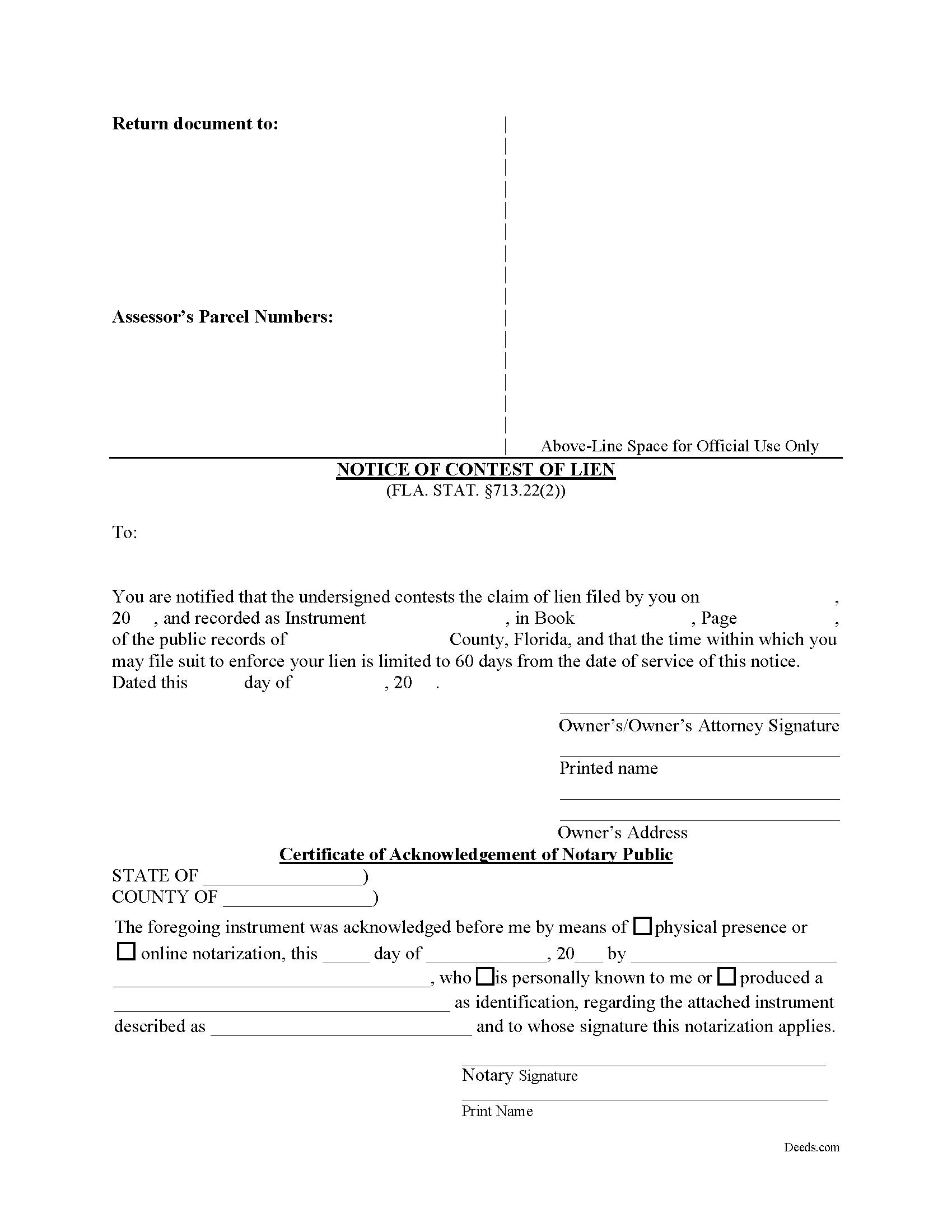
About the Florida Notice of Contest of Lien
How to Use This Form
- Select your county from the list
- Download the county-specific form
- Fill in the required information
- Have the document notarized if required
- Record with your county recorder's office
What Others Like You Are Saying
"that worked great I like to see what I'm filling out and the extra info is really helpful.."
"This website was very handy and had everything I needed. Thanks!"
"I love simple and easy! This is the model that many businesses should use!"
"I am happy with the document but did not know that it would still have to go before the court. Thoug…"
"Excellent, easy to use. Technically accurate in all information offered."
4.8/5 from 4,836 reviews. Read all
Florida is one of the few states whose construction lien statute gives a property owner an affirmative tool to compress a lienor's enforcement window without filing a lawsuit. A recorded claim of lien is generally valid for one year, but an owner who records a Florida Notice of Contest of Lien can shrink that period to 60 days from the date the clerk serves the lienor (Fla. Stat. 713.22). If the lienor does not file an action to enforce the lien within those 60 days, the lien is extinguished by operation of law. The mechanism is owner-initiated, clerk-served, and self-executing — a creature of Florida's Construction Lien Law that has no direct equivalent in most states, where an owner must typically bring an action to discharge a stale lien rather than start a clock running.
When a Florida Notice of Contest of Lien Is Used
A Notice of Contest of Lien is a defensive instrument. Owners record it after a contractor, subcontractor, laborer, supplier, or other lienor has filed a claim of lien against the property and the owner wants to force the lienor to either bring suit promptly or lose the lien. Typical situations include stale claims of lien left on title after a project closes out, disputed claims where the lienor has not moved to enforce, encumbrances that complicate a planned sale or refinance, and recorded claims the owner believes lack a factual or contractual basis. Filing the notice does not adjudicate whether the lien is valid — it sets a deadline.
Florida Statutory Requirements
The form and procedure are governed by Fla. Stat. 713.22(2), which prescribes a notice that is substantially in the form set out in the statute itself. The notice must include the following information:
- The name and address of the lienor as shown in the recorded claim of lien
- The official records book and page where the claim of lien is recorded
- The legal description of the property
- The name of the owner
- The date of execution
The notice must be signed by the owner or the owner's attorney. Departures from the statutory form risk a finding that the notice is ineffective, which would leave the lienor's full one-year enforcement window intact.
Execution and Recording Format
The notice is signed by the owner (or the owner's attorney) and acknowledged before a notary so it can be accepted for recording. Florida's recording-format standards under Fla. Stat. 695.26 apply to instruments affecting interests in real property and require: the signer's name typed or legibly printed beneath the signature, the post office address of each natural person who executes the instrument, and the name and address of the person who prepared the document. Clerks also expect a 3-inch-by-3-inch blank space at the top right of the first page for the recording stamp, with consistent margins on subsequent pages. Documents that fail these formatting requirements can be rejected or returned, costing time on a clock that has not yet started.
How the 60-Day Clock Works
Once the notice is recorded, the clerk serves it on the lienor at the address shown in the claim of lien. Service by the clerk — not by the owner — is what triggers the 60-day deadline (Fla. Stat. 713.22(2)). The lienor must commence an action to enforce the lien within 60 days of service, or the lien is extinguished. The owner does not need to file anything further. If the lienor has already filed an enforcement action before the notice is recorded, the notice has no shortening effect. The procedure also does not extinguish any underlying contract claim the lienor may have for the unpaid amount — it only affects the lien against the real property.
Recording Process
The notice is recorded in the official records of the county where the property is located, with the same clerk that recorded the original claim of lien. Recording fees follow the schedule in Fla. Stat. 28.24. Documentary stamp tax does not apply because the notice does not convey an interest in real property. Prompt recording matters when the property is under contract, in refinance, or otherwise needs clean title within a known timeframe — the 60 days does not begin to run until the clerk completes service on the lienor.
Florida-Specific Traps
- The lienor's name and address in the notice must match what appears in the recorded claim of lien — a mismatch can frustrate service by the clerk and prevent the 60-day clock from starting
- The notice must reference the specific official records book and page of the claim of lien being contested; a vague reference is grounds to challenge effectiveness
- If the lienor has already filed suit to enforce the lien before the notice is recorded, the procedure provides no benefit
- The owner does not serve the notice — the clerk does. Self-service by the owner short-circuits the statute
- The procedure does not address the underlying debt; it only affects the encumbrance on the real property
- Preparer identification under Fla. Stat. 695.26 is required, and an unidentified preparer can cause the clerk to refuse the recording
- The notice does not relieve the owner of separate obligations under the Construction Lien Law, including any responsibilities tied to a Notice of Commencement that may still be open on the project
- Recording a Notice of Contest of Lien does not waive defenses or counterclaims the owner may have if the lienor does file suit within the 60 days
What's Included in the Download Package
The download package includes the Florida Notice of Contest of Lien form, a completed example for reference, and a guide explaining how to fill in each section, where to record, and what happens once the clerk serves the lienor. Files are delivered as instant downloads in standard formats compatible with common word processors and PDF readers.
Important: County-Specific Forms
Our notice of contest of lien forms are specifically formatted for each of the 67 counties in Florida.
After selecting your county, you'll receive forms that meet all local recording requirements, ensuring your documents will be accepted without delays or rejection fees.