Mcduffie County Transfer on Death Deed for Joint Tenants with Right of Survivorship Form
Last validated May 28, 2026 by our Forms Development Team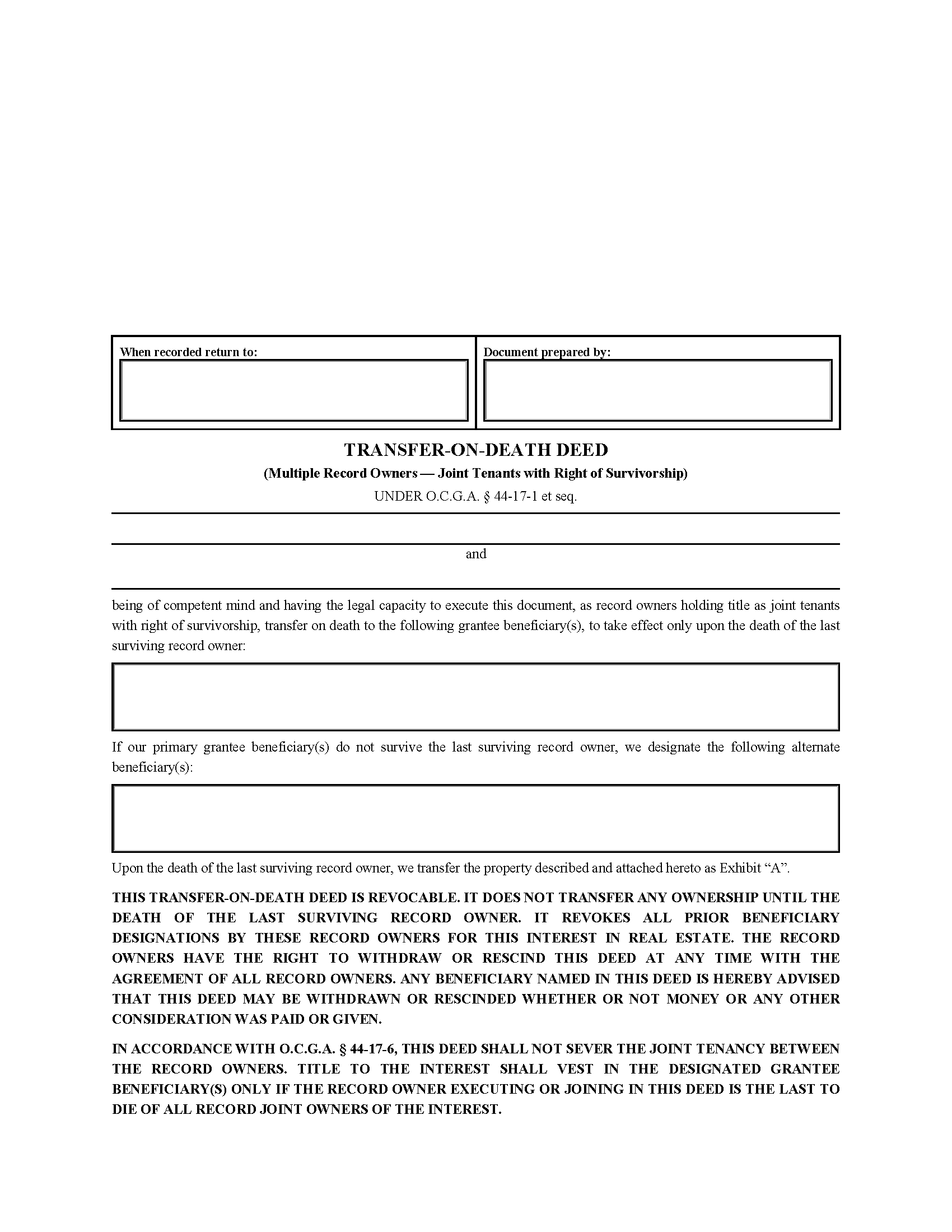
Mcduffie County Transfer on Death Deed for Joint Tenants with Right of Survivorship Form
Fill in the blank Transfer on Death Deed for Joint Tenants with Right of Survivorship form formatted to comply with all Georgia recording and content requirements.
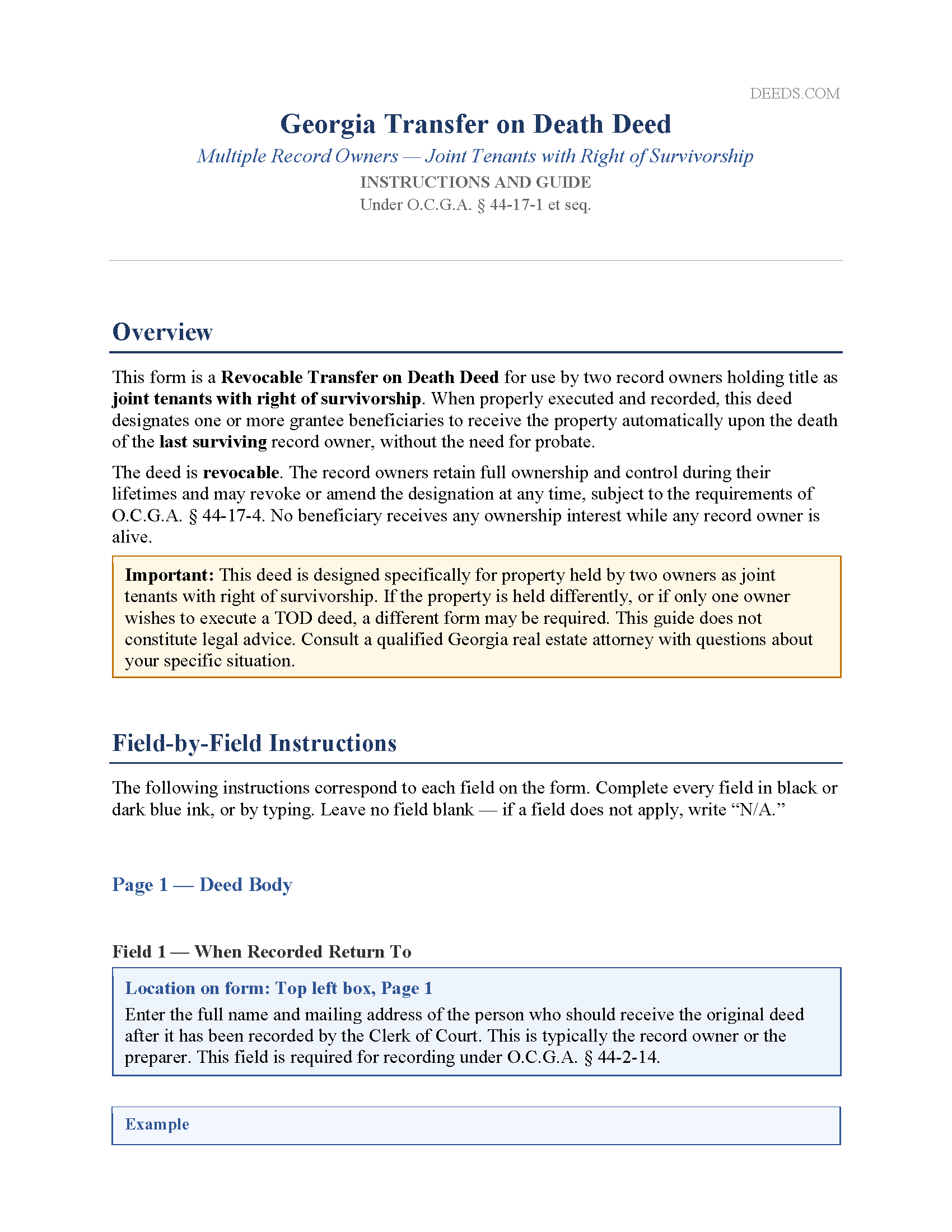
Mcduffie County Transfer on Death Deed for Joint Tenants with Right of Survivorship Guide
Line by line guide explaining every blank on the Transfer on Death Deed for Joint Tenants with Right of Survivorship form.
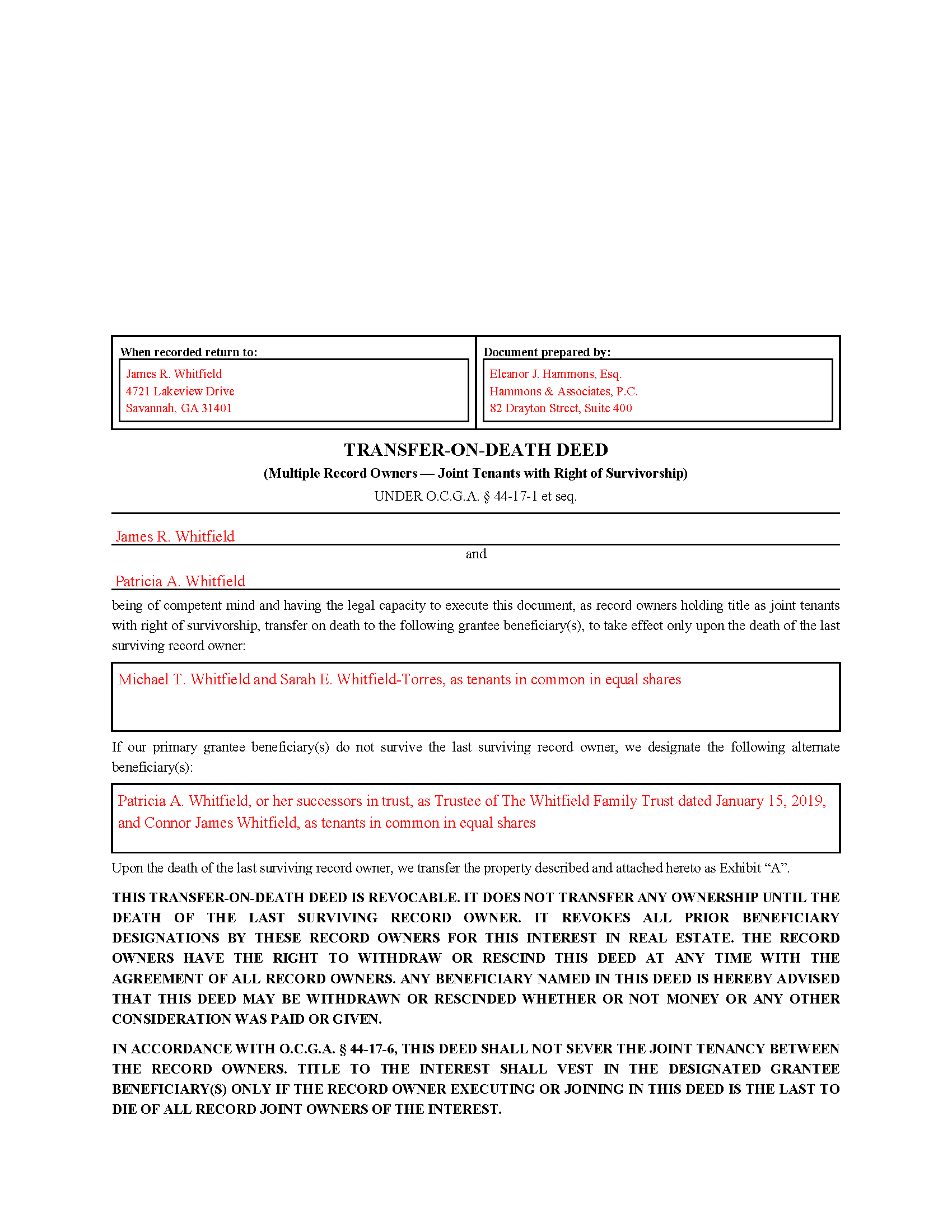
Mcduffie County Completed Example of the Transfer on Death Deed for Joint Tenants with Right of Survivorship Document
Example of a properly completed Georgia Transfer on Death Deed for Joint Tenants with Right of Survivorship document for reference.
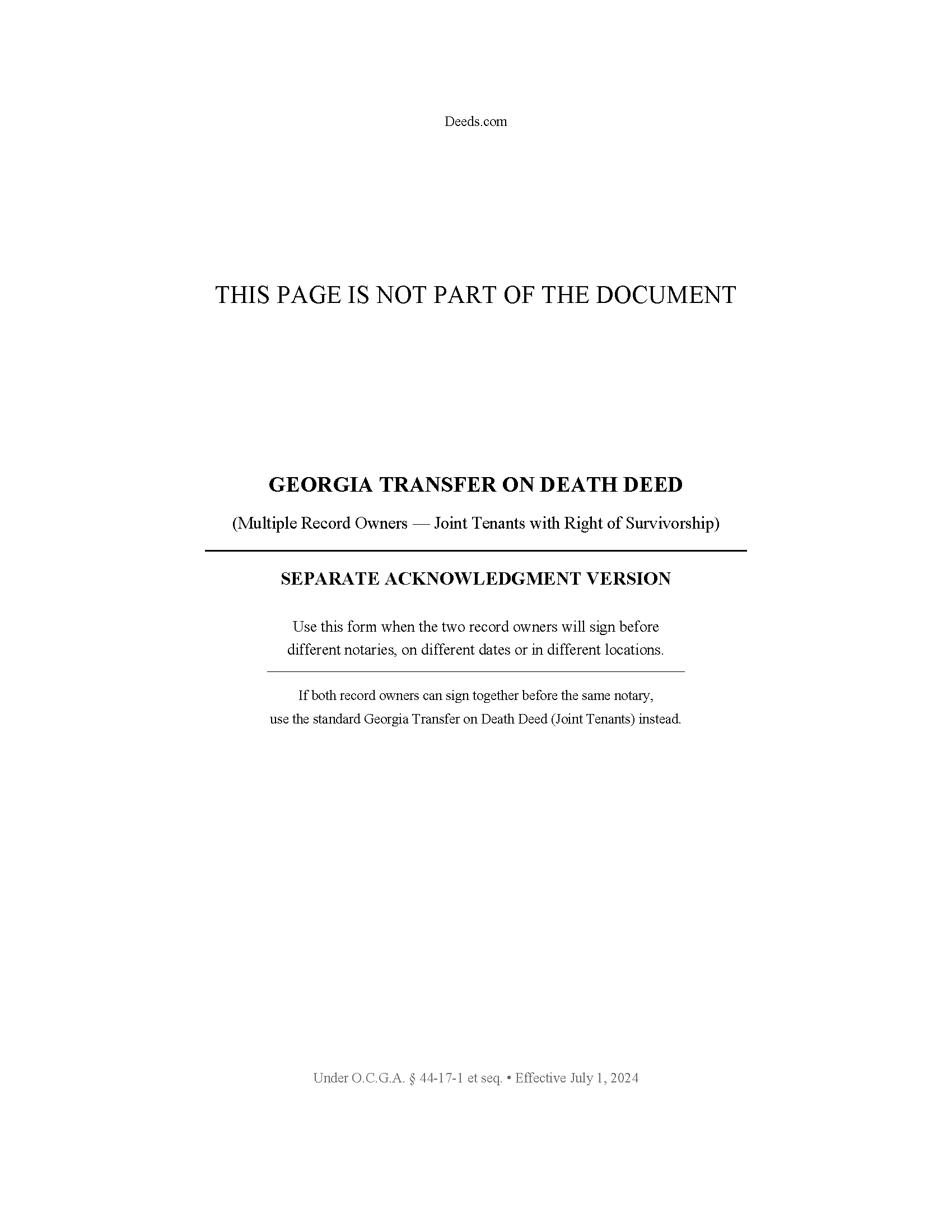
Mcduffie County Form - Separate Acknowledgment Version
Use this version of the form when the two record owners will sign before different notaries on different dates or in different locations.
All 4 documents above included • One-time purchase • No recurring fees
Immediate Download • Secure Checkout
Additional Georgia and Mcduffie County documents included at no extra charge:
Where to Record Your Documents
Clerk of Superior Court
Thomson, Georgia 30824
Hours: 8:30 to 5:00 M-F
Phone: (706) 595-2134
Recording Tips for Mcduffie County:
- Check that your notary's commission hasn't expired
- Leave recording info boxes blank - the office fills these
- Avoid the last business day of the month when possible
Cities and Jurisdictions in Mcduffie County
Properties in any of these areas use Mcduffie County forms:
- Boneville
- Dearing
- Thomson
Hours, fees, requirements, and more for Mcduffie County
How do I get my forms?
Forms are available for immediate download after payment. The Mcduffie County forms will be in your account ready to download to your computer. An account is created for you during checkout if you don't have one. Forms are NOT emailed.
Are these forms guaranteed to be recordable in Mcduffie County?
Yes. Our form blanks are guaranteed to meet or exceed the applicable formatting requirements used for recording in Mcduffie County, including margin requirements, font requirements, and other layout standards. This guarantee applies to formatting, not to the legal sufficiency of information entered by the user or the suitability of a form for a particular transaction.
Can I reuse these forms?
Yes. You can reuse the forms for your personal use. For example, if you have multiple properties in Mcduffie County you only need to order once.
What do I need to use these forms?
The forms are PDFs that you fill out on your computer. You'll need Adobe Reader (free software that most computers already have). You do NOT enter your property information online - you download the blank forms and complete them privately on your own computer.
Are there any recurring fees?
No. This is a one-time purchase. Nothing to cancel, no memberships, no recurring fees.
How much does it cost to record in Mcduffie County?
Recording fees in Mcduffie County vary. Contact the recorder's office at (706) 595-2134 for current fees.
Questions answered? Let's get started!
Georgia's Transfer on Death Deed for joint tenants addresses a situation that the single-owner version cannot: two people who already hold title together as joint tenants with right of survivorship and want to name a beneficiary who steps in only after both of them are gone. Under O.C.G.A. § 44-17-6, that survivor-takes-all structure is preserved in full — the TOD deed does not sever the joint tenancy, and the named beneficiary receives nothing until the last surviving record owner dies. This is a deed that married couples and other co-owners use to keep their existing ownership intact while adding a probate-avoidance safety net for the generation that comes after them.
What This Form Does
Both joint tenants execute a single deed that designates one or more grantee beneficiaries to receive the property automatically upon the death of the last surviving record owner. While either owner is alive, the joint tenancy operates exactly as it did before the deed was signed: if one dies, the survivor becomes the sole owner. The beneficiary designation waits silently in the public record, activating only when the surviving owner also dies. No probate proceeding is required to transfer the property at that point. The deed is fully revocable during the owners' lifetimes and does not transfer any present interest to the beneficiary (O.C.G.A. § 44-17-7).
Georgia's Joint Owner Rule — The Critical Difference from Other States
Most states that recognize TOD deeds treat each co-owner's interest as independently designatable. Georgia's statute takes a different approach for jointly executed deeds. When both joint tenants sign a single TOD deed together under O.C.G.A. § 44-17-6, the beneficiary designation applies to the entire property but vests only upon the death of the last survivor. There is no partial transfer when the first joint tenant dies — that owner's interest passes by survivorship to the co-owner, who continues as the sole record owner subject to the same TOD designation. A purchaser or creditor dealing with either owner during their lifetime treats the property as if no TOD deed exists (O.C.G.A. § 44-17-7).
When It Is Commonly Used
This form is used by married couples and other joint tenants who hold their home or investment property together and want to designate where that property goes after both are deceased, without relying on probate or a will for that transfer. It is also commonly used in combination with a revocable living trust, where the trust itself — through its trustee — is named as the beneficiary, allowing trust administration to govern distribution after the second death.
Execution Requirements
Both record owners must sign the deed. Georgia requires attestation by two witnesses and a notary public, with the notary permitted to serve as one of the two witnesses (O.C.G.A. § 44-2-15). The deed must be signed in the presence of the notary — pre-signing invalidates the acknowledgment. Each signer's full legal name must appear exactly as it does on the current vesting deed. If a name has changed since acquisition, both the current name and the former name should be recited.
Georgia-Specific Traps
Both Owners Must Sign — No Unilateral Execution
Unlike a single-owner TOD deed, this form requires the signature of both joint tenants. A deed signed by only one joint tenant is not invalid on its face, but under O.C.G.A. § 44-17-6 it will vest in the beneficiary only if the signing owner happens to be the last survivor — a condition that cannot be guaranteed at execution and that defeats the purpose of a jointly executed deed.
Revocation Requires All Joint Owners
Because both owners executed the deed together, neither can revoke or amend the beneficiary designation unilaterally while the other is living. Revocation requires a jointly executed revocation instrument that references the original TOD deed, is signed by both record owners (or their duly authorized attorneys-in-fact), and is attested by an officer and two additional witnesses before being recorded in the same county (O.C.G.A. § 44-17-4(a)). A will cannot revoke a TOD deed (O.C.G.A. § 44-17-4(c)).
The Deed Does Not Sever the Joint Tenancy
Signing this deed does not convert a joint tenancy into a tenancy in common. Survivorship rights between the two record owners remain unchanged. Some co-owners mistakenly believe that naming separate beneficiaries on a jointly executed deed will cause the property to split — it will not. The joint tenancy survives the TOD deed intact.
Preparer Identification Required for Recording
Under O.C.G.A. § 44-2-14, the name and mailing address of the person who prepared the deed must appear on the first page. Omitting preparer information can result in rejection at the Clerk of Court's office.
Return Address Required
The name and mailing address of the person to whom the recorded deed should be returned must also appear on the first page (O.C.G.A. § 44-2-14). The Clerk will not accept a deed without this information.
The Three-Inch Top Margin
The first page of every deed recorded in Georgia must have a three-inch blank margin at the top, reserved for the Clerk of Court's recording information. Content placed in that zone will be rejected. This form is formatted to that standard.
Spousal Homestead Rights
When the property serves as the primary residence of both spouses, both should execute the deed to address any homestead rights. A spouse who acquired any interest prior to the TOD deed's execution retains claims that are not extinguished by the deed (O.C.G.A. § 44-17-5(a)). Spouses who became co-owners after the deed is executed have no claim against the designated beneficiary.
Marital Status in Beneficiary Designations
Georgia deed practice requires the marital status of each grantee beneficiary to be recited. For individual beneficiaries, identify each as a single man or woman, an unmarried man or woman, or a married person taking as separate property. For trusts, identify the trustee in their fiduciary capacity rather than naming the trust as the direct recipient — a trust is not a legal entity capable of holding title.
The Nine-Month Beneficiary Deadline
After the last surviving record owner dies, the designated beneficiary must record an affidavit — together with a copy of the death certificate — with the Clerk of Superior Court in the county where the property is located within nine months of death. The affidavit must confirm the owner's death, state whether the beneficiary and owner were married at the time of death, and include the legal description of the property. Missing this deadline causes the property interest to revert to the deceased owner's estate (O.C.G.A. § 44-17-2(d)).
Property Tax Transfer Form
A PT-61 real estate transfer tax form is ordinarily required at recording of deeds that transfer property. Because a TOD deed conveys no present interest during the owners' lifetimes, PT-61 requirements at the time of recording should be confirmed with the local Clerk of Court before submission.
Recording
The deed must be recorded with the Clerk of Superior Court in the county where the property is located before the death of either record owner. An unrecorded TOD deed has no effect. Submit the original executed deed — not a copy — along with applicable recording fees. Print on 8.5" × 11" white paper, single-sided. Do not bind or staple pages, do not highlight text, and include a self-addressed stamped envelope for return of the recorded deed.
What Is Included
The download package contains the Georgia Transfer on Death Deed for joint tenants, formatted to meet Georgia recording requirements including the three-inch first-page margin, preparer and return-address blocks, statutory notice language required by O.C.G.A. § 44-17-3, and an exhibit page for the legal description. Also included are a completed example showing how to fill in each field and a detailed instruction guide covering Georgia-specific requirements, beneficiary designation examples, vesting options, the nine-month claim deadline, and execution instructions for situations where both owners cannot sign at the same time.
Important: Your property must be located in Mcduffie County to use these forms. Documents should be recorded at the office below.
This Transfer on Death Deed for Joint Tenants with Right of Survivorship meets all recording requirements specific to Mcduffie County.
Our Promise
The documents you receive here are guaranteed to meet or exceed the applicable Mcduffie County recording format requirements. If there is a rejection caused by our formatting, we will correct the issue or refund your payment. This guarantee applies to document formatting only and does not extend to information entered by the user, the selection of the form, or the legal effect of the completed document.
Save Time and Money
Get your Mcduffie County Transfer on Death Deed for Joint Tenants with Right of Survivorship form done right the first time with Deeds.com Uniform Conveyancing Blanks. At Deeds.com, we understand that your time and money are valuable resources, and we don't want you to face a penalty fee or rejection imposed by a county recorder for submitting nonstandard documents. We constantly review and update our forms to meet rapidly changing state and county recording requirements for roughly 3,500 counties and local jurisdictions.
4.8 out of 5 - ( 4729 Reviews )
Barbara J.
February 27th, 2020
I haven't actually used any forms yet, but I am very pleased with the simplicity of the website. I love the nmber and variety of forms offered. Thank you for such a great website,
Thank you!
Steve R.
July 30th, 2022
Great! One time cost, ordering was easy, documents where just what I needed.
We appreciate your business and value your feedback. Thank you. Have a wonderful day!
Diane C.
April 28th, 2021
This was just the info I needed
Thank you!
Regina A.
February 19th, 2019
I needed to look for a recorded document and found what I was looking for. Thank you for the great service.
Thank you for your feedback. We really appreciate it. Have a great day!
Steven W.
April 11th, 2021
Seems to be just what I needed and easy to use.
Thank you!
Pamela R.
April 8th, 2022
Thank you for this excellent website. Obtaining appropriate forms was very easy. Thank you!
Thank you!
Stuart C.
April 29th, 2019
Quit, clear, simple...just the way it shouldbe! Thank you!
We appreciate your business and value your feedback. Thank you. Have a wonderful day!
CHRISTINE M.
September 6th, 2019
It was all I needed and guided me to fill it out.
Thank you!
Jason B.
May 9th, 2019
Providing .doc versions would be much easier than trying to jam information into a non-editable PDF.
Thank you for your feedback. We really appreciate it. Have a great day!
Dorien C.
March 25th, 2023
Easy to use, thank you.
Thank you!
Lynn S.
July 22nd, 2020
Great service. I did not have to put much thought into the process!!! Worth the $15.00 extra!!
Thank you for your feedback. We really appreciate it. Have a great day!
Ute P.
February 14th, 2019
Thank you it was hard for me to pull these documents online you been a big help since I am in a different state, quick and awesome.
We appreciate your business and value your feedback. Thank you. Have a wonderful day!
Mayte S.
October 28th, 2020
I am pleasantly suprised at the service. Fair rates and speedy process. No complaints! Happy to use this service again and recommend to anyone. Thank you very much for all your help!
Thank you!
Lori F.
January 20th, 2021
That was easy!
Thank you for your feedback. We really appreciate it. Have a great day!
Thomas M.
September 21st, 2020
EXCELLENT resource for ALL state documents! The forms come with explanations and examples. A real Deal!!!
Thank you!