Idaho Easement Deed
County Specific Legal Forms Validated as recently as October 12, 2026 by our Forms Development Team
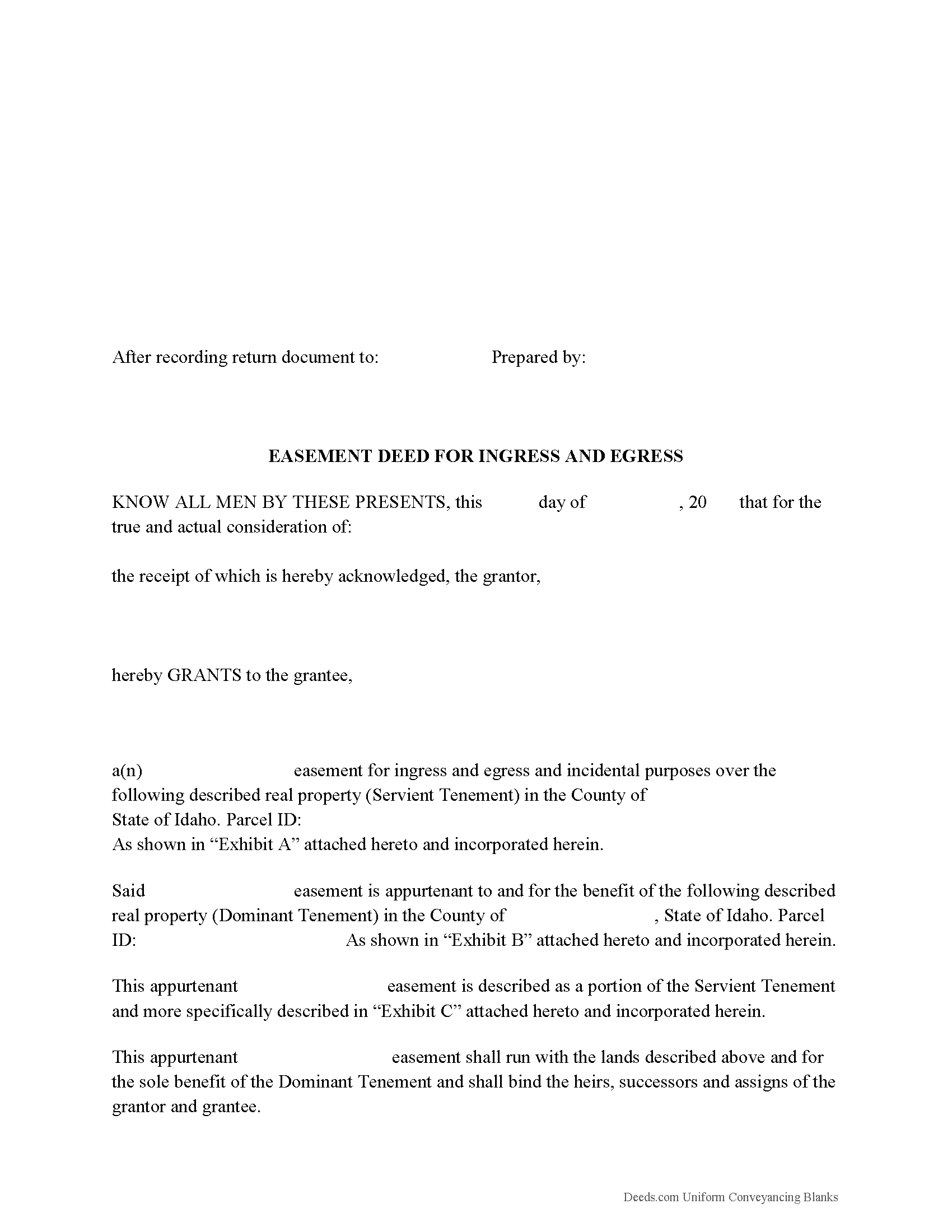
About the Idaho Easement Deed
How to Use This Form
- Select your county from the list
- Download the county-specific form
- Fill in the required information
- Have the document notarized if required
- Record with your county recorder's office
What Others Like You Are Saying
"I’m in Clearwater, FL and needed to record a something in Palm Beach County. Deeds.com made the enti…"
"Deeds.com is amazing. It made finding out how to file legal documents worry free and easily understo…"
"The downloads were a great help in understanding of both what a Warranty Deed was and how to follow …"
"First the convenience to get forms without going or calling Recorder's office is outstanding. Sugges…"
"The site is fine with one exception. About half the pdf files I downloaded were corrupted. I could n…"
4.8/5 from 4,829 reviews. Read all
An easement is the right or interest to use another's land for a specific purpose. An easement deed is the instrument in writing which entitles the holder to a privilege or benefit, such as to place access points, pipe lines, or roads on another's land. Easements can be temporary or permanent. An easement in Idaho can also be obtained for the purpose of exposure of a solar energy device to sunlight, which is known as a solar easement. This type of easement is created in writing and is subject to the same requirements as other easements (55-615). A conservation easement can also be created in Idaho, and must also conform to the laws for other easements and conveyances (55-2101).
A transfer of real property in this state will pass all the easements attached to the land, and will create in favor thereof an easement to use other real property of the person whose estate is transferred, in the same manner and to the same extent as such property was obviously and permanently used by the person whose estate is transferred, for the benefit thereof, at the time when the transfer was completed or agreed upon (55-603).
In order for an easement deed to be eligible for recording, it must be signed by the grantor and acknowledged according to law. If not acknowledged, the execution of the easement deed can be proved in a manner dictated by statute (55-718). Easement deeds that have been executed and acknowledged in a state other than Idaho are entitled to be recorded by a county recorder in Idaho if they have been executed and acknowledged according to the laws of the state wherein such acknowledgements were made (55-805). Easements deeds must contain a proper certificate of acknowledgement in order to be recorded in this state, regardless of where they were acknowledged. Acknowledgements can be made before any of the officers listed in 55-701 of the Idaho Revised Statutes and must also meet the requirements as set forth in 55-707.
If left unrecorded, an easement deed is void as against any subsequent purchaser or mortgagee of the same property, or part thereof, in good faith and for a valuable consideration, whose conveyance is first duly recorded (55-812). However, an unrecorded easement deed is valid between the parties to it and those who have notice of it (55-815). Easement deeds and other instruments affecting the title to real property that are acknowledged or proved, and certified, and recorded as prescribed by law, from the time they are filed with the recorder, are constructive notice of the contents to subsequent purchasers and mortgagees. Easement deeds should be recorded by the county recorder of the county where the property is located (55-808).
Important: County-Specific Forms
Our easement deed forms are specifically formatted for each of the 44 counties in Idaho.
After selecting your county, you'll receive forms that meet all local recording requirements, ensuring your documents will be accepted without delays or rejection fees.