Williamson County Quitclaim Deed (Divorce) Form
Last validated October 14, 2026 by our Forms Development TeamFormatted for recording in Williamson County, for property anywhere in the county: rural and unincorporated areas as well as Cambria, Carterville, Colp, Creal Springs, Energy, Freeman Spur, Herrin, Hurst and 3 more.
- 3 documents included
- Immediate PDF download
- Formatting guarantee
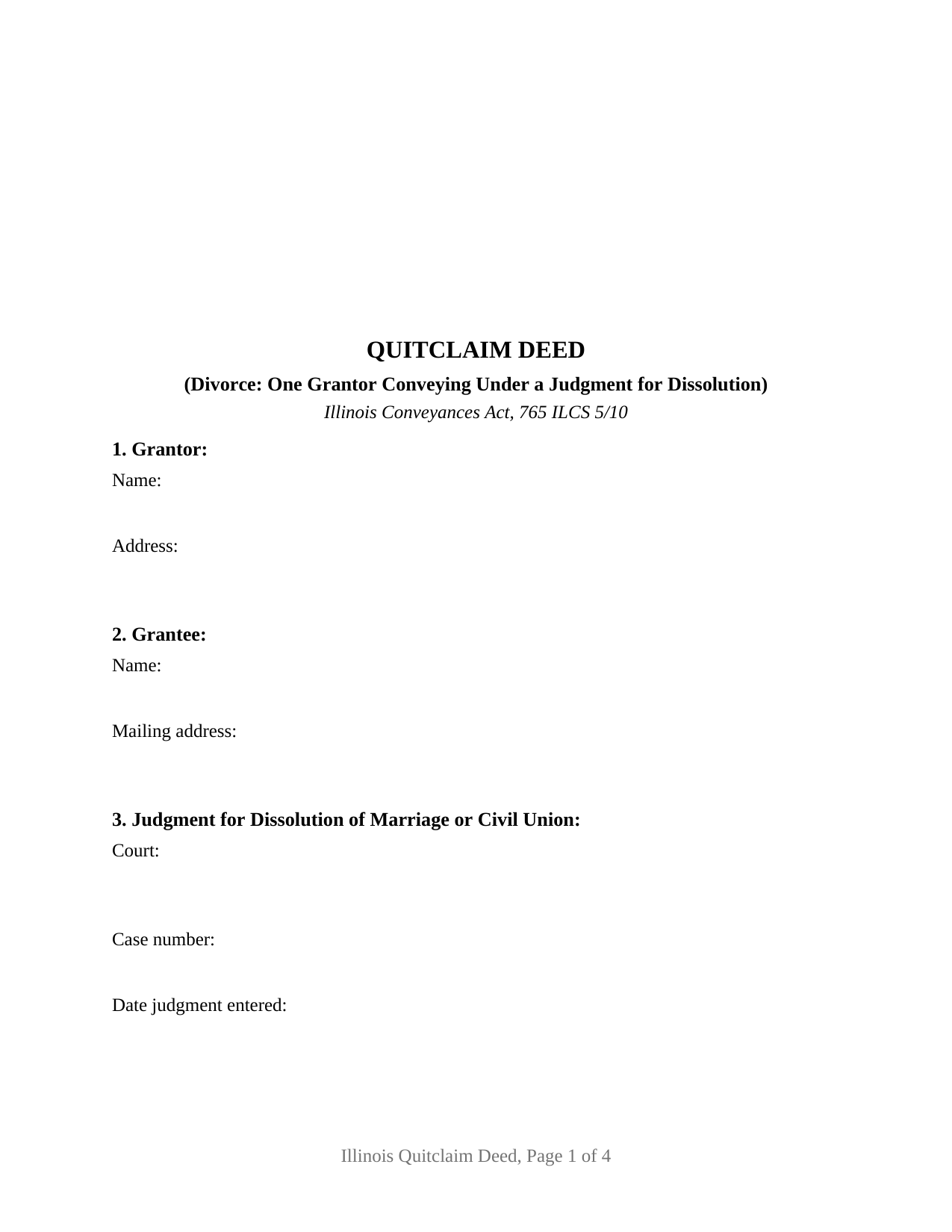
Williamson County Quitclaim Deed (Divorce) Form
Fill in the blank Quitclaim Deed (Divorce) form formatted to comply with all Illinois recording and content requirements.
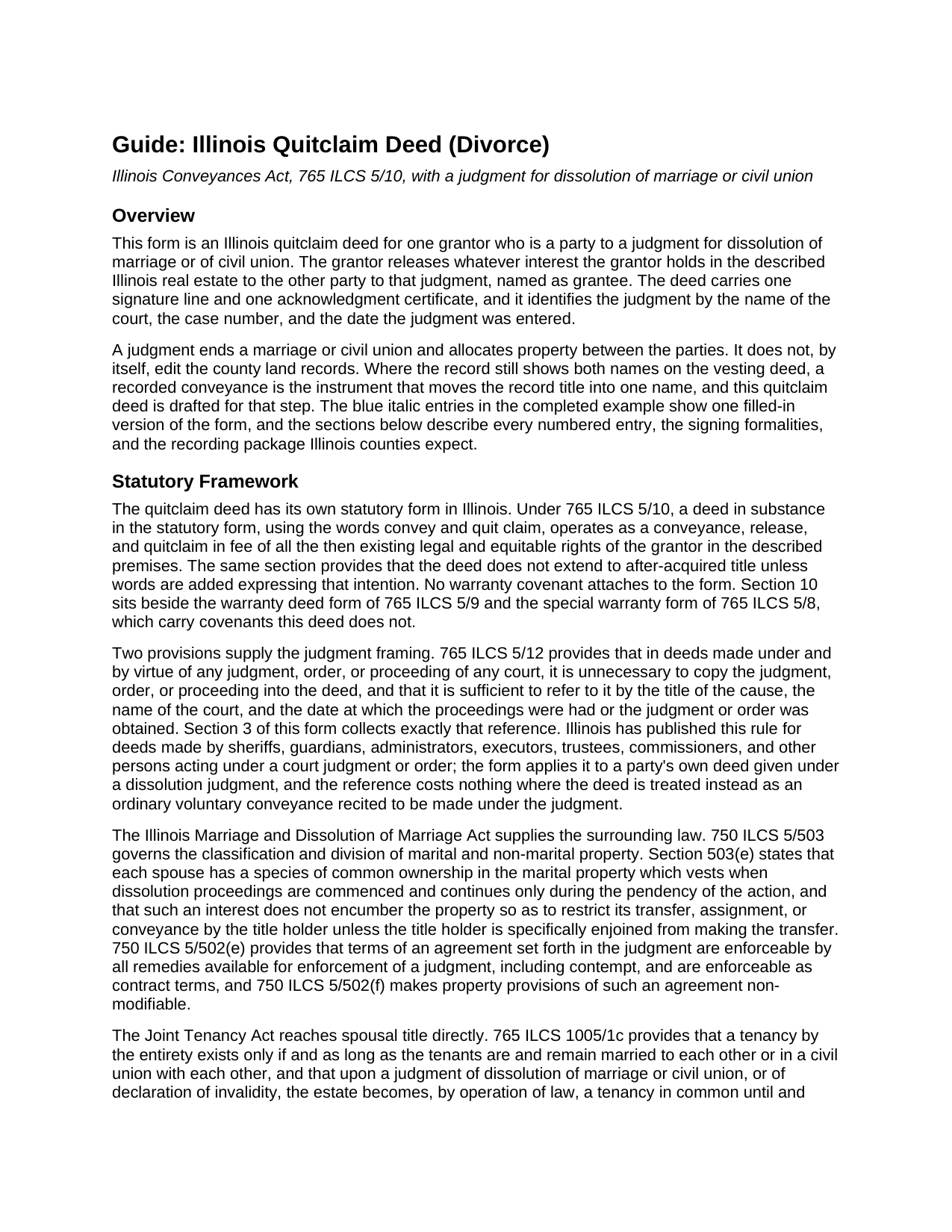
Williamson County Quitclaim Deed (Divorce) Guide
Line by line guide explaining every blank on the Quitclaim Deed (Divorce) form.
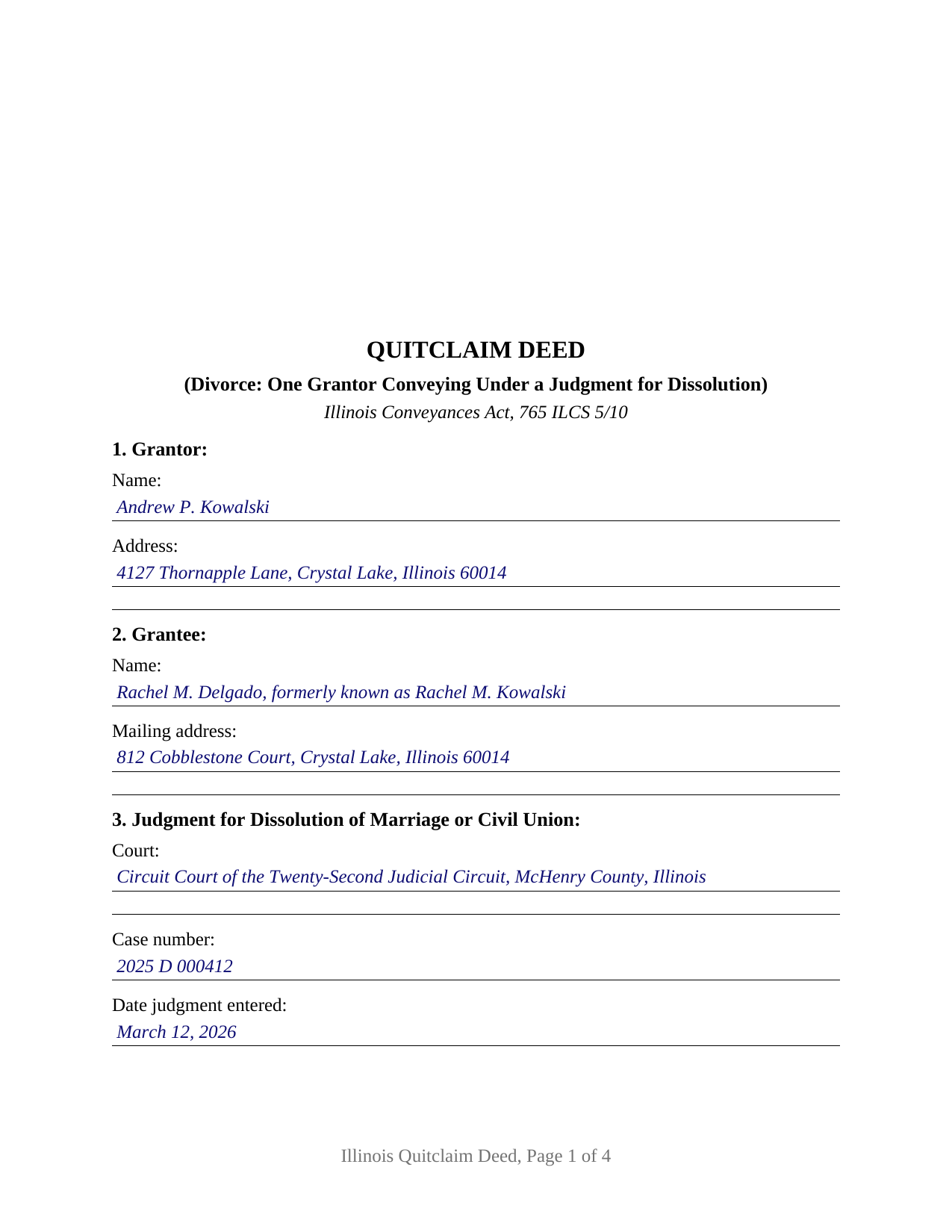
Williamson County Completed Example of the Quitclaim Deed (Divorce) Document
Example of a properly completed Illinois Quitclaim Deed (Divorce) document for reference.
All 3 documents above included • One-time purchase • No recurring fees
Immediate Download • Secure Checkout
Additional Illinois and Williamson County documents included at no extra charge:
Where to Record Your Documents
Williamson County Clerk & Recorder
Marion, Illinois 62959
Hours: 8:00 to 4:00 Monday through Friday
Phone: (618) 998-2110 and 998-2112
Recording Tips for Williamson County:
- Bring your driver's license or state-issued photo ID
- Ensure all signatures are in blue or black ink
- Ask about accepted payment methods when you call ahead
- Ask for certified copies if you need them for other transactions
- Ask if they accept credit cards - many offices are cash/check only
Cities and Jurisdictions in Williamson County
Properties in any of these areas use Williamson County forms:
- Cambria
- Carterville
- Colp
- Creal Springs
- Energy
- Freeman Spur
- Herrin
- Hurst
- Johnston City
- Marion
- Pittsburg
Hours, fees, requirements, and more for Williamson County
How do I get my forms?
Forms are available for immediate download after payment. The Williamson County forms will be in your account ready to download to your computer. An account is created for you during checkout if you don't have one. Forms are NOT emailed.
Are these forms guaranteed to be recordable in Williamson County?
Yes. Our form blanks are guaranteed to meet or exceed the applicable formatting requirements used for recording in Williamson County, including margin requirements, font requirements, and other layout standards. This guarantee applies to formatting, not to the legal sufficiency of information entered by the user or the suitability of a form for a particular transaction.
Can I reuse these forms?
Yes. You can reuse the forms for your personal use. For example, if you have multiple properties in Williamson County you only need to order once.
What do I need to use these forms?
The forms are PDFs that you fill out on your computer. The free Adobe Acrobat Reader is recommended, and most PDF apps also work. You do NOT enter your property information online - you download the blank forms and complete them privately on your own computer.
Are there any recurring fees?
No. This is a one-time purchase. Nothing to cancel, no memberships, no recurring fees.
How much does it cost to record in Williamson County?
Recording fees in Williamson County vary. Contact the recorder's office at (618) 998-2110 and 998-2112 for current fees.
Questions answered? Let's get started!
A judgment for dissolution of marriage settles which party keeps the house. County land records do not read judgments, so until an instrument is recorded the departing party's name still stands in the chain of title. This Illinois quitclaim deed is arranged for that step: one party to the judgment signs as Grantor, the other party is named as Grantee, and Section 3 fixes the judgment by court, case number, and date entered.
What the judgment moves on its own
One estate changes shape the moment the judgment is entered. Under 765 ILCS 1005/1c a tenancy by the entirety exists only while the tenants remain married to each other or in a civil union with each other, and on a judgment of dissolution the estate becomes, by operation of law, a tenancy in common until and unless the court directs otherwise. Survivorship between the parties ends there; both names stay on the record. Under 750 ILCS 5/503(e) the species of common ownership each spouse holds in marital property continues only during the pendency of the action, and it does not restrict a transfer by the title holder unless that holder has been specifically enjoined. Closing the gap between an allocation on paper and a clean record takes a recorded deed.
Naming the judgment rather than attaching it
Illinois settles how a deed made under a court judgment refers to it. 765 ILCS 5/12 provides that such a deed need not copy the judgment into itself, and that a reference by the title of the cause, the name of the court, and the date the judgment was obtained is sufficient. Section 3 collects those identifiers, and the operative section recites that the conveyance is made under and by virtue of the judgment they describe.
What the divorce configuration carries
The form recites one individual Grantor, a party to the judgment, and one Grantee, the other party to it. The operative sentence applies the statutory convey and quit claim words of 765 ILCS 5/10 to the whole of the Grantor's interest, prints the express homestead release clause that 765 ILCS 5/27 requires an instrument to state rather than imply, and recites the parties' relationship to the judgment. One signature line and one acknowledgment certificate follow, with the printed name line 765 ILCS 5/35c contemplates. Title patterns presenting this configuration include a residence the parties held by the entirety before the judgment, a jointly held parcel where the same deed also ends the survivorship between them, and a parcel standing in one party's name alone that the judgment awards to the other. Two record owners signing together sit outside this layout, as does a joining spouse's release: where the grantor is married when the conveyance is made and the parcel is an occupied homestead, 735 ILCS 5/12-904 makes a release of that estate good only in a writing both the owner and the owner's spouse have signed.
Consideration, and the entry it drives
A divorce quitclaim deed usually recites a nominal figure, and that recital decides the transfer tax route. 35 ILCS 200/31-45(e) exempts deeds where the actual consideration is less than $100, and an exempt transfer records on the signed and dated notation Section 11 prints. A payment for the other party's equity is consideration, and the deed then travels with the PTAX-203 declaration or its MyDec equivalent and the stamps. A divorcing party commonly takes the house with the loan still on it, and 35 ILCS 200/31-10 leaves the amount of an existing mortgage to which the transfer is subject out of the taxable base.
What it leaves in place
No covenant of title rides on this instrument. Liens, easements, and plat restrictions of record continue against the parcel in the Grantee's hands, and a Grantor who signed the note is still on it after record title moves. Nor does a deed rewrite what the court entered: under 750 ILCS 5/502(f) the property provisions of an agreement set forth in the judgment are not modifiable.
Three files come with the purchase: the fillable deed, a McHenry County example completed from the judgment entries down to the notary's commission date, and a guide that takes the numbered sections in turn and covers signing, homestead, notarization, and recording at the county. Nothing here is legal advice; these pages describe the statutes in general terms, and a specific judgment, mortgage, or chain of title is a matter for an Illinois attorney or title company.
Important: Your property must be located in Williamson County to use these forms. Documents should be recorded at the county recording office listed above.
This Quitclaim Deed (Divorce) meets all recording requirements specific to Williamson County.
Our Promise
The documents you receive here are guaranteed to meet or exceed the applicable Williamson County recording format requirements. If there is a rejection caused by our formatting, we will correct the issue or refund your payment. This guarantee applies to document formatting only and does not extend to information entered by the user, the selection of the form, or the legal effect of the completed document.
Save Time and Money
Get your Williamson County Quitclaim Deed (Divorce) form done right the first time with Deeds.com Uniform Conveyancing Blanks. At Deeds.com, we understand that your time and money are valuable resources, and we don't want you to face a penalty fee or rejection imposed by a county recorder for submitting nonstandard documents. We constantly review and update our forms to meet rapidly changing state and county recording requirements for roughly 3,500 counties and local jurisdictions.
4.8 out of 5 - ( 4,832 Reviews )
Erik N. 5 out of 5 stars
I liked it, very much.
Thank you!
Roger G. 4 out of 5 stars
was difficult to find the location on the website to actually download the form I needed. Initially was directed only to information pages related to the form I needed
Thank you for your feedback. We really appreciate it. Have a great day!
Cheryl S. 5 out of 5 stars
quick response
Thank you!
MARY LACEY M. 5 out of 5 stars
The recording process was done perfectly. We much appreciate your communication, prompt service and highly professional assistance. Thank you.
Thank you so much for the kind words. We're glad the recording went smoothly and that our team kept you informed along the way. Keeping things prompt and professional is exactly what we aim for, so it means a lot to hear it landed. We appreciate you taking the time to share this, and we're here whenever you need us again.
wayne s. 5 out of 5 stars
Wonderful forms! Thanks for making this available.
Thank you Wayne, have a great day!
Nawal F. 5 out of 5 stars
Friendly user
Thank you!
Jeremy C. 5 out of 5 stars
Really impressed with the speed and professionalism of the service. I would recommend putting a grey background on the form field inputs as I had trouble seeing them in the user interface, but otherwise I was really impressed and would happily return as a customer.
Thank you for your feedback. We really appreciate it. Have a great day!
Arnie M. 5 out of 5 stars
I found this to be a great experience, it was Fairley easy to upload my documents and your customer service was awsome.
We appreciate your business and value your feedback. Thank you. Have a wonderful day!
Marlene B. 4 out of 5 stars
I appreciated the fact that the forms were by Texas County and I knew I had the right form. The form were fairly easy to complete. I had trouble completing the form because the property description was long and kept disappearing and I had to re-type. It would also have helped it I could have saved and not had to start over every time.
Your satisfaction with our services is of utmost importance to us. Thank you for letting us know how we did!
Paul D. 5 out of 5 stars
Easy to use! The forms were perfect and everything was explained well! Will use again!
We appreciate your business and value your feedback. Thank you. Have a wonderful day!
Brenn C. 2 out of 5 stars
These products would be more useful if they final deed could be copied and pasted into a word document for proper formatting. Because most of the document is protected against selecting and copying, I did not find it useful. I would not purchase again.
Thank you for your feedback. We really appreciate it. Have a great day!
Laurie B. 5 out of 5 stars
You have made this process so simple - I can see it would have been complicated and frustrating without Deeds.com. Thank you!
Thank you!
tim g. 5 out of 5 stars
that is what I was looking for thanks
Thanks Tim, glad we could help.
Allan y. 5 out of 5 stars
I liked the guide and example to follow to fill out the form. Very helpful!!
Thank you!
Shane J. 5 out of 5 stars
Easy to use and quickly filed documents!
Thank you!