Illinois Quitclaim Deed (Divorce)
County Specific Legal Forms Validated as recently as October 14, 2026 by our Forms Development Team
About the Illinois Quitclaim Deed (Divorce)
How to Use This Form
- Select your county from the list
- Download the county-specific form
- Fill in the required information
- Have the document notarized if required
- Record with your county recorder's office
What Others Like You Are Saying
"High rating, great site and forms were exactly what I needed. Thanks for being there for me."
"GREAT FORMS. THANK YOU."
"Happy with the forms no complaints at all."
"The Executor's Guide needs more info about what to put for grantee (estate of deceased or my name as…"
"The form and instruction were perfect. Thank you."
4.8/5 from 4,833 reviews. Read all
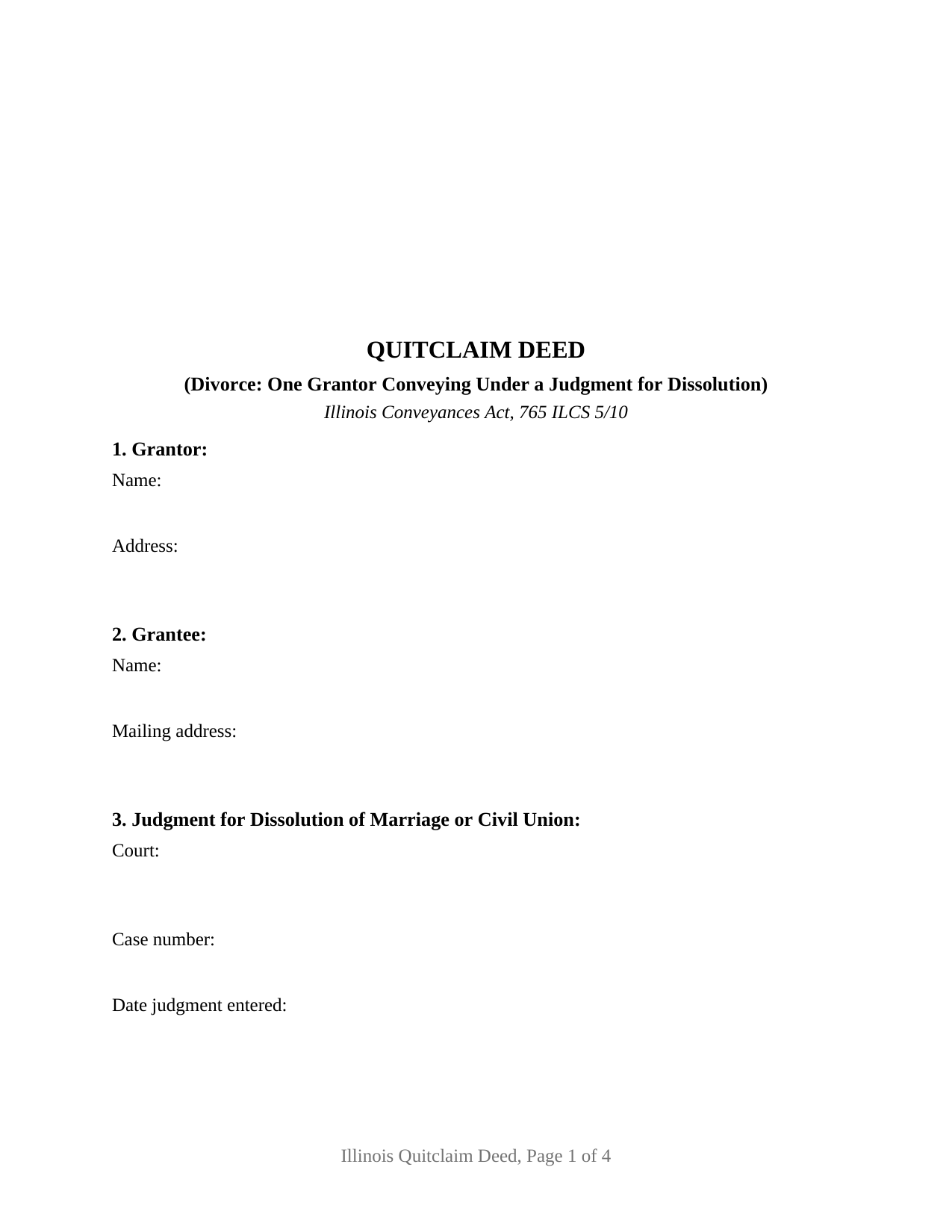
A judgment for dissolution of marriage settles which party keeps the house. County land records do not read judgments, so until an instrument is recorded the departing party's name still stands in the chain of title. This Illinois quitclaim deed is arranged for that step: one party to the judgment signs as Grantor, the other party is named as Grantee, and Section 3 fixes the judgment by court, case number, and date entered.
What the judgment moves on its own
One estate changes shape the moment the judgment is entered. Under 765 ILCS 1005/1c a tenancy by the entirety exists only while the tenants remain married to each other or in a civil union with each other, and on a judgment of dissolution the estate becomes, by operation of law, a tenancy in common until and unless the court directs otherwise. Survivorship between the parties ends there; both names stay on the record. Under 750 ILCS 5/503(e) the species of common ownership each spouse holds in marital property continues only during the pendency of the action, and it does not restrict a transfer by the title holder unless that holder has been specifically enjoined. Closing the gap between an allocation on paper and a clean record takes a recorded deed.
Naming the judgment rather than attaching it
Illinois settles how a deed made under a court judgment refers to it. 765 ILCS 5/12 provides that such a deed need not copy the judgment into itself, and that a reference by the title of the cause, the name of the court, and the date the judgment was obtained is sufficient. Section 3 collects those identifiers, and the operative section recites that the conveyance is made under and by virtue of the judgment they describe.
What the divorce configuration carries
The form recites one individual Grantor, a party to the judgment, and one Grantee, the other party to it. The operative sentence applies the statutory convey and quit claim words of 765 ILCS 5/10 to the whole of the Grantor's interest, prints the express homestead release clause that 765 ILCS 5/27 requires an instrument to state rather than imply, and recites the parties' relationship to the judgment. One signature line and one acknowledgment certificate follow, with the printed name line 765 ILCS 5/35c contemplates. Title patterns presenting this configuration include a residence the parties held by the entirety before the judgment, a jointly held parcel where the same deed also ends the survivorship between them, and a parcel standing in one party's name alone that the judgment awards to the other. Two record owners signing together sit outside this layout, as does a joining spouse's release: where the grantor is married when the conveyance is made and the parcel is an occupied homestead, 735 ILCS 5/12-904 makes a release of that estate good only in a writing both the owner and the owner's spouse have signed.
Consideration, and the entry it drives
A divorce quitclaim deed usually recites a nominal figure, and that recital decides the transfer tax route. 35 ILCS 200/31-45(e) exempts deeds where the actual consideration is less than $100, and an exempt transfer records on the signed and dated notation Section 11 prints. A payment for the other party's equity is consideration, and the deed then travels with the PTAX-203 declaration or its MyDec equivalent and the stamps. A divorcing party commonly takes the house with the loan still on it, and 35 ILCS 200/31-10 leaves the amount of an existing mortgage to which the transfer is subject out of the taxable base.
What it leaves in place
No covenant of title rides on this instrument. Liens, easements, and plat restrictions of record continue against the parcel in the Grantee's hands, and a Grantor who signed the note is still on it after record title moves. Nor does a deed rewrite what the court entered: under 750 ILCS 5/502(f) the property provisions of an agreement set forth in the judgment are not modifiable.
Three files come with the purchase: the fillable deed, a McHenry County example completed from the judgment entries down to the notary's commission date, and a guide that takes the numbered sections in turn and covers signing, homestead, notarization, and recording at the county. Nothing here is legal advice; these pages describe the statutes in general terms, and a specific judgment, mortgage, or chain of title is a matter for an Illinois attorney or title company.
Important: County-Specific Forms
Our quitclaim deed (divorce) forms are specifically formatted for each of the 102 counties in Illinois.
After selecting your county, you'll receive forms that meet all local recording requirements, ensuring your documents will be accepted without delays or rejection fees.