Illinois Warranty Deed (Two Grantors)
County Specific Legal Forms Validated as recently as September 15, 2026 by our Forms Development Team
About the Illinois Warranty Deed (Two Grantors)
How to Use This Form
- Select your county from the list
- Download the county-specific form
- Fill in the required information
- Have the document notarized if required
- Record with your county recorder's office
What Others Like You Are Saying
"Easy peasy! Thank y'all so much."
"I love the service you provide. Very helpful and saves a ton of time."
"Excellent source of information and forms. Deeds.com had exactly what I've been looking for and even…"
"Good resource. Got what I needed easily"
"This was great. Happy I found you!"
4.8/5 from 4,825 reviews. Read all
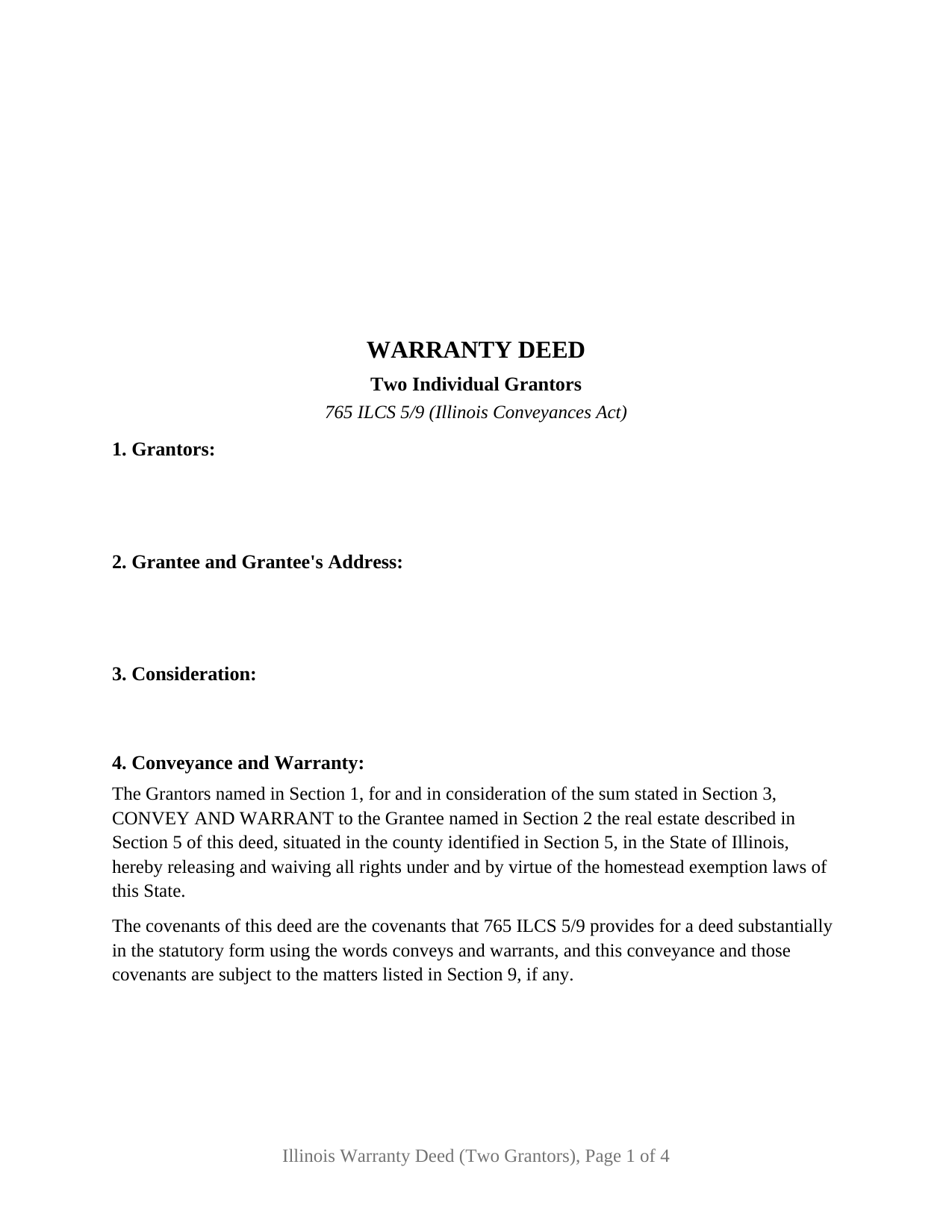
When both owners of Illinois real estate join in a single sale, the deed carries the pattern this form recites: two individual grantors named together in the grantor section, a signature and date line for each, and a notary certificate completed for each signature. Built on the statutory language of 765 ILCS 5/9, this Illinois warranty deed conveys the property in fee simple with full warranty covenants running from both grantors, and the package pairs the fillable PDF with a completed example and a plain language guide keyed to Illinois recording law.
Both owners join in one conveyance
The two-grantor configuration is the product. Section 1 recites exactly two natural persons holding record title, in the statutory style of name, marital status, and place of residence. Each grantor has a dedicated signature block with the typed name beneath it that 765 ILCS 5/35c describes, and each signature is followed by its own acknowledgment certificate carrying the substance of the certificate form in 765 ILCS 5/26, so the two grantors are free to appear before different notaries on different days. The ownership patterns that present this configuration in the record: spouses selling a jointly owned residence, two joint tenants ending the survivorship arrangement by conveying together, and two tenants in common passing both undivided half interests to one buyer in a single instrument. A deed from one owner alone, or from a corporation, trustee, or estate representative, follows a different configuration than the two individual grantors this form recites.
Homestead and the two-signature rule
Illinois puts teeth behind the second signature. Under 735 ILCS 5/12-904, a release, waiver, or conveyance of the exempt homestead estate is not valid unless it is in writing and signed by the owner and the owner's spouse, and 765 ILCS 5/27 adds that one spouse's waiver never binds the other unless the other joins. A married couple conveying the home they occupy therefore presents exactly the architecture this deed carries: the express waiver of homestead rights printed in the operative section where the statutory deed forms place it, plus both spouses signing as grantors. Where the couple holds title in tenancy by the entirety, 765 ILCS 1005/1c independently makes a deed of the homestead property ineffective unless both tenants sign, a rule the two signature lines satisfy on their face.
Covenants from each grantor, exceptions on the record
The words conveys and warrants do the warranty work: a deed substantially in the Section 9 statutory form binds the grantors to covenants of lawful ownership in fee simple, freedom from encumbrances, quiet possession, and defense of title against all lawful claims, obligations that follow the grantors and their representatives as if written out in full. Because that protection reaches back through the whole chain of title, the form gives recorded easements, subdivision covenants, and current year taxes a dedicated exceptions section, so matters meant to survive the closing ride through as express exceptions rather than as covenant breaches.
What the recorder screens for
Illinois recorders read deeds for statutory content, and the form gives each item a labeled home: the preparer statement of 55 ILCS 5/3-5022, the grantee name and address that 55 ILCS 5/3-5026 makes a recording condition, the return address, the permanent index number, the prior document reference, and the tax bill endorsement. The layout tracks the county fee statutes as well, with half inch clean margins and the blank first-page space reserved for recording data. At recording, the deed travels with the PTAX-203 or MyDec transfer declaration and the state tax of fifty cents per five hundred dollars of value, plus county and certified municipal taxes where they apply; a transfer within an exemption category of 35 ILCS 200/31-45 instead carries its exemption notation in the form's transfer tax section. The guide walks through the declaration, the flat county recording fees, and the added items Cook County requires.
The download contains three pieces: the blank two-grantor warranty deed as a fillable PDF, a completed example filled out for a realistic Kane County sale, and a guide covering the numbered sections, execution and notarization, and the recording package. The materials describe Illinois law in general terms and are not legal advice.
Important: County-Specific Forms
Our warranty deed (two grantors) forms are specifically formatted for each of the 102 counties in Illinois.
After selecting your county, you'll receive forms that meet all local recording requirements, ensuring your documents will be accepted without delays or rejection fees.