Illinois Special Warranty Deed
County Specific Legal Forms Validated as recently as October 15, 2026 by our Forms Development Team
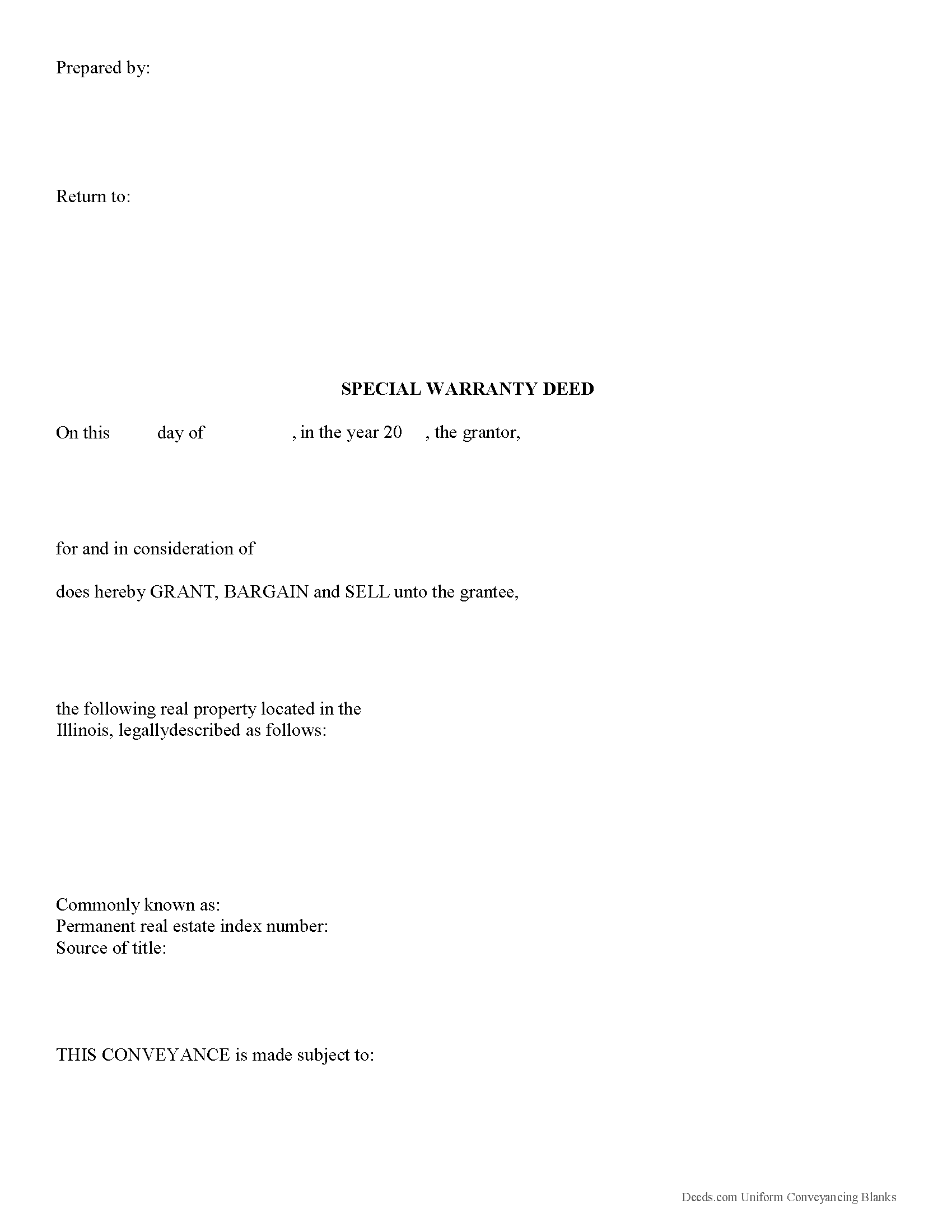
About the Illinois Special Warranty Deed
How to Use This Form
- Select your county from the list
- Download the county-specific form
- Fill in the required information
- Have the document notarized if required
- Record with your county recorder's office
What Others Like You Are Saying
"Very helpful!!! Thanks again."
"The Web site is very intuitive, organized well and forms are easily found. The instructions provided…"
"The pdf form is good; however, the input boxes merge into the line above so the text is hard to read…"
"I am so impress with the forms that is needed for your state. It makes your task so easy and no worr…"
"Great site. quick turnaround and communication. I needed an exception that they told me I needed and…"
4.8/5 from 4,828 reviews. Read all
A special warranty deed is a legal document used to transfer, or convey, rights in real property from a grantor (seller) to a grantee (buyer). Also referred to as a limited warranty deed, this type of deed provides significant liability protection for the grantor (seller), and less protection for the grantee (buyer). In a special warranty deed, the grantor only warrants against defects in the title during his or her ownership, and that he or she has an actual right to the title, and is authorized to sell it. Unlike a deed with full warranty, however, it does not guarantee that there are no other claims on the title of the property before the grantor owned the property, nor does it bind the grantor to defend against them. Because of the risk of unknown claims on the title, special warranty deeds are less common than traditional warranty deeds for residential real estate transactions.
A special warranty deed, once acknowledged, should be recorded in the recorder's office in the county where such lands are located. If it is acknowledged in Illinois, acknowledgements may be taken before a notary public, United States commissioner, county clerk, or any court, judge, clerk, or deputy clerk of such court. When they are taken before a notary public or United States commissioner, they must be attested by his or her official seal; and if taken before a judge or clerk of a court, the acknowledgements must be attested by the seal of the court (765 ILCS 5/20).
A lawful deed includes the grantor's full name and marital status, as well as the grantee's full name, marital status, mailing address, and vesting. Vesting describes how the grantee holds title to the property. For Illinois residential property, the primary methods for holding title in co-ownership are tenancy in common, joint tenancy and tenancy by entirety. A grant of ownership of real estate to two or more persons creates a tenancy in common, unless a joint tenancy or tenancy by the entirety is specified. (765 ILCS 1005/1, 1005/1c.).
As with any conveyance of real estate, special warranty deeds must comply with all state and local recording standards, including a complete legal description of the parcel. Recite the source of title to establish a clear chain of title, and detail any restrictions associated with the property.
Include all relevant documents, affidavits, forms, and fees with the along with the deed for recording as well. Pursuant to 35 ILCS 200/31-10, documents conveying real property are subject to a documentary transfer tax. An Illinois Real Estate Transfer Declaration is required (35 ILCS 200/31-25), unless an exemption is claimed. See 35 ILCS 200/31-45 for a list of exemptions.
A Notarial Record Form is also required, unless an exemption is claimed. A list of exempt conveyances can be found on page 1 of the Notarial Record Form (5 ILCS 312/3-102). Some Illinois counties require a Plat Act Affidavit of Metes and Bounds pursuant to 765 ILCS 205/1 with all deeds, assuring that the land has not been divided or identifies specific types of division according to the plat act. Contact the local recorder for additional details about supplemental document requirements.
This article is provided for informational purposes only and is not a substitute for the advice of an attorney. Consult an attorney with questions about special warranty deeds or for any other issues related to the transfer of real property.
(Illinois Special Warranty Deed Package includes form, guidelines, and completed example)
Important: County-Specific Forms
Our special warranty deed forms are specifically formatted for each of the 102 counties in Illinois.
After selecting your county, you'll receive forms that meet all local recording requirements, ensuring your documents will be accepted without delays or rejection fees.