Illinois Warranty Deed
County Specific Legal Forms Validated as recently as August 29, 2026 by our Forms Development Team
About the Illinois Warranty Deed
How to Use This Form
- Select your county from the list
- Download the county-specific form
- Fill in the required information
- Have the document notarized if required
- Record with your county recorder's office
What Others Like You Are Saying
"Easy to use website and extremely helpful. great service!"
"When I found this website, I was confused and hesitant to use this website to submit paperwork that …"
"Fantastic way to record any deed! Done in less than a few hours, right to your inbox. Very small fee…"
"OK service"
"Very quick and painless process!"
4.8/5 from 4,828 reviews. Read all
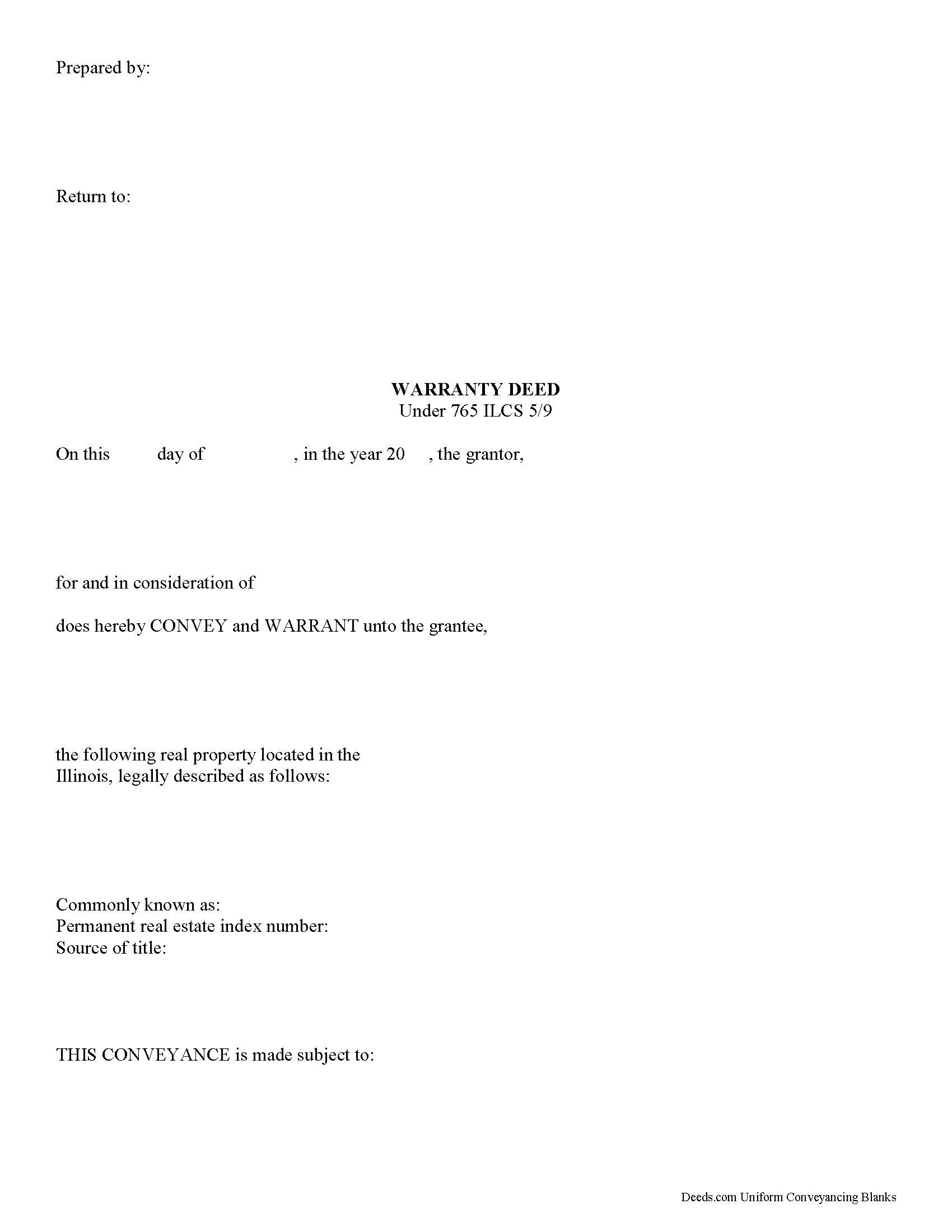
Section 9 of the Illinois Conveyances Act prints its warranty deed as a template with the insertion points showing: the grantor, here insert name or names and place of residence, conveys and warrants to the named grantee the described real estate, situated in the named county, in the State of Illinois. This Illinois warranty deed is that template built as a fillable PDF, with a labeled blank wherever the statute marks one and nothing preprinted about who the parties are or how they take title.
What conveys and warrants imports
Illinois is economical about warranties. A deed made in substance in the Section 9 form is deemed a conveyance in fee simple to the grantee and the grantee's heirs and assigns, carrying three covenants that never appear on the page: an indefeasible fee with full power to convey, premises then free of encumbrances, and a warranty of quiet and peaceable possession with a duty to defend the title. That last promise answers every lawful claimant rather than only those claiming through the grantor, which is what makes this a general warranty deed and what gives the exceptions section its work. Section 8 supplies the narrower special warranty form, Section 10 the quitclaim.
A deed with no vesting printed on it
The configuration is the product. One free form grantor block receives one or two natural persons, each with a place of residence and whatever status the parties recite; a matching grantee block receives one or two names followed by the words of co-ownership the parties select. Nothing about marital status, tenancy, or capacity is printed anywhere on the instrument, so one sheet serves one or two grantors conveying to one or two grantees, in any combination. Two signature blocks and two acknowledgment certificates stand behind the party blocks; a single grantor conveyance leaves the second block and its certificate blank, and where two people sign, the separate certificates let them acknowledge on different days before different officers.
The grantee blank does real work, because 765 ILCS 1005/1 abolished survivorship between co-owners unless the instrument expressly declares that the premises pass not in tenancy in common but in joint tenancy. Estate distributions in which the receiving side takes the survivorship wording, and closings where the name on the old deed differs from the name signed today, present the free form architecture this deed recites. A deed executed by a corporation, by a trustee, including an Illinois land trustee, or by an attorney in fact follows a different configuration, as does a conveyance with three or more owners on a side.
Illinois content the face of the deed carries
Illinois builds its recording requirements into the instrument itself, and the numbered sections give each a home: the preparer statement of 55 ILCS 5/3-5022, without which a recorder may not record; the grantee name and address that 55 ILCS 5/3-5026 makes a condition of recording; the return address; the endorsement naming who receives future tax bills; the permanent index number; and a reference to the recorded instrument that put title in the grantor's name. The operative sentence also prints the express homestead release, placed immediately after the words State of Illinois the way the statutory forms place it, and the upper right corner of page one stays open for the recording stamp.
The rest of the recording package
Illinois recording fees are flat by document class rather than counted by page: published schedules put a standard document at $70 in Lake County, $90 in Will County, and $99 in Kane County. A deed that departs from the format standards yet still reproduces legibly is recorded in a nonstandard or irregular class at a higher minimum instead of being refused. Tax follows the deed to the counter, at 50 cents per $500 of value in state transfer tax, up to 25 cents per $500 more where a county board has imposed its own, plus municipal stamps where a home rule ordinance is certified to the recorder and the PTAX-203 declaration or its MyDec equivalent, with a Section 31-45 exemption notation on the face standing in for it on exempt categories. Cook County adds sworn grantor and grantee statements on exempt transfers.
Three files come with the purchase: the fillable deed, a completed example prepared for a Lake County sale, and a guide covering the numbered sections, execution and notarization, the co-ownership forms open to the grantees, and the recording package. These materials describe Illinois law in general terms and are not legal advice.
Important: County-Specific Forms
Our warranty deed forms are specifically formatted for each of the 102 counties in Illinois.
After selecting your county, you'll receive forms that meet all local recording requirements, ensuring your documents will be accepted without delays or rejection fees.