Tippecanoe County Quitclaim Deed (Interspousal) Form
Last validated October 23, 2026 by our Forms Development TeamFormatted for recording in Tippecanoe County, for property anywhere in the county: rural and unincorporated areas as well as Battle Ground, Buck Creek, Clarks Hill, Dayton, Lafayette, Montmorenci, Romney, Stockwell and 2 more.
- 3 documents included
- Immediate PDF download
- Formatting guarantee
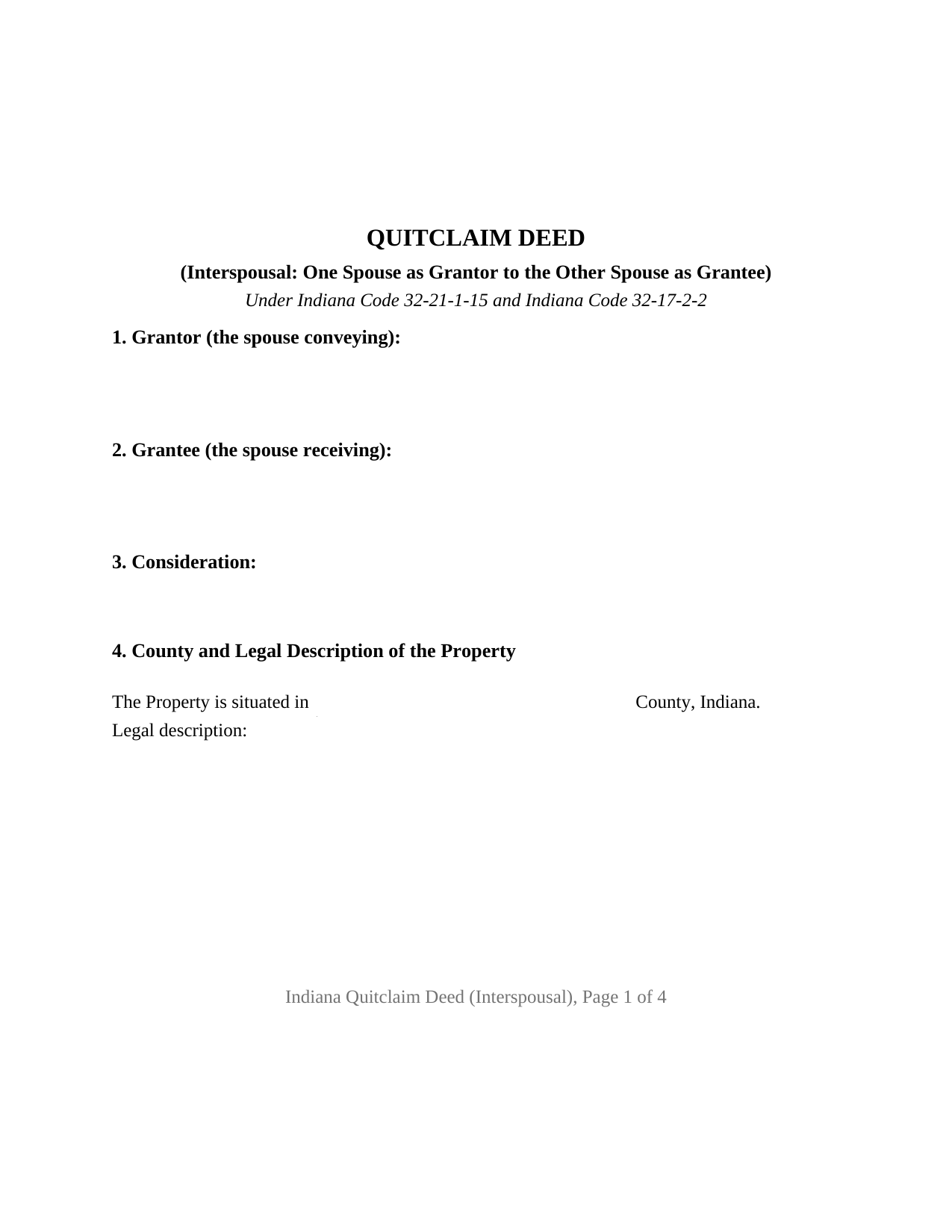
Tippecanoe County Quitclaim Deed (Interspousal) Form
Fill in the blank Quitclaim Deed (Interspousal) form formatted to comply with all Indiana recording and content requirements.
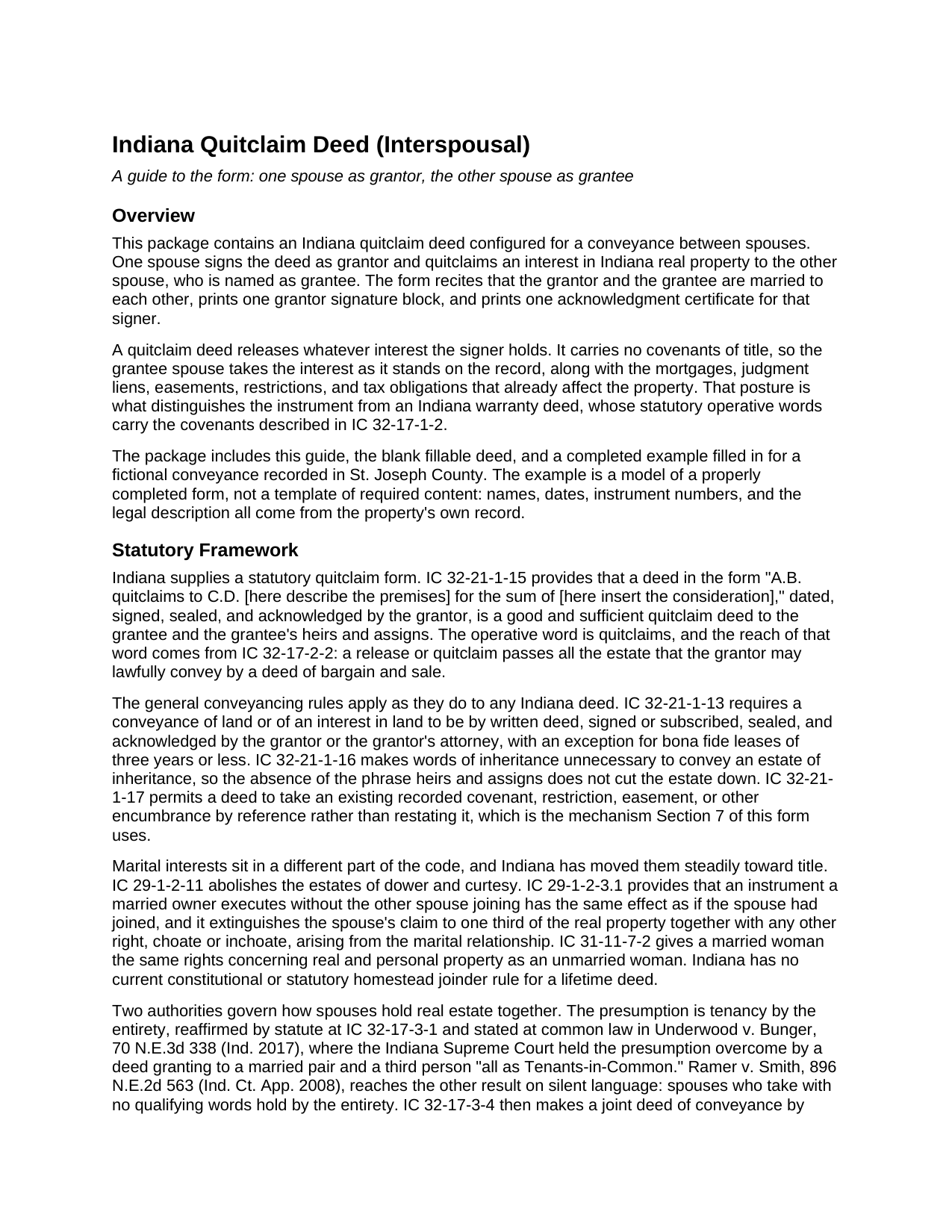
Tippecanoe County Quitclaim Deed (Interspousal) Guide
Line by line guide explaining every blank on the Quitclaim Deed (Interspousal) form.
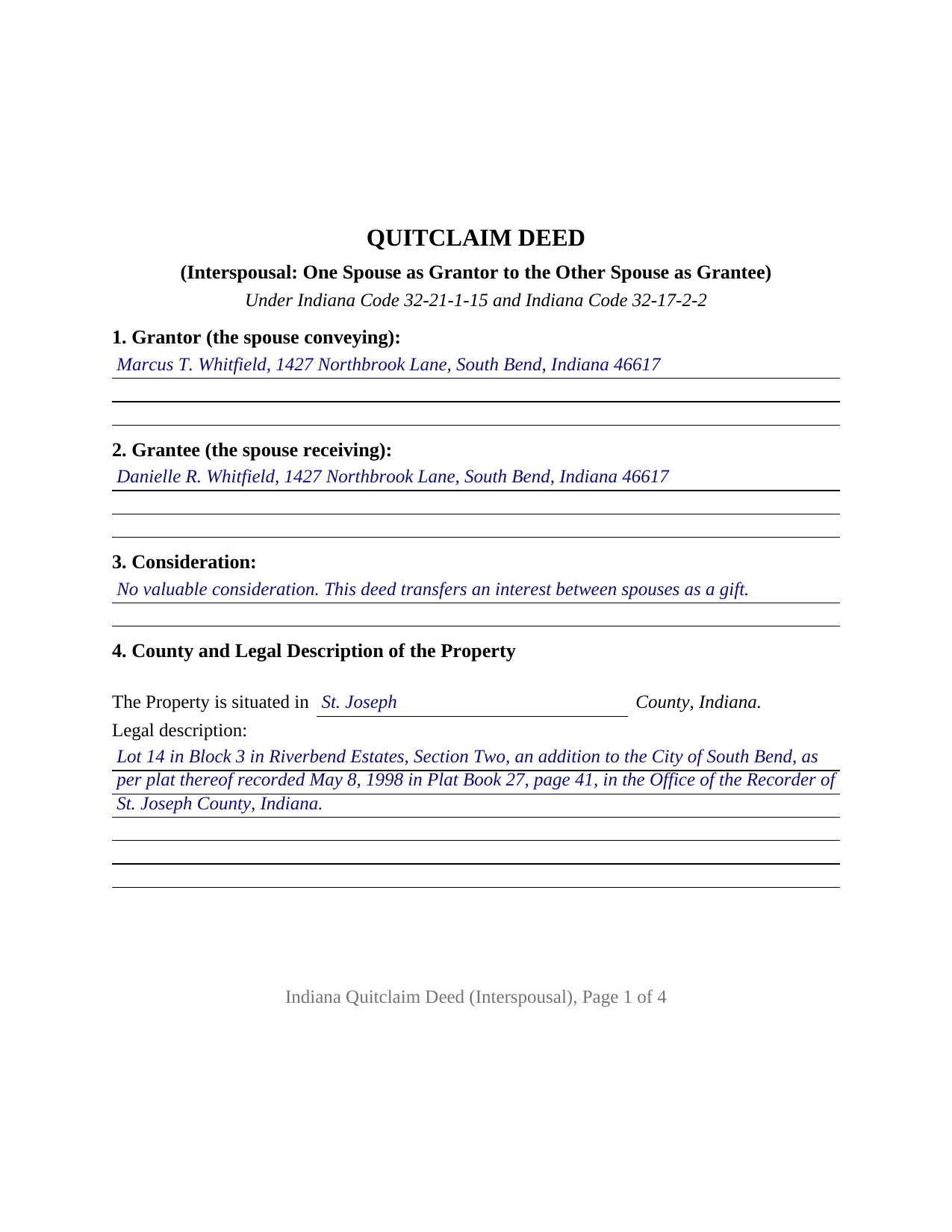
Tippecanoe County Completed Example of the Quitclaim Deed (Interspousal) Document
Example of a properly completed Indiana Quitclaim Deed (Interspousal) document for reference.
All 3 documents above included • One-time purchase • No recurring fees
Immediate Download • Secure Checkout
Additional Indiana and Tippecanoe County documents included at no extra charge:
Where to Record Your Documents
Tippecanoe County Recorder
Lafayette, Indiana 47901
Hours: 8:00 to 4:30 Monday through Friday
Phone: (812) 423-9352
Recording Tips for Tippecanoe County:
- Bring your driver's license or state-issued photo ID
- Ensure all signatures are in blue or black ink
- Recording fees may differ from what's posted online - verify current rates
- Request a receipt showing your recording numbers
- Ask about accepted payment methods when you call ahead
Cities and Jurisdictions in Tippecanoe County
Properties in any of these areas use Tippecanoe County forms:
- Battle Ground
- Buck Creek
- Clarks Hill
- Dayton
- Lafayette
- Montmorenci
- Romney
- Stockwell
- West Lafayette
- Westpoint
Hours, fees, requirements, and more for Tippecanoe County
How do I get my forms?
Forms are available for immediate download after payment. The Tippecanoe County forms will be in your account ready to download to your computer. An account is created for you during checkout if you don't have one. Forms are NOT emailed.
Are these forms guaranteed to be recordable in Tippecanoe County?
Yes. Our form blanks are guaranteed to meet or exceed the applicable formatting requirements used for recording in Tippecanoe County, including margin requirements, font requirements, and other layout standards. This guarantee applies to formatting, not to the legal sufficiency of information entered by the user or the suitability of a form for a particular transaction.
Can I reuse these forms?
Yes. You can reuse the forms for your personal use. For example, if you have multiple properties in Tippecanoe County you only need to order once.
What do I need to use these forms?
The forms are PDFs that you fill out on your computer. The free Adobe Acrobat Reader is recommended, and most PDF apps also work. You do NOT enter your property information online - you download the blank forms and complete them privately on your own computer.
Are there any recurring fees?
No. This is a one-time purchase. Nothing to cancel, no memberships, no recurring fees.
How much does it cost to record in Tippecanoe County?
Recording fees in Tippecanoe County vary. Contact the recorder's office at (812) 423-9352 for current fees.
Questions answered? Let's get started!
An interspousal deed puts a spouse on both sides of the conveyance. The Indiana form here is built around that pairing: one married person signs as grantor and releases an interest in the property to the other spouse, named in the deed as grantee. The form prints one grantor section, one signature block, and one notarial certificate, and the interest it moves crosses from one spouse to the other without any warranty of title.
A Transfer That Stays Inside the Marriage
Indiana measures a spouse's stake in real estate by the record rather than by the marriage certificate. Dower and curtesy are abolished (IC 29-1-2-11), and under IC 29-1-2-3.1 an instrument a married owner executes alone has the same effect as though the spouse had joined in it. What this deed answers is therefore a title question: what the signing spouse holds is what the deed can move. A parcel standing in one spouse's name alone, an undivided share the spouses hold as tenants in common, and a joint tenant's interest are each interests one spouse can release. Real estate the couple holds as tenants by the entireties stands differently: Indiana makes the joint deed of both spouses the instrument that conveys that estate (IC 32-17-3-4), a rule enforced against a spouse acting alone in Beneficial Mortgage Co. of Indiana v. Powers, 550 N.E.2d 793 (Ind. Ct. App. 1990).
How Far a Quitclaim Reaches Between Spouses
The statutory wording comes from IC 32-21-1-15, built on the single verb quitclaims, and IC 32-17-2-2 sets its reach: the release carries all the estate the signer may lawfully convey by a deed of bargain and sale. A spousal quitclaim deed promises nothing about what the grantor owned and does nothing to a mortgage the signing spouse still owes; it places that spouse's recorded interest with the other spouse as of delivery. The conveyance section states that measure, so the instrument reads as the statutory Indiana quit claim deed rather than a warranty deed with its covenants crossed out.
What the Receiving Spouse Ends Up Holding
Because both parties are married to each other, the grantee entry decides the shape of the resulting title. Naming the receiving spouse alone vests the conveyed interest in that spouse in severalty, the pattern behind a search for a deed removing a spouse. Naming both spouses together meets Indiana's presumption that a conveyance of real property to spouses creates a tenancy by the entirety, reaffirmed at IC 32-17-3-1 and applied by the Indiana Supreme Court in Underwood v. Bunger, 70 N.E.3d 338 (Ind. 2017), where express words defeated it. That is the mechanism behind adding a spouse to a deed after a marriage.
One Grantor Section, One Certificate
One grantor is recited, executing in an individual capacity, and the deed itself states that the two parties are married to each other. The signature block carries the printed name line IC 36-2-11-16(c) requires, and one acknowledgment certificate follows it. Record patterns presenting this configuration include a dissolution settlement under which one spouse's interest goes to the spouse keeping the home, an undivided tenancy in common share consolidating in one spouse's name, and a married owner placing a separately titled parcel into both spouses' names. The form is not set up for real estate already titled in both spouses, for grantors who are not married to each other, for an entity or trustee grantor, or for a deed executed under a power of attorney.
The Filing Question an Interspousal Transfer Raises
Consideration decides whether a sales disclosure form travels with the deed. IC 6-1.1-5.5-1 defines a conveyance as a transfer of a real property interest for valuable consideration, so a gift between spouses falls outside the chapter and no disclosure form is filed, while a transfer compelled by a divorce is a covered conveyance document that carries no disclosure filing fee. The auditor's taxation endorsement under IC 36-2-11-14 remains a condition of recording, the recorder's charge for a deed is the statewide twenty five dollars of IC 36-2-7-10, and Indiana levies no transfer tax. Under IC 32-21-4-1 a recorded deed takes its priority from the time of filing.
Inside the Package
Three items arrive with the purchase: the fillable Indiana interspousal quitclaim deed formatted to the state's recording standards, a completed example documenting a conveyance between spouses recorded in St. Joseph County, and a guide covering the entries, the certificate, and the county filing sequence. These pages describe Indiana law in general terms and are informational, not legal advice.
Important: Your property must be located in Tippecanoe County to use these forms. Documents should be recorded at the county recording office listed above.
This Quitclaim Deed (Interspousal) meets all recording requirements specific to Tippecanoe County.
Our Promise
The documents you receive here are guaranteed to meet or exceed the applicable Tippecanoe County recording format requirements. If there is a rejection caused by our formatting, we will correct the issue or refund your payment. This guarantee applies to document formatting only and does not extend to information entered by the user, the selection of the form, or the legal effect of the completed document.
Save Time and Money
Get your Tippecanoe County Quitclaim Deed (Interspousal) form done right the first time with Deeds.com Uniform Conveyancing Blanks. At Deeds.com, we understand that your time and money are valuable resources, and we don't want you to face a penalty fee or rejection imposed by a county recorder for submitting nonstandard documents. We constantly review and update our forms to meet rapidly changing state and county recording requirements for roughly 3,500 counties and local jurisdictions.
4.8 out of 5 - ( 4,833 Reviews )
linda l. 4 out of 5 stars
I was very impressed with the Mineral Deed form, especially with the instructions to fill it out AND a copy of a completed for to compare against. This definitely saved me money for an attorney. The one thing I don't understand, though, is why I could not save the completed Deed to my hard drive. I did have to change a few things after the fact and I had to re-type the entire page to make the corrections. If not for this, I would definitely rate the forms and instructions as a 5 star.
Thank you for your feedback. We really appreciate it. Have a great day!
James K. 5 out of 5 stars
Looks like a very professional site. I just don’t know what it would cost using this site.
Thanks for the kind words about the website James, sorry to hear that you could not find pricing information, we will try harder.
Sandra B. 5 out of 5 stars
Easy to navigate through. Documents were in orderly fashion. Highly recommend. Step by step instructions
We appreciate your business and value your feedback. Thank you. Have a wonderful day!
Ryan E. 5 out of 5 stars
Great customer service. I was surprised by the attention to detail that went into reviewing my documents and value provided by deeds.com. Definitely recommend.
Thank you for your feedback. We really appreciate it. Have a great day!
Tyler F. 5 out of 5 stars
worked great!!!
Awesome, great to hear. Thank you.
Virginia W. 5 out of 5 stars
Easy instructions and a example on how to fill out the form.
Thank you for your feedback. We really appreciate it. Have a great day!
Shantu S. 5 out of 5 stars
Easy to follow directions and complete the Deed.
Thank you!
Robert C. 2 out of 5 stars
Not easy to navigate as a first time user. I printed the first page but lost the link to the second page.
Thank you for taking the time to provide us with your valuable feedback. I'm sorry to hear that you've encountered difficulties with our website's navigation, particularly as a first-time user.
Furthermore, your comments about the website's navigation have been taken into account. We continually strive to improve our website and make it as intuitive and user-friendly as possible. Your feedback is crucial for us in achieving this goal.
Thank you again for your feedback. If you have any other suggestions or need further assistance, please don't hesitate to contact us.
Cynthia S. 5 out of 5 stars
The staff was wonderful we needed an additional state form for Wisconsin for the transfer. They went Above And Beyond assisting it was they were just amazing. They are truly an asset and I am very grateful.
Great to hear — thank you for taking the time to write a review.
Roy W. 5 out of 5 stars
It's fine
Thank you!
LETICIA N. 5 out of 5 stars
I AM VERY PLEASED WITH YOUR WEBSITE. EASY AND I WAS GIVEN A SAMPLE OF THE FORM AND INSTRUCTIONS. I AM VERY PLEASED.
We appreciate your business and value your feedback. Thank you. Have a wonderful day!
Glenn H. 5 out of 5 stars
Searched online 3 hours until I found Deeds.com, afterwards smooth sailing definitely 5 stars
Thank you for your feedback. We really appreciate it. Have a great day!
Glenda C. 4 out of 5 stars
It was easy to find what I was looking for. The instructions were easy to follow. The example given was most beneficial in completing form.
We appreciate your business and value your feedback. Thank you. Have a wonderful day!
Stephanie G. 5 out of 5 stars
Wonderful. Easier to fill out this form than I thought it would be.
Thank you for your feedback. We really appreciate it. Have a great day!
Toshimi M. 4 out of 5 stars
Sofar very good. Especially an example helps.
Thank you for your feedback. We really appreciate it. Have a great day!