Indiana Quitclaim Deed (Interspousal)
County Specific Legal Forms Validated as recently as October 23, 2026 by our Forms Development Team
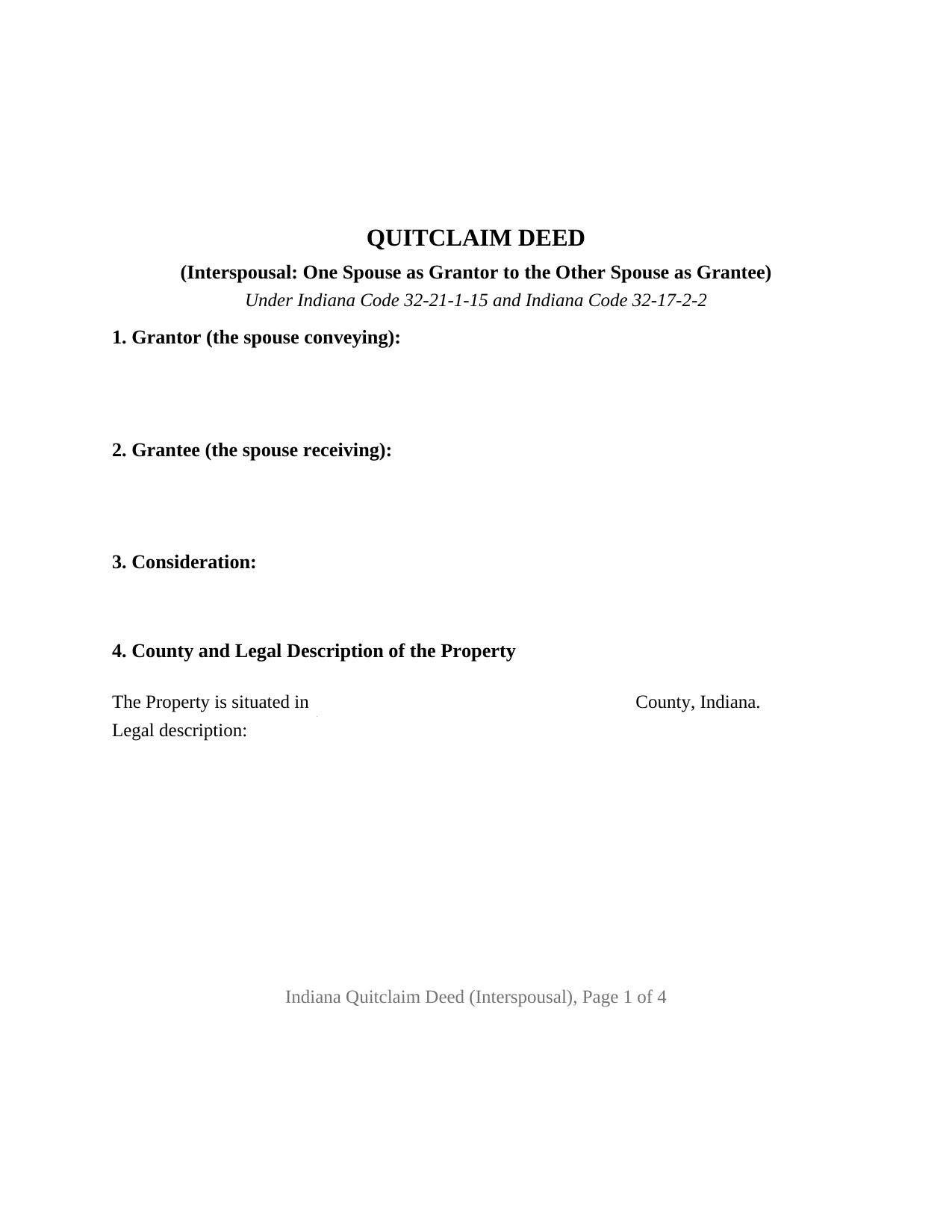
About the Indiana Quitclaim Deed (Interspousal)
How to Use This Form
- Select your county from the list
- Download the county-specific form
- Fill in the required information
- Have the document notarized if required
- Record with your county recorder's office
What Others Like You Are Saying
"Very Good Product. Provided a lot of good info to assist people to DIY various Deed"
"I just started using Deeds.com but so far it has been a very easy and pleasant experience. I work in…"
"I was searching information about my boyfriend family home and received the results in a timely mann…"
"Excellent service with rapid turn around time!"
"The service was excellent. The fee to use Deeds was more than I expected however, but the service wa…"
4.8/5 from 4,830 reviews. Read all
An interspousal deed puts a spouse on both sides of the conveyance. The Indiana form here is built around that pairing: one married person signs as grantor and releases an interest in the property to the other spouse, named in the deed as grantee. The form prints one grantor section, one signature block, and one notarial certificate, and the interest it moves crosses from one spouse to the other without any warranty of title.
A Transfer That Stays Inside the Marriage
Indiana measures a spouse's stake in real estate by the record rather than by the marriage certificate. Dower and curtesy are abolished (IC 29-1-2-11), and under IC 29-1-2-3.1 an instrument a married owner executes alone has the same effect as though the spouse had joined in it. What this deed answers is therefore a title question: what the signing spouse holds is what the deed can move. A parcel standing in one spouse's name alone, an undivided share the spouses hold as tenants in common, and a joint tenant's interest are each interests one spouse can release. Real estate the couple holds as tenants by the entireties stands differently: Indiana makes the joint deed of both spouses the instrument that conveys that estate (IC 32-17-3-4), a rule enforced against a spouse acting alone in Beneficial Mortgage Co. of Indiana v. Powers, 550 N.E.2d 793 (Ind. Ct. App. 1990).
How Far a Quitclaim Reaches Between Spouses
The statutory wording comes from IC 32-21-1-15, built on the single verb quitclaims, and IC 32-17-2-2 sets its reach: the release carries all the estate the signer may lawfully convey by a deed of bargain and sale. A spousal quitclaim deed promises nothing about what the grantor owned and does nothing to a mortgage the signing spouse still owes; it places that spouse's recorded interest with the other spouse as of delivery. The conveyance section states that measure, so the instrument reads as the statutory Indiana quit claim deed rather than a warranty deed with its covenants crossed out.
What the Receiving Spouse Ends Up Holding
Because both parties are married to each other, the grantee entry decides the shape of the resulting title. Naming the receiving spouse alone vests the conveyed interest in that spouse in severalty, the pattern behind a search for a deed removing a spouse. Naming both spouses together meets Indiana's presumption that a conveyance of real property to spouses creates a tenancy by the entirety, reaffirmed at IC 32-17-3-1 and applied by the Indiana Supreme Court in Underwood v. Bunger, 70 N.E.3d 338 (Ind. 2017), where express words defeated it. That is the mechanism behind adding a spouse to a deed after a marriage.
One Grantor Section, One Certificate
One grantor is recited, executing in an individual capacity, and the deed itself states that the two parties are married to each other. The signature block carries the printed name line IC 36-2-11-16(c) requires, and one acknowledgment certificate follows it. Record patterns presenting this configuration include a dissolution settlement under which one spouse's interest goes to the spouse keeping the home, an undivided tenancy in common share consolidating in one spouse's name, and a married owner placing a separately titled parcel into both spouses' names. The form is not set up for real estate already titled in both spouses, for grantors who are not married to each other, for an entity or trustee grantor, or for a deed executed under a power of attorney.
The Filing Question an Interspousal Transfer Raises
Consideration decides whether a sales disclosure form travels with the deed. IC 6-1.1-5.5-1 defines a conveyance as a transfer of a real property interest for valuable consideration, so a gift between spouses falls outside the chapter and no disclosure form is filed, while a transfer compelled by a divorce is a covered conveyance document that carries no disclosure filing fee. The auditor's taxation endorsement under IC 36-2-11-14 remains a condition of recording, the recorder's charge for a deed is the statewide twenty five dollars of IC 36-2-7-10, and Indiana levies no transfer tax. Under IC 32-21-4-1 a recorded deed takes its priority from the time of filing.
Inside the Package
Three items arrive with the purchase: the fillable Indiana interspousal quitclaim deed formatted to the state's recording standards, a completed example documenting a conveyance between spouses recorded in St. Joseph County, and a guide covering the entries, the certificate, and the county filing sequence. These pages describe Indiana law in general terms and are informational, not legal advice.
Important: County-Specific Forms
Our quitclaim deed (interspousal) forms are specifically formatted for each of the 92 counties in Indiana.
After selecting your county, you'll receive forms that meet all local recording requirements, ensuring your documents will be accepted without delays or rejection fees.