Indiana Warranty Deed (Two Grantors)
County Specific Legal Forms Validated as recently as September 29, 2026 by our Forms Development Team
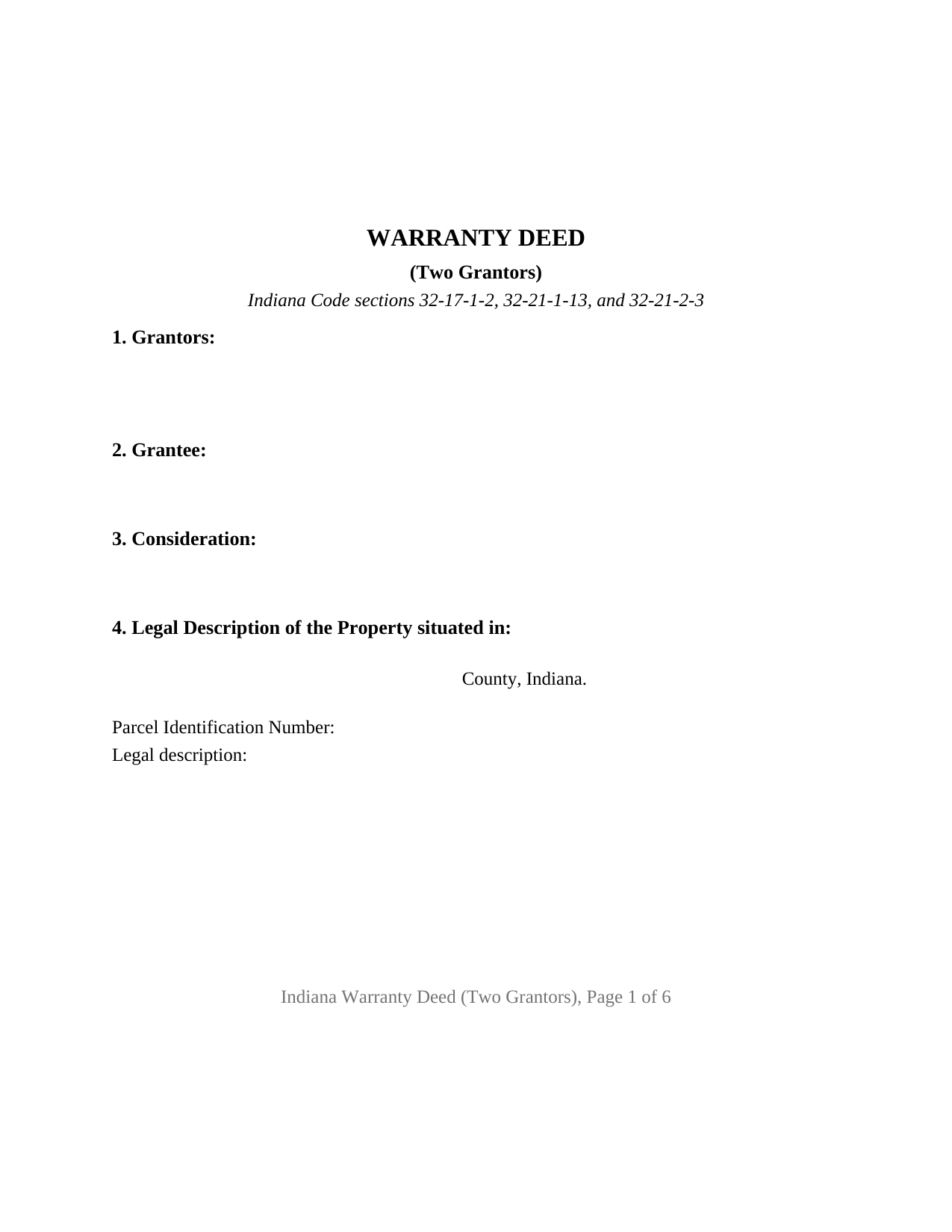
About the Indiana Warranty Deed (Two Grantors)
How to Use This Form
- Select your county from the list
- Download the county-specific form
- Fill in the required information
- Have the document notarized if required
- Record with your county recorder's office
What Others Like You Are Saying
"This is another great deal that has come out of the quarantine for covid. Saved me hours and days of…"
"Easy to use and understand. I am glad to have found this resource."
"easy-peasy"
"I was frustrated by Orange County and all the other options they gave me to submit my paperwork. Dee…"
"Excellent!! Site VERY easy/simple to navigate."
4.8/5 from 4,828 reviews. Read all
Two record owners, one Indiana conveyance: this fillable warranty deed is arranged for a pair of grantors who join in a single instrument, with two signature blocks, two acknowledgment certificates, and operative language in which both owners convey and warrant the entire title. The form serves Indiana real property held by two people, spouses or not, passing the whole co-owned interest to the grantee in one recorded deed.
Why Indiana title often takes two signatures
Indiana co-ownership makes the second signature a matter of substance, not formality. Spouses who took title together are presumed to hold as tenants by the entirety under Indiana Code Section 32-17-3-1, and Indiana case law holds that neither spouse acting alone can convey or encumber the entireties estate, so the sale of a married couple's jointly titled property is inherently a two-grantor transaction. Tenants in common each own an undivided share, and a buyer taking the whole parcel takes a deed from both owners. Joint tenants with right of survivorship pass complete, unsevered title when both join in the same conveyance. This deed collects those situations into one instrument: both owners appear in the granting clause, both make the covenants, and both acknowledge before a notary.
Full statutory covenants from both grantors
The operative language rests on the two words Indiana Code Section 32-17-1-2 defines, convey and warrant. A deed in that statutory form passes fee simple and implies covenants of seisin, right to convey, quiet possession, freedom from encumbrances, and a promise to warrant and defend the title against all lawful claims, reaching the whole chain of title rather than only the grantors' own years of ownership. Because two people make those covenants here, the grantee holds the general warranty from both sides of the co-owned title. The deed's exceptions section pairs with the covenant against encumbrances, so recorded easements, plat restrictions, and the current year's taxes can be carved out of the covenant rather than breached on the day of delivery.
Two signature blocks, two certificates
The form recites exactly two record owners. Section 1 names both grantors with marital status and mailing address; the signature section carries a separate block for each grantor, with the printed name Indiana Code Section 36-2-11-16(c) requires beneath each signature; and two acknowledgment certificates follow, so the grantors may acknowledge on different dates, before different notaries, or in different states. Each certificate carries the content Indiana Code Section 33-42-9-12 makes certificate matter, including the commission expiration date and the notary's county of residence. Spouses selling a home they hold as tenants by the entirety, two co-owners who bought together and now convey together, and co-heirs passing their undivided halves to one buyer present the record pattern this deed recites. A deed from a single owner, or from three or more co-owners, follows a different execution pattern than the two blocks and two certificates this form carries.
How the grantees take title
The receiving side of the conveyance has its own Indiana menu. A deed to two or more grantees creates a tenancy in common by default under Indiana Code Section 32-17-2-1; a joint tenancy with right of survivorship arises only when the deed states it or the intent manifestly appears; and grantees who are married to each other are presumed to take as tenants by the entirety. The grantee section of this form accepts the chosen designation following the grantee names, and the guide describes the words that create each form and what each form does at a co-owner's death.
Like every Indiana conveyance for consideration, the signed deed travels with a sales disclosure form through the county assessor, takes the county auditor's taxation endorsement, and then records with the county recorder for the statewide twenty-five dollar fee; the deed closes with the tax mailing address, the grantee's street address, the redaction affirmation, and the prepared by statement Indiana recording law places at the end of the instrument. The pages are formatted above the floors of Indiana Code Section 36-2-11-16.5, with two inch clean top and bottom margins throughout.
The download delivers the fillable two-grantor deed, a completed example showing a married couple's Monroe County sale line by line, and a plain-language guide covering every section, both notarizations, and the county recording sequence. This is the Indiana general warranty deed in its two-owner configuration, the instrument also searched as a joint warranty deed or a husband and wife warranty deed form; the materials are informational and are not legal advice.
Important: County-Specific Forms
Our warranty deed (two grantors) forms are specifically formatted for each of the 92 counties in Indiana.
After selecting your county, you'll receive forms that meet all local recording requirements, ensuring your documents will be accepted without delays or rejection fees.