Louisiana Correction Deed
Parish Specific Legal Forms Validated as recently as October 16, 2026 by our Forms Development Team
About the Louisiana Correction Deed
How to Use This Form
- Select your parish from the list
- Download the parish-specific form
- Fill in the required information
- Have the document notarized if required
- Record with your parish recorder's office
What Others Like You Are Saying
"Much easier than going to the courthouse!"
"Absolutely perfect! Quitclaim deed form was easy to complete and the recorder had no issues with it …"
"Good."
"Lee County, FL did accept the "Satisfaction of Mortgage" form. It was easy to fill out exc…"
"Outstanding forms, thanks for making this easy."
4.8/5 from 4,828 reviews. Read all
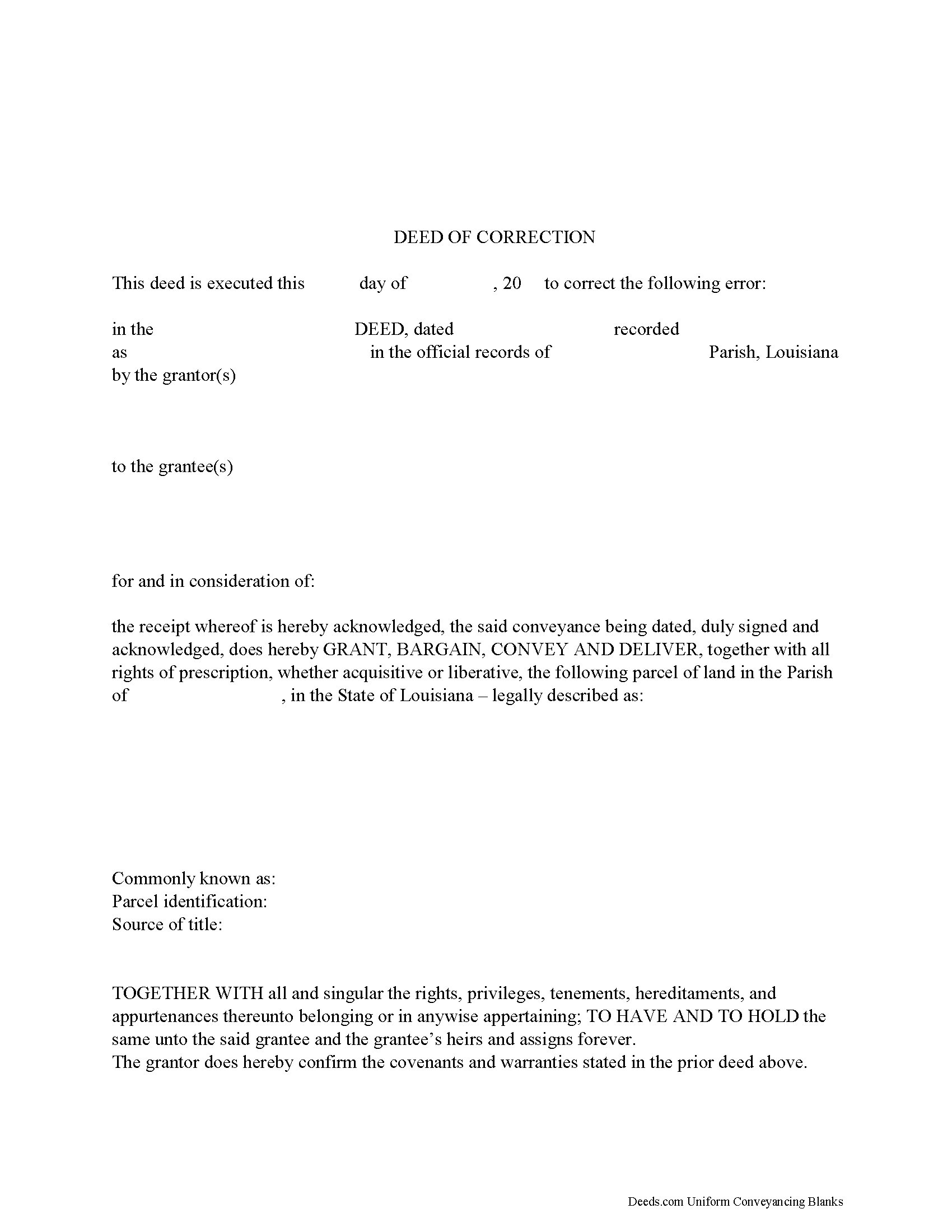
Use the correction deed to correct an error in a previously recorded quitclaim, warranty or grant deed in Louisiana.
In Louisiana, a previously recorded deed can be corrected by recording a second deed for the sole purpose of correcting the error and preventing potential title flaws, which may create problems when the current owner attempts to sell the property. The correction deed does not convey title but confirms the prior conveyance. For the most part it reiterates the prior deed verbatim, except for the correction.
Louisiana statutes also allow for an affidavit or act of correction, which must be executed by the notary or preparer of the original act or deed, or by a notary familiar with the records and the reason for the necessary correction. Such an act of correction is effective retroactively "to the date of recordation of the original act," but does not "prejudice the rights acquired by any third person before the act of correction is recorded" (LARS 35.2.1). It is usually reserved for clerical errors, such as minor omissions or typographical mistakes, sometimes called scrivener's errors.
When in doubt about the gravity of the error and its effects, it may be safer to record a correction deed since that involves execution by the affected parties and acknowledgment by a notary in the presence of two witnesses. The correction deed must be executed from the original grantor to the original grantee and state that its purpose is to correct a specific error, identified by type. It references the prior deed by date(s) and by book and page number, as well as place of recording.
Certain types of changes, however, might not be achieved by the use of a correction deed. Adding or omitting a grantee, for example, or changing the manner in which title is held, or making material changes to the legal description, especially deleting a portion of the originally transferred property, may all require a new deed of conveyance instead of a correction of the original deed.
(Louisiana CD Package includes form, guidelines, and completed example)
Important: Parish-Specific Forms
Our correction deed forms are specifically formatted for each of the 64 parishes in Louisiana.
After selecting your parish, you'll receive forms that meet all local recording requirements, ensuring your documents will be accepted without delays or rejection fees.