Maine Warranty Deed
County Specific Legal Forms Validated as recently as October 8, 2026 by our Forms Development Team
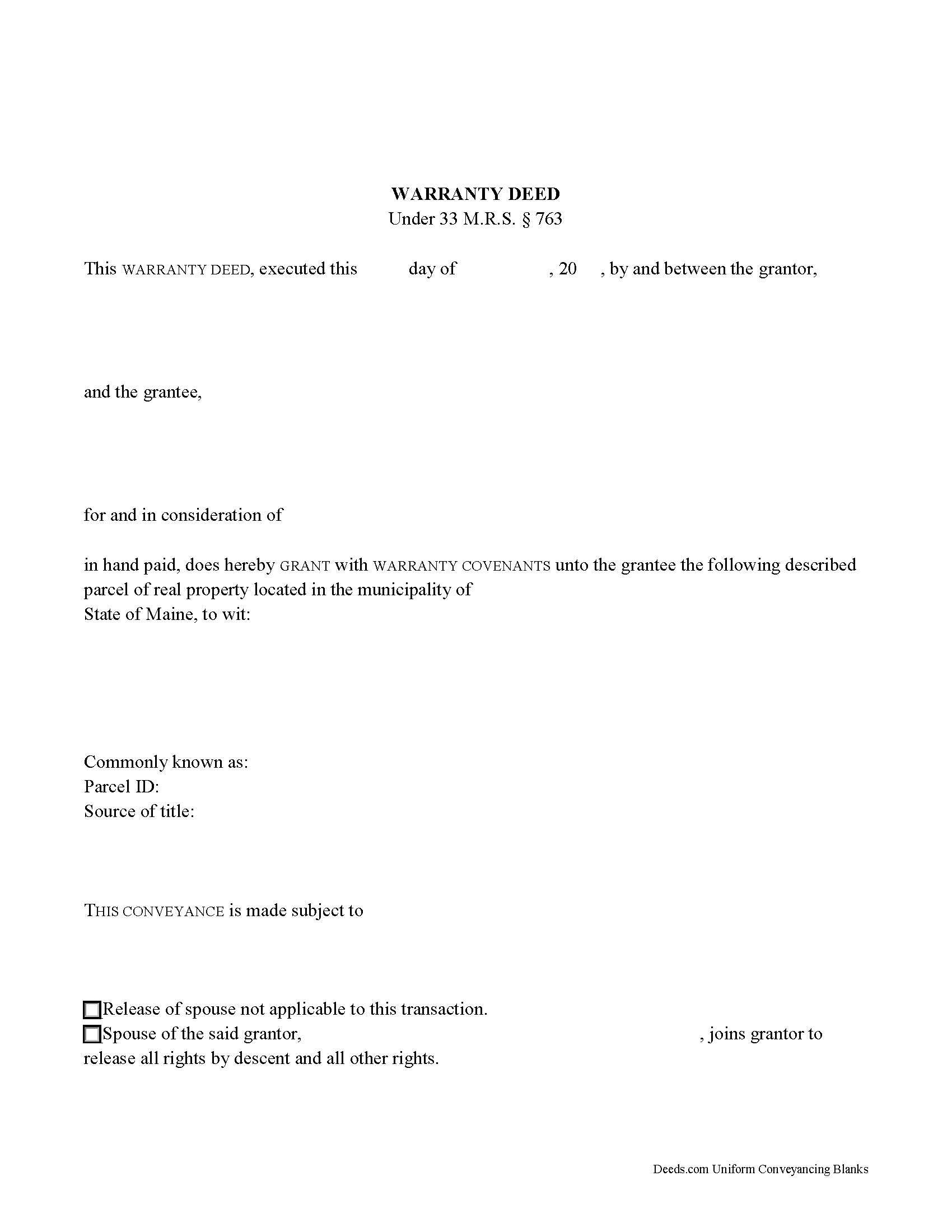
About the Maine Warranty Deed
How to Use This Form
- Select your county from the list
- Download the county-specific form
- Fill in the required information
- Have the document notarized if required
- Record with your county recorder's office
What Others Like You Are Saying
"Excellent"
"Excellent! Great communication through the process and quick response."
"The forms where easy to get to and I hope that they will be as easy to fill out."
"The website was short and to the point. And I receive three responses quite quickly."
"Makes recording fast and easy. Great service!"
4.8/5 from 4,819 reviews. Read all
Maine put its deed forms in the statute book and kept them short. Under the Short Form Deeds Act at 33 M.R.S. 761 to 775, a conveyance needs no words of inheritance, no habendum clause, no seal, and no recited consideration to pass a fee simple, so what stays on the page is the parties, the land, the exceptions, and one operative sentence. This is the base Maine warranty deed built to that pattern: free-form party blocks taking one or two natural persons on each side, and the full statutory warranty.
A deed the statute keeps short
Three sections do the trimming. 33 M.R.S. 771 makes grant a sufficient word of conveyance while implying no covenant from it. 33 M.R.S. 772 provides that heirs, successors, assigns, forever, and a habendum clause are all unnecessary, and that a conveyance passes the grantor's whole estate unless a different intention clearly appears. 33 M.R.S. 774 keeps a deed valid though no consideration is stated and nothing is sealed. Section 761 makes the appendix forms permissive: they may be used or altered as circumstances require, and their use is not preclusive. This form carries Form 1's operative language in numbered sections, the latitude section 761 describes.
Where the warranty comes from
The promise is compressed into a defined phrase. Under 33 M.R.S. 764 those two words carry, by force of statute, a full paragraph: the grantor holds a fee, nothing encumbers it beyond what the deed itself states, the grantor may sell and convey, and the grantor and the grantor's heirs will defend the title against every lawful claim. Because that phrase is fixed, the section of this form listing exceptions, reservations, and encumbrances sets the outer edge of the promise, and 33 M.R.S. 201-A governs how each entry is written: with the registry volume and page of the instrument it points to, or with a description adequate on its own.
Blanks that hold whatever the record says
Nothing about status, capacity, or co-ownership is preprinted here. The grantor block is a free-form multi-line entry taking one or two natural persons with the status wording the title calls for, and the grantee block takes one or two names plus whatever designation of co-ownership the parties intend. Two signature blocks follow, headed GRANTOR and SECOND GRANTOR (if applicable), each paired with a printed-name line that 33 M.R.S. 651-A makes a condition of acceptance at the registry, and each carrying its own certificate underneath. A conveyance by one owner leaves the second block and its certificate empty. The four count patterns are plain: one grantor to one grantee, one to two, two to one, and two to two.
The open grantee entry matters most, because 33 M.R.S. 159 assigns a default to it. A deed naming two or more people that expresses nothing makes an estate in common; the same section lists the survivorship wordings that produce a joint tenancy instead, treats entireties language as one of them, and lets an owner deed to themselves and another in survivorship form with no straw conveyance between. Deeds executed by an entity, a trustee, a personal representative, or an attorney-in-fact carry capacity language and certificate wording this form does not print, and three or more owners on one side exceed its two signature blocks.
What the registry expects
33 M.R.S. 201 supplies the recording rule: acknowledged and recorded, a deed is good against the world, while an unrecorded one binds only the grantor, the grantor's heirs and devisees, and anyone holding actual notice. Acknowledgment comes first under 33 M.R.S. 203, and the certificate here follows the Maine short form at 4 M.R.S. 1917. Maine fixes its recording charge by statute instead of county by county, and the registries have published forty dollars per instrument for general submitters since the January 1, 2026 amendments to 33 M.R.S. 751 and 752. The register also computes and collects the real estate transfer tax under 36 M.R.S. 4641-B, against a declaration of value prepared through Maine Revenue Services and presented with the deed, not recorded as part of it.
Searches for a Maine general warranty deed, a Maine deed form, or a warranty deed form land on this instrument. The download delivers it three ways: the fillable form, a completed example filled in for a Penobscot County sale, and a guide covering the numbered sections, the vesting choices, signing, and the recording and transfer tax steps. The materials describe Maine law and this form in general terms and are not legal advice.
Important: County-Specific Forms
Our warranty deed forms are specifically formatted for each of the 16 counties in Maine.
After selecting your county, you'll receive forms that meet all local recording requirements, ensuring your documents will be accepted without delays or rejection fees.