Massachusetts Trustee Deed
County Specific Legal Forms Validated as recently as September 25, 2026 by our Forms Development Team
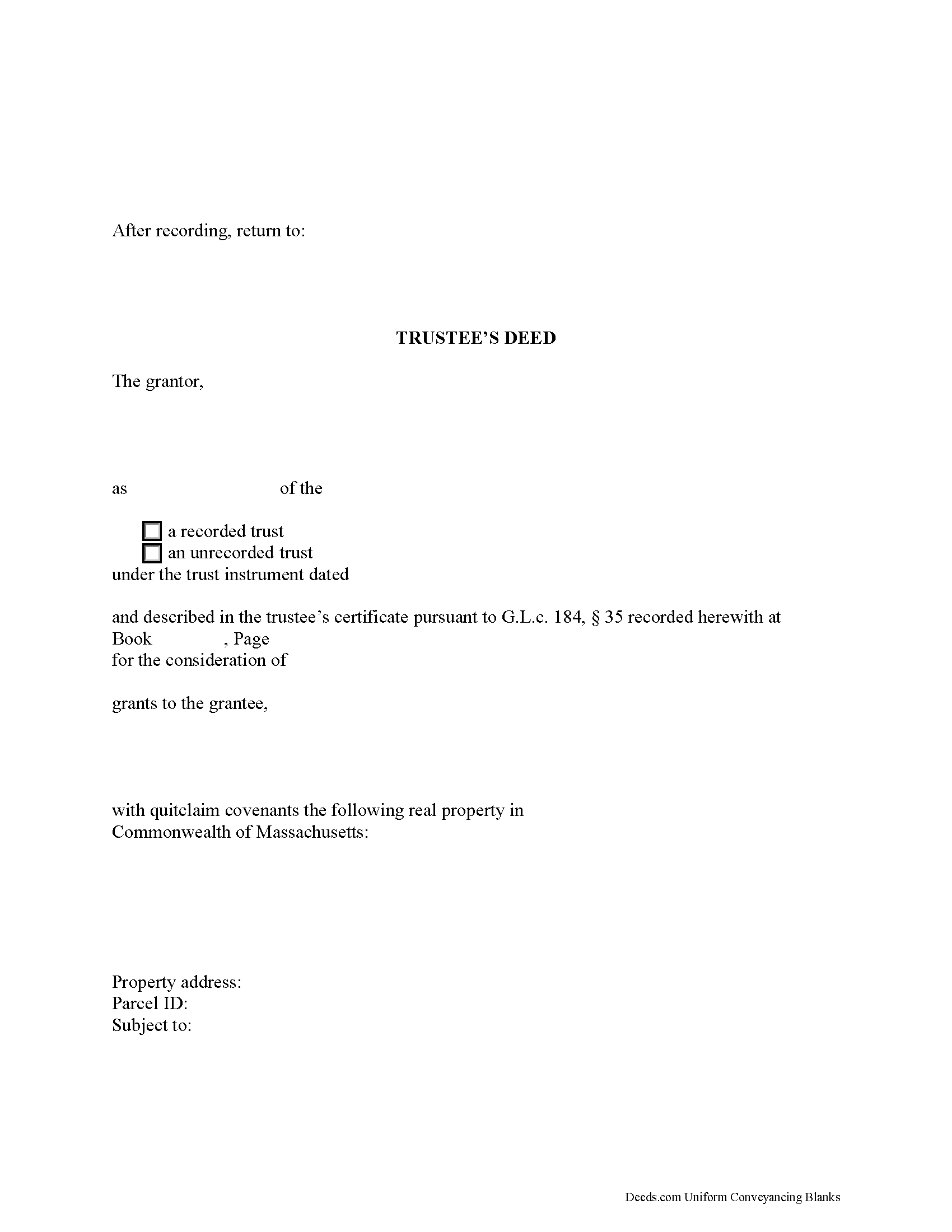
About the Massachusetts Trustee Deed
How to Use This Form
- Select your county from the list
- Download the county-specific form
- Fill in the required information
- Have the document notarized if required
- Record with your county recorder's office
What Others Like You Are Saying
"I bought a quitclaim deed package, and it was very easy to use. Prints nicely. Two thumbs up!"
"The website and information is fine. The proof in the pudding, of course, is whether the forms I use…"
"Download was smooth. I'll post an update after I get a change to work with the forms."
"This product was easy to use and instructions were helpful."
"Amazing forms, nice to have something specific and not generic like some other sites. Getting the ot…"
4.8/5 from 4,815 reviews. Read all
Used to convey title to real property held in a living (non-testamentary) trust, the trustee's deed takes its name from the party executing the conveyance, the trustee. In Massachusetts, the trustee's deed typically carries quitclaim covenants guaranteeing title against claims arising only under the grantor's duration of ownership.
Trusts are governed by the Massachusetts Uniform Trust Code at chapter 203E of the Massachusetts General Laws. In a trust, the trustee holds legal title to property conveyed into trust by the trust's settlor, for the benefit of a beneficiary. A beneficiary is someone with a present or future interest in the trust (G.L.c. 203E, 103). The terms of the trust, including a designation of the trustee, the trustee's powers, and the trust's beneficiary, are set forth in the trust instrument, which is executed by the settlor and generally not recorded.
Conveyances by trustee are generally accompanied by a trustee's certificate under G.L.c. 184, 35, evidencing the trustee's authority in the transaction at hand. The trustee's certificate is recorded separately, either simultaneously with the deed conveying real property into trust, or when the trustee acts upon the title.
The Massachusetts Real Estate Bar Association (REBA) Title Standard 33 also addresses transfers by trustees. The standard states that recipients of a trustee's deed are not obligated to inquire into the trustee's authority if the trustee's certificate is presented, which recites that third parties may rely without inquiry on the acts of said trustee. The standard also applies if a trustee's certificate is unrecorded or unreferenced in the transfer, but the transfer is executed by all trustees appearing of record to be trustees.
Apart from naming each acting trustee, the trustee's deed recites the name of the trust and contains a reference to the trustee's certificate, if any, of record. The document should also contain a reference to the prior instrument granting title to the trustee. As the conveyance affects real property, the deed requires a legal description of the affected parcel. Each acting trustee must sign the deed in the presence of a notary public for a valid transfer.
Consult a lawyer for guidance, as trust law can quickly become complex, and each situation is unique.
(Massachusetts TD Package includes form, guidelines, and completed example)
Important: County-Specific Forms
Our trustee deed forms are specifically formatted for each of the 14 counties in Massachusetts.
After selecting your county, you'll receive forms that meet all local recording requirements, ensuring your documents will be accepted without delays or rejection fees.