Missouri Quitclaim Deed (Interspousal)
County or Independent City Specific Legal Forms Validated as recently as October 2, 2026 by our Forms Development Team
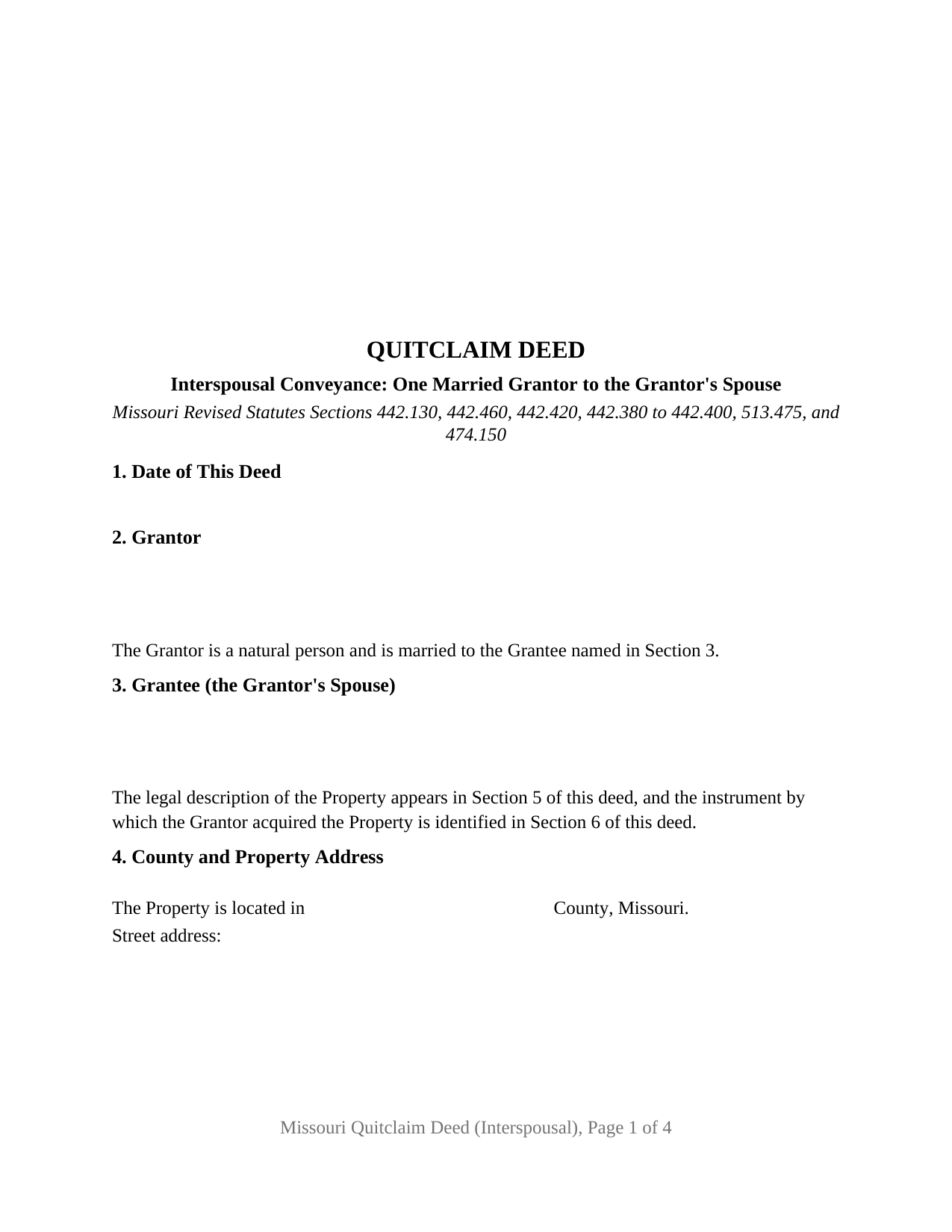
About the Missouri Quitclaim Deed (Interspousal)
How to Use This Form
- Select your county or independent city from the list
- Download the county or independent city-specific form
- Fill in the required information
- Have the document notarized if required
- Record with your county or independent city recorder's office
What Others Like You Are Saying
"The process worked great! It's a great solution for recording documents at the county during the pan…"
"Very easy to complete Quitclaim Deed"
"I filled out the Xfer on Death Deed and turned it in to the County Recorder - everything went well. …"
"The service was fast, but I didn't learn about the results until I logged in. I would have liked to …"
"I purchased the Affidavit of Surviving Joint Tenant document and found the whole package of document…"
4.8/5 from 4,828 reviews. Read all
Both spouses sign this Missouri quitclaim deed, and only one of them gives anything up. The Grantor is a married person who holds the interest being released; the Grantee is that person's own spouse, who receives it and who signs as well, in a joinder section written for the receiving spouse rather than for the owner. That two signature, one conveyance shape is what makes an interspousal deed different from every other quitclaim in Missouri.
A transfer that stays inside one marriage
Missouri is a separate property state, so a parcel deeded to one spouse belongs to that spouse, and moving it to the other takes an instrument. This deed does that and nothing more: it releases whatever right, title, and interest the Grantor holds when the deed is delivered, and it stops there. Patterns that show up in the land records under this configuration include a parcel standing in one spouse's name that moves to the other so the record shows the intended owner, a residence placed in the name of the spouse whose credit a lender underwrote, and a parcel shifted to the other spouse's side of a family estate plan.
Why the spouse receiving the property signs too
Two Missouri statutes explain the second signature, and neither one is about who owns the land. Section 513.475.2 of the Revised Statutes of Missouri debars either spouse separately from selling, mortgaging, or alienating the homestead in any manner whatever and declares such a separate act null and void, while expressly preserving a homestead disposition made jointly by husband and wife. Section 474.150.2 reaches every conveyance by a married person: absent the spouse's joinder or duly acknowledged written express assent, the conveyance is deemed made in fraud of that spouse's marital rights if that spouse becomes a surviving spouse, unless the contrary is shown. Because the Grantee here is the very spouse those sections protect, Section 9 has the Grantee join in the deed and assent to it, and the Grantee's acknowledged signature follows the Grantor's.
One Grantor, one Grantee, two acknowledgments
The form recites exactly one Grantor, a married natural person acting individually, and exactly one Grantee, that Grantor's spouse. Section 2 carries the Grantor's name, mailing address, and the married status statement Section 442.130 draws from a natural person executing a conveyance, phrased for this variant as married to the Grantee named in Section 3. Each signer then gets an acknowledgment certificate of their own, carrying the substance of the short form in Section 442.210.1(1) plus the line Section 442.145 gives the officer for designating physical presence or appearance by communication technology, so spouses appearing together before one notary and spouses signing on different days are both accommodated. A deed by two record owners, a deed to two grantees, and a deed by a trustee or company officer each recite different party sections than this one.
A release of interest, with nothing promised
Missouri publishes no official quit claim deed form, so the operative words carry the whole load. Section 442.420 turns the phrase grant, bargain and sell into limited statutory covenants of title, so this deed keeps those words off the page and adds a sentence saying that no covenant of title arises from anything written in it. The conveyance is confined to the interest held at delivery, which keeps the after acquired title rule of Section 442.430 out of play.
Page one, recording, and the county extras
Missouri's format statute reserves the top three inches of page one for the recorder and lists what goes below it, so the form prints the title, date, both party blocks, and the marital status statement there, then uses the statutory page reference to locate the legal description further in. From the moment of filing, the record gives notice of the conveyance to everyone. No Missouri transfer tax applies to a spousal transfer or any other deed, though a certificate of value rides along at recording in St. Charles County, St. Louis County, and the City of St. Louis, prepared apart from the deed. The completed example works a Clay County transfer, where the deed stands alone.
The download holds the interspousal quitclaim deed as a fillable PDF, a completed example filled in end to end for the Clay County pattern above, and a plain language guide covering each section, the spousal statutes, and recording. It describes Missouri law generally, for information, and is not legal advice.
Important: County or Independent City-Specific Forms
Our quitclaim deed (interspousal) forms are specifically formatted for each of the 115 county or independent cities in Missouri.
After selecting your county or independent city, you'll receive forms that meet all local recording requirements, ensuring your documents will be accepted without delays or rejection fees.