Missouri Quitclaim Deed (Two Grantors)
County or Independent City Specific Legal Forms Validated as recently as October 2, 2026 by our Forms Development Team
About the Missouri Quitclaim Deed (Two Grantors)
How to Use This Form
- Select your county or independent city from the list
- Download the county or independent city-specific form
- Fill in the required information
- Have the document notarized if required
- Record with your county or independent city recorder's office
What Others Like You Are Saying
"Loved it!!!!! Beats going downtown!!!! Super easy and fast!!!"
"Really good product, included guide to filling out forms. Totally pleased with that part. Customer s…"
"I cannot believe how fast your service is! Thank you!"
"Great service!!! I was feeling overwhelmed but then I found deeds! I spent about 10 mins ordering, t…"
"Thank you for this excellent website. Obtaining appropriate forms was very easy. Thank you!"
4.8/5 from 4,828 reviews. Read all
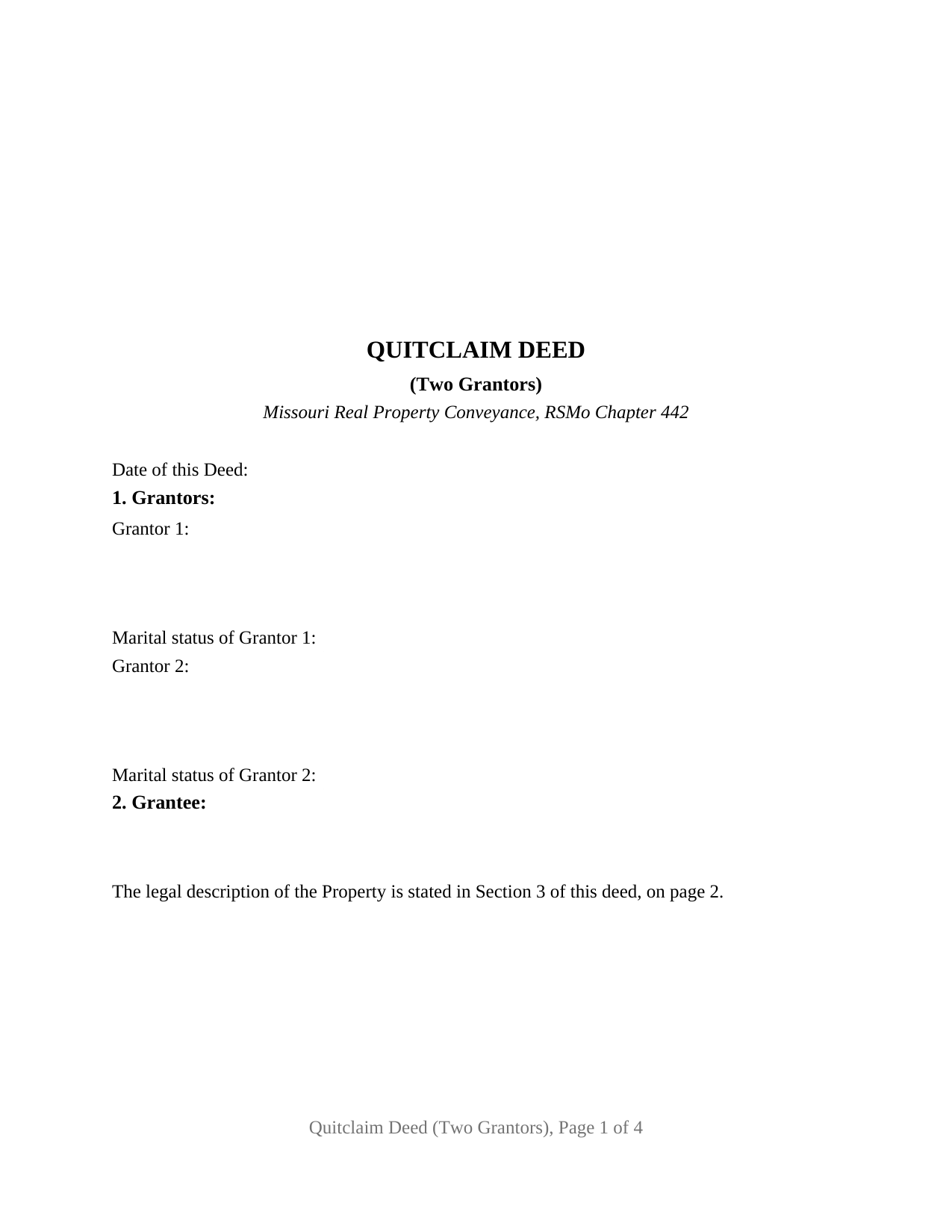
Missouri asks every natural person who signs a deed one question, married or unmarried, and this quitclaim deed asks it twice. The form is arranged for exactly two grantors: a block for Grantor 1 and one for Grantor 2, each with its own marital status line, two signature lines, and two notarial acknowledgment certificates. Together they release to one grantee whatever interest they hold in the described Missouri real property.
Two grantors, each answering for themselves
Section 442.130.2 of the Revised Statutes of Missouri requires an instrument conveying real estate to state whether a natural person executing it is married or unmarried, and Section 59.310.2 places all grantors' names and marital status on the first page below the recorder's three inch band. With two grantors the statement is made twice, and the form keeps the answers apart: one grantor may be married and the other unmarried, both may be married to each other, or each to someone else. Nothing about status is preprinted.
What two signatures carry out of the record
The operative section has the grantors, and each of them, remise, release, and forever quitclaim to the grantee all of their right, title, and interest in the Property, so the grantee holds whatever both held at delivery. Two tenants in common who took title under one deed, a brother and sister who inherited a parcel together, and spouses whose entirety estate moves only when both act present the two grantor pattern this deed recites. The form recites exactly two record owners, natural persons acting individually; a sole owner, three or more owners, a trustee or company officer, and an agent under a power of attorney each follow a different structure.
Why spouses holding by the entirety sign as a pair
Under Nelson v. Hotchkiss, 601 S.W.2d 14 (Mo. banc 1980), a deed naming a husband and wife as co-grantees ordinarily vests them by the entirety, an estate that answers only to both spouses acting together. Section 442.030 lets husband and wife convey the real estate of either by their joint acknowledged deed, and Section 513.475 declares a separate alienation of the homestead by one spouse null and void while preserving a joint disposition. Two grantors married to each other, each stating that status, signing, and acknowledging, make that joint conveyance; the Greene County example works the pattern through, a Springfield couple releasing their residence to a family member.
A certificate for each grantor, in the statute's own words
Each grantor's signature is followed by its own certificate, so the grantors may acknowledge on different dates or before different officers; Missouri does not require separate certificates, and the form's design is what supplies them. Each carries the substance of the Section 442.210.1(1) form for natural persons acting in their own right and the blank Section 442.145.2 calls for: after personally appeared, the officer designates whether the grantor appeared by physical presence or by communication technology.
Words chosen to keep covenants out
Section 442.420 reads limited covenants of title into a fee simple conveyance made with the words grant, bargain and sell unless express terms restrain them. This deed never uses that phrase. It remises, releases, and forever quitclaims, states that no covenant of title arises by implication from any word in it, and provides that title a grantor acquires after delivery does not pass, which keeps Section 442.430 and after-acquired title outside the transaction. A quit claim deed, or a quitclaim form, names the same instrument; liens, easements, and unpaid taxes stay with the land.
Page one and the recorder
Sections 59.310 and 59.313 reserve the top three inches of the first page for the recorder and list what sits below it. Two grantor blocks and two status lines fill most of that space, so the form uses the statute's own overflow rule: a sentence on page one locates the legal description in Section 3 on page 2. The deed is recorded where the land lies, and from filing it imparts notice to all persons under Section 442.390. Missouri collects no transfer tax, though three jurisdictions take a certificate of value with the deed, prepared apart from it.
The purchase delivers three items: the two grantor quitclaim deed as a fillable PDF, a completed example filled in end to end for the Greene County pattern above, and a plain language guide to each blank, the two status statements, the two acknowledgments, and recording. The materials describe Missouri law in general terms; they are informational and not legal advice.
Important: County or Independent City-Specific Forms
Our quitclaim deed (two grantors) forms are specifically formatted for each of the 115 county or independent cities in Missouri.
After selecting your county or independent city, you'll receive forms that meet all local recording requirements, ensuring your documents will be accepted without delays or rejection fees.