Nebraska Transfer on Death Revocation (Joint Transferors)
County Specific Legal Forms Validated as recently as September 15, 2026 by our Forms Development Team
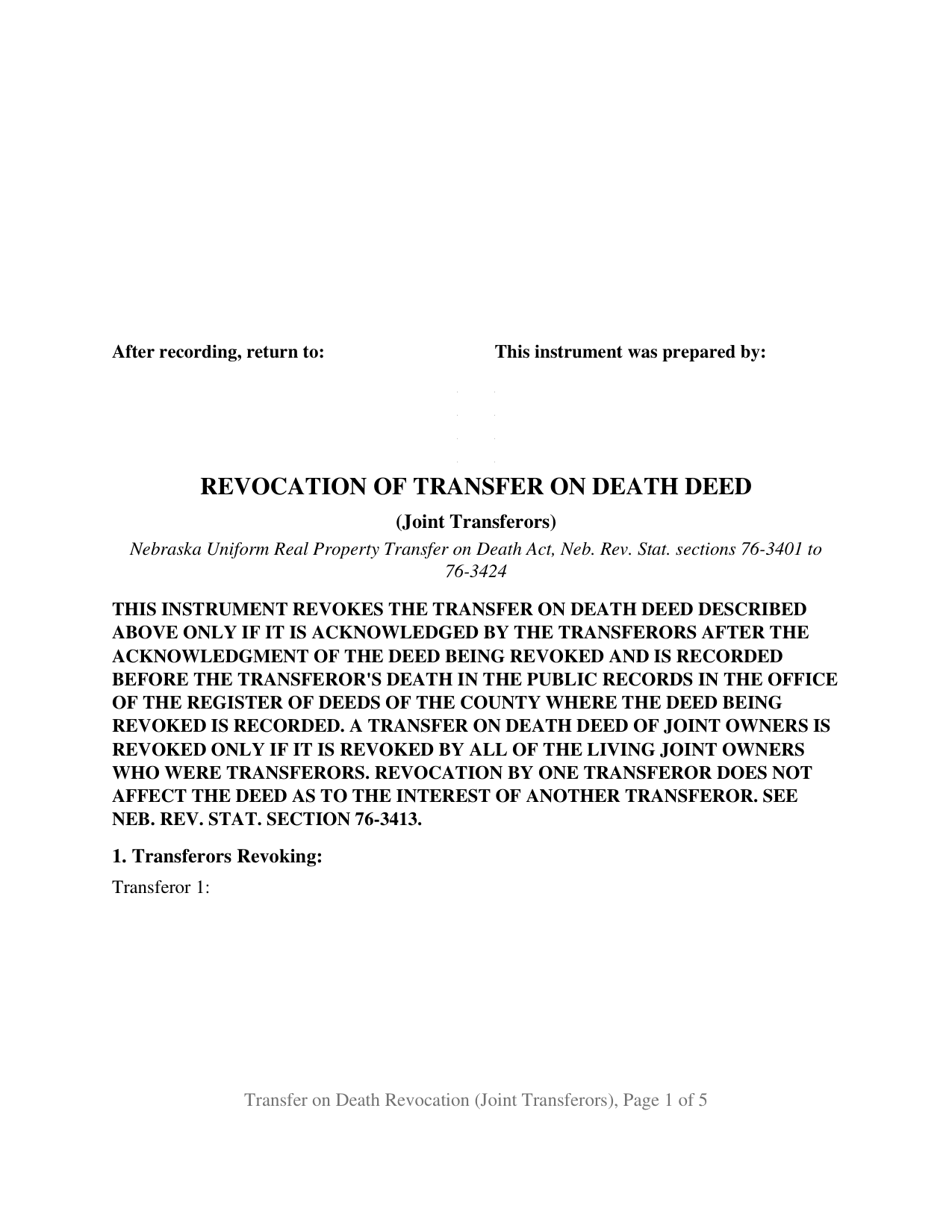
About the Nebraska Transfer on Death Revocation (Joint Transferors)
How to Use This Form
- Select your county from the list
- Download the county-specific form
- Fill in the required information
- Have the document notarized if required
- Record with your county recorder's office
What Others Like You Are Saying
"Great, immediate access to everything I needed to assist my client! This is truly a great resource f…"
"Thank-you."
"The product was just what I needed. Not being the sharpest computer user I stumbled a little but aft…"
"I used the Oklahoma Gift Deed transferring property intra-family, and found it easy to complete. I c…"
"Well worth the $20.00 for the Transfer on Death Deed, if you are willing to do the leg work to notar…"
4.8/5 from 4,823 reviews. Read all
A Nebraska transfer on death deed that two joint owners signed together does not come apart one signature at a time. Neb. Rev. Stat. section 76-3413(b)(2) provides that a deed of joint owners is revoked only if it is revoked by all of the living joint owners who were transferors, and section 76-3413(b)(1) provides that revocation by one transferor leaves the deed standing as to the interest of another transferor. This Nebraska Transfer on Death Revocation is built for that arithmetic: one recorded instrument, two transferor signature blocks, two disinterested witnesses, and one sworn certificate tying all four signatures to a single date.
Why a joint deed takes every living owner
Section 76-3402(4) defines a joint owner as an individual who owns property concurrently with one or more others with a right of survivorship, includes a joint tenant, and excludes a tenant in common without a right of survivorship. A TOD deed made by such owners operates at the death of the last of them, and the statute matches the revocation to the deed: the signatures of all living joint owner transferors on one instrument. Where one of two transferors has died, the section reaches the living joint owners who were transferors.
The acknowledgment that has to come second
Timing is the trap the statute sets for a beneficiary deed revocation. Section 76-3413(a)(2) makes an instrument of revocation effective only if it is acknowledged by the transferor after the acknowledgment of the deed being revoked and recorded before the transferor's death, in the office of the register of deeds of the county where the deed being revoked is recorded. Section 76-3413(c) closes the informal exit: once a transfer on death deed is recorded, no revocatory act on the paper revokes it. The form devotes a section to the recorded deed's date, recording date, instrument number, book and page, and county, so the revocation identifies on its face the deed whose acknowledgment it follows.
Two transferors, two witnesses, one certificate
The form recites exactly two record transferors and prints a signature block, a printed-name line, and a date line for each. Under it sit two subscribing witness blocks, because section 76-3413(a)(1)(B) carries the deed's own execution formality across to the revocation: section 76-3409 calls for attestation in writing by two or more disinterested witnesses, and section 76-3402(3) defines a disinterested witness as one who is not a designated beneficiary or an heir, child, or spouse of a designated beneficiary. All four signatures meet in one officer's certificate reciting that the instrument was subscribed, sworn to, and acknowledged before the notarial officer by the transferors and subscribed and sworn to by the witnesses on the same date, the structure the statutory certificate itself uses. Spouses holding as joint tenants, a parent and an adult child who bought a house together, and unmarried co-owners with a survivorship deed all stand behind this two-transferor pattern in the record. A deed one owner signed alone follows a different pattern, and this form does not recite it.
Sworn language, not an ordinary acknowledgment
Nebraska borrows will-style formalities here. The transferors' declaration follows the section 76-3409 language: each signs, being first duly sworn, declaring the signing free and voluntary and stating that the signer is of sound mind and under no constraint or undue influence. The witnesses' declaration mirrors it, and section 76-3408 sets the capacity to revoke at the capacity required to make a will, which is the capacity the form recites.
Recording with no stamp tax and no Form 521
Section 76-902(16) exempts revocations of transfer on death deeds from the Nebraska documentary stamp tax, and section 76-214(2)(b) states that the Form 521 Real Estate Transfer Statement is not required when an instrument of revocation described in section 76-3413(a)(1)(B) is filed, so the recording package is the instrument alone plus the section 33-109 fee. The layout answers Nebraska format law: the first page opens with the blank space section 23-1510 reserves for the register of deeds, the return address and instrument title print below it, and every party name is typed beneath its signature line as section 23-1503.01(3) requires. A later transfer on death deed making a fresh designation is prepared and recorded separately and is not included here.
The package delivers the fillable revocation form, a completed example filled in for a Lancaster County property, and a guide covering the statute, the section by section entries, the execution formalities, and recording. These are informational materials and are not legal advice.
Important: County-Specific Forms
Our transfer on death revocation (joint transferors) forms are specifically formatted for each of the 93 counties in Nebraska.
After selecting your county, you'll receive forms that meet all local recording requirements, ensuring your documents will be accepted without delays or rejection fees.