Churchill County Notice of Mechanics Lien Form
Last validated October 12, 2026 by our Forms Development TeamFormatted for recording in Churchill County, for property anywhere in the county or independent city: rural and unincorporated areas as well as Fallon.
- 3 documents included
- Immediate PDF download
- Formatting guarantee
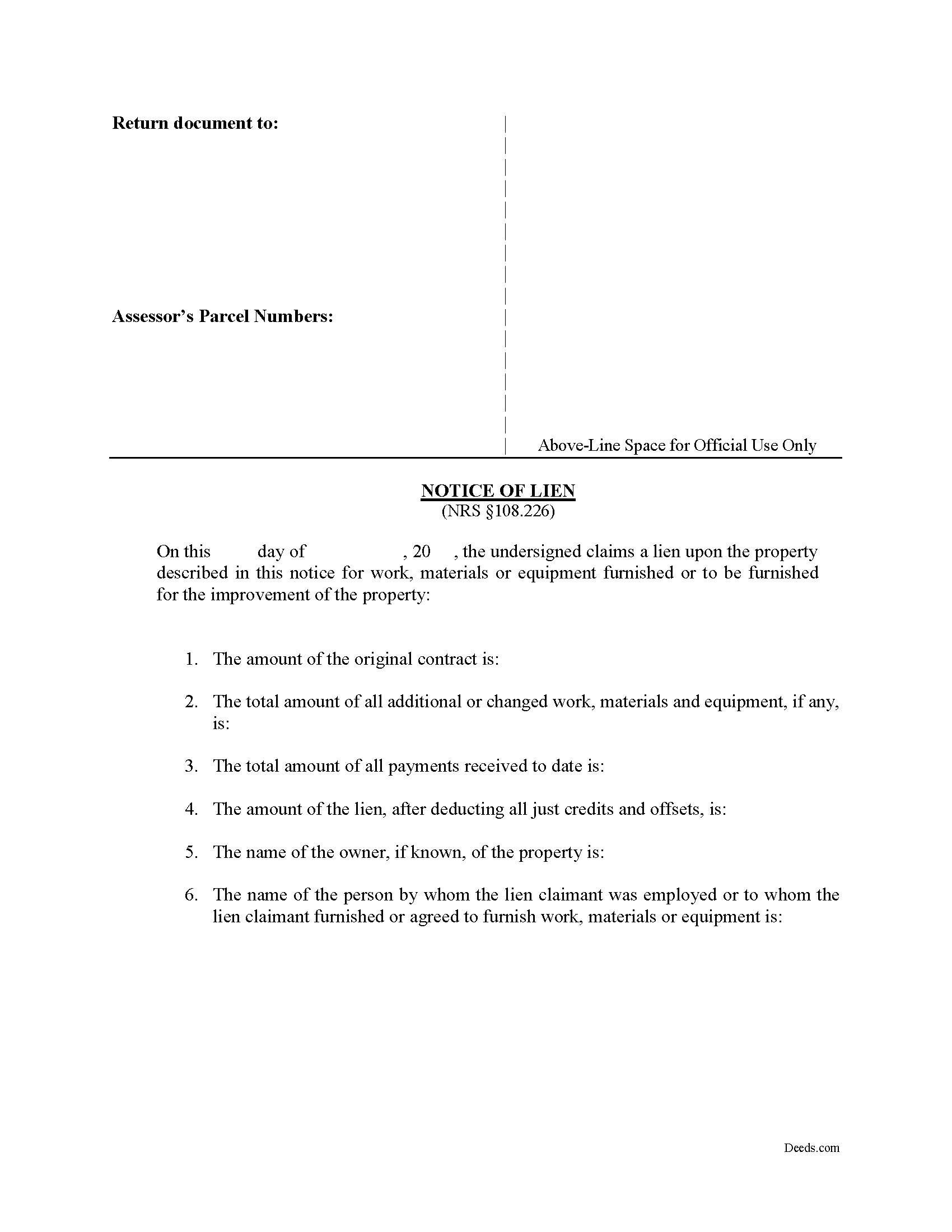
Churchill County Notice of Mechanics Lien Form
Fill in the blank Notice of Mechanics Lien form formatted to comply with all Nevada recording and content requirements.
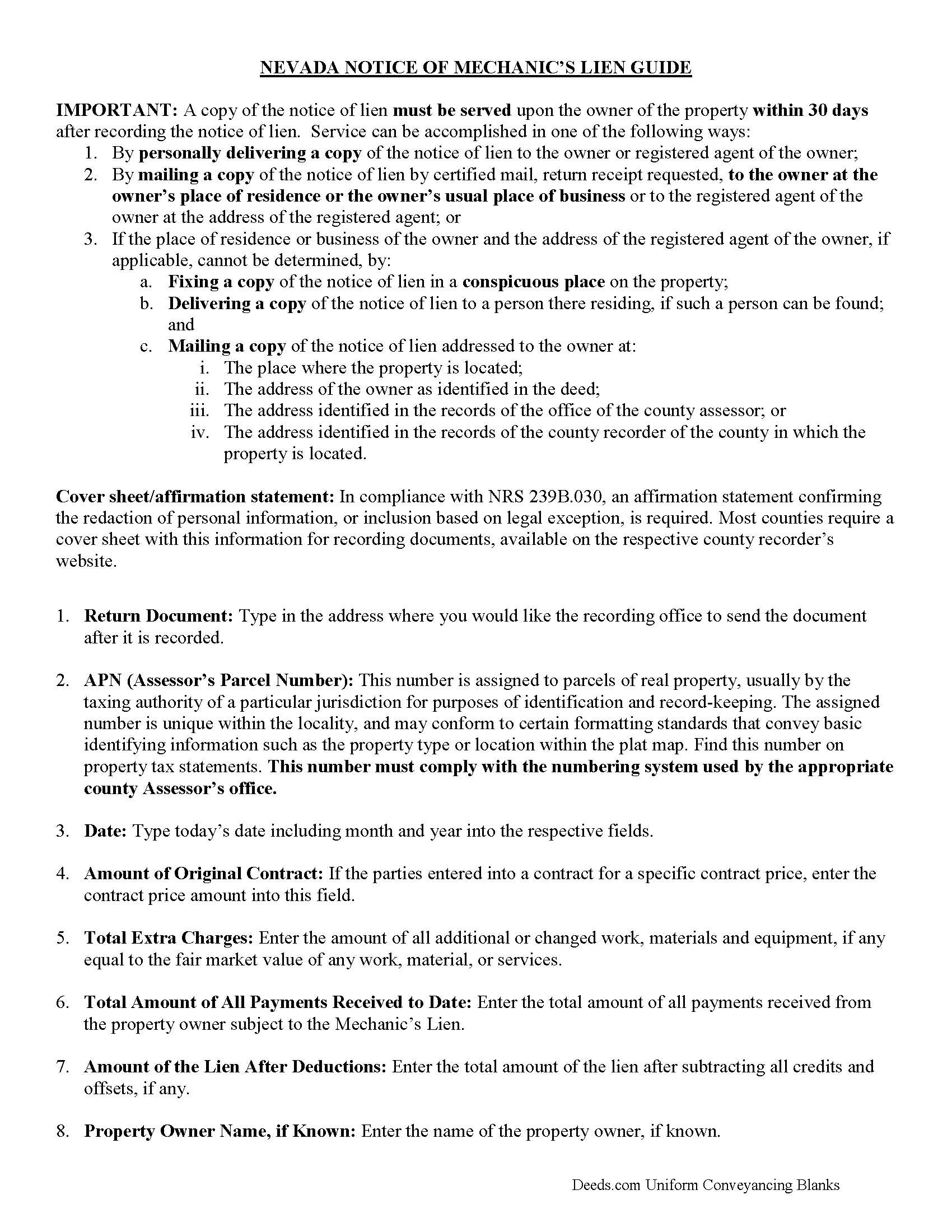
Churchill County Notice of Mechanics Lien Guide
Line by line guide explaining every blank on the form
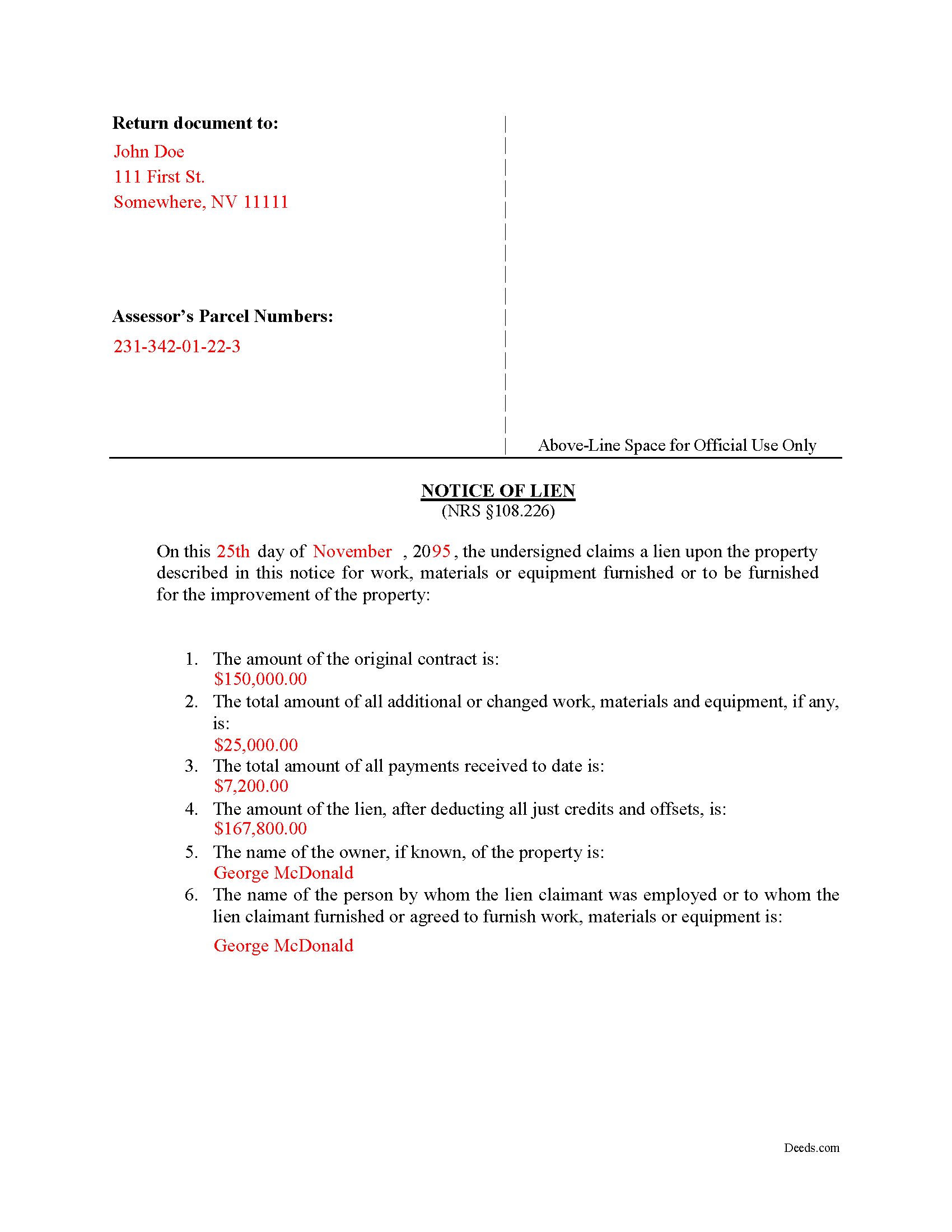
Churchill County Completed Example of the Notice of Mechanics Lien Document
Example of a properly completed form for reference.
All 3 documents above included • One-time purchase • No recurring fees
Immediate Download • Secure Checkout
Additional Nevada and Churchill County documents included at no extra charge:
Where to Record Your Documents
County Recorder's Office
Fallon, Nevada 89406
Hours: Monday - Friday 8am to 5pm
Phone: 775-423-6001
Recording Tips for Churchill County:
- Bring your driver's license or state-issued photo ID
- Ensure all signatures are in blue or black ink
- Avoid the last business day of the month when possible
- Both spouses typically need to sign if property is jointly owned
- Bring extra funds - fees can vary by document type and page count
Cities and Jurisdictions in Churchill County
Properties in any of these areas use Churchill County forms:
- Fallon
Hours, fees, requirements, and more for Churchill County
How do I get my forms?
Forms are available for immediate download after payment. The Churchill County forms will be in your account ready to download to your computer. An account is created for you during checkout if you don't have one. Forms are NOT emailed.
Are these forms guaranteed to be recordable in Churchill County?
Yes. Our form blanks are guaranteed to meet or exceed the applicable formatting requirements used for recording in Churchill County, including margin requirements, font requirements, and other layout standards. This guarantee applies to formatting, not to the legal sufficiency of information entered by the user or the suitability of a form for a particular transaction.
Can I reuse these forms?
Yes. You can reuse the forms for your personal use. For example, if you have multiple properties in Churchill County you only need to order once.
What do I need to use these forms?
The forms are PDFs that you fill out on your computer. The free Adobe Acrobat Reader is recommended, and most PDF apps also work. You do NOT enter your property information online - you download the blank forms and complete them privately on your own computer.
Are there any recurring fees?
No. This is a one-time purchase. Nothing to cancel, no memberships, no recurring fees.
How much does it cost to record in Churchill County?
Recording fees in Churchill County vary. Contact the recorder's office at 775-423-6001 for current fees.
Questions answered? Let's get started!
A mechanic's lien is a security interest in the title to property for the benefit of those who have supplied labor or materials that improve the property. In terms of real property, a mechanic's lien is also known as a construction lien. It is also called a materialman's lien or supplier's lien when referring to those supplying materials, a laborer's lien when referring to those supplying labor, and a design professional's lien when referring to architects or designers who contribute to a work of improvement.
Under Nevada law, in order to ensure payment for services and to protect the rights of a contractor, subcontractor, or material supplier, a mechanic's lien can be filed against a homeowner's property. The lien creates a legal method for these contractors, subcontractors and suppliers to foreclose on the improved property, in turn forcing a sale of the property in order to obtain payment for their work or materials.
In Nevada, mechanic's liens are governed under Chapter 108 of Nevada Revised Statutes. Any person who provides labor, materials, or equipment valued at $500 or more which is used in the construction, alteration, or repair of property is entitled to a mechanic's lien. However, if a license is required to perform the work in question, the contractor or professional can only file a lien if he or she is licensed to perform the work.
A mechanic's lien is available when labor, services, or equipment, and/or materials have been provided; labor was performed; materials were intended for and used on the property; permanent work or improvement was performed; and the work was performed with the consent of the owner or his or her agent.
Property subject to a mechanic's lien includes any property in which any improvements including work, materials, and equipment have been furnished and any construction disbursement account (NRS 108.222(1)). The definition of property includes the land and all buildings, improvements and fixtures, and any convenient space around the land. Improvements are defined as any development, enhancement, or addition to the real property. A single lien can be recorded against several buildings when there are multiple parcels or buildings. However, lien claimants should be cautious because a failure to allocate a lienable amount (unpaid debt) among several buildings can result in the subordination of the lien to a lien subsequently recorded (NRS 108.231(5)).
The lienholder is entitled to either the contract price in which case the lien is equal to the unpaid balance or the agreed upon price (NRS 108.221(1)(a)) or if no agreement has been made on a specific price, the fair market value of the work, materials, or services provided (NRS 108.222(1)(b)).
The order in which lienholders are entitled to collect on a lien is governed by rules of priority. A lienholder who provided labor is given first priority, followed by material suppliers and lessors of equipment, then other lien claimants who performed under contract with the prime contractor or sub-contractor, and all other lien claimants are given last priority.
A lien must be perfected in order to achieve priority over unperfected or later perfected liens. To perfect a mechanic's lien, the first step is to provide pre-lien notice in the form of a notice of right to lien. Under NRS 108.245(1), a lien claimant may provide notice at any time after the first delivery of materials or performance or work or services under his or her contract. Although no time frame is provided, a lien claimant should record this notice promptly. The purpose of recording is to provide warning to the owner of the property that the lien claimant may at a future date record a lien on the property. This required notice does not, however, create a lien (NRS 108.245(B)). Notice must be delivered in person or through certified mail to the owner (NRS 108.245(1)). Sub-contractors must also give notice to the prime contractor in person or by certified mail. Failure to provide such notification is grounds for disciplinary action against the sub-contractor by the State Contractor's Board. There is an exception to this rule for sub-contractors who provide labor only.
Additional notice is required for all residential construction projects. If the work includes construction, alteration, or repair of a multi-family or single family residence, including without limitation, apartment houses, then the lien claimant (party to the construction contract other than the owner who is seeking payment) must also serve a 15-day notice of intent to lien. The notice of intent to lien is not required to be recorded although it must be served personally or by certified mail (NRS 108.226(6)). The owner and the prime contractor must be served within 15 days of the notice of intent to lien as a statutory pre-requisite to the notice of lien filing.
To actually create a lien, you must take the second step of filing, recording, and serving a notice of lien in order to perfect. Under NRS 108.226(5), the notice of lien must be completed in substantial accordance with the form set forth by statute and specify: 1) the total amount of the original contract, 2) the total amount of all work, materials, or equipment, 3) the total amount of all payments received to date, 4) the amount of the lien after subtracting all credits and offsets, 5) the name of the property owner, 6) the name of the person by whom the lien claimant was employed or to whom the lien claimant furnished or agreed to furnish work, materials, or equipment, 7) a brief statement of the terms of payment of the lien claimants contract, and 8) a description of the property to be charged with the lien. The notice of lien must contact a verification by oath of the lien claimant.
The timing of the notice of lien is governed under NRS 108.226(1)(a) and (b) which states that the notice of lien must be recorded within 90 days after completion of the work or improvements or the last delivery of materials or the furnishing of equipment by the lien claimant, and must be served upon the owner of the property within 30 days after recording the notice of lien.
The notice of lien must be served through delivering a copy to the owner personally, or if the owner is absent from the residence or place of business, a copy can be mailed through certified mail with return receipt to the owner at his residence, usual place of business, or through his or her resident agent. If the owner cannot be located and the owner's residence or place of business cannot be ascertained, service can be achieved by fixing a copy of the notice of lien in a conspicuous place (such as affixing to the main entrance door), delivering a copy to the person residing there, or mailing a copy addressed to the owner at the property address. All owners must be served with the notice of lien, but a failure to serve all owners will not invalidate the lien (NRS 108.227(2)). Additional caution should be exercised by sub-contractors as failure to deliver notice to a general contractor is a basis for disciplinary proceedings against a sub-contractor (NRS 108.256(4)).
A mechanic's lien or construction lien is effective for six months after the recording date (NRS 108.233(1)) unless a lawsuit is commenced to enforce the lien or the time to commence a suit has been extended by written agreement, signed by both the lien claimant and the person with an interest in the subject property. The agreement to extend the time to foreclose is only effective if recorded in the county recording office prior to the expiration of six months and must be notarized. The agreement cannot exceed one year from the date of recording.
A lien claimant must wait thirty days from the date of recording the notice of lien in order to initiate a foreclosure action (NRS 108.244). An action to foreclose on a lien may not be brought any later than six months after the lien was recorded unless the time has been extended by agreement. In order to foreclose, the following documents are required: 1) a complaint filed in a court of competent jurisdiction which should include additional contract-based causes of action, and 2) a notice of pendency which must be filed with the court and recorded to provide constructive notice to the work of an alleged claim or an interest in the property.
The notice of foreclosure must be published once per week for three consecutive weeks in a newspaper published in the county where the property is located and must be delivered in person or by certified mail to all other lien claimants who have had liens recorded against the subject property at the time the complaint is filed.
A lien claimant who receives a notice of foreclosure of another lien claimant's lien must file a statement of facts constituting lien with the court within a reasonable time after publication or receipt of the notice of foreclosure. Discuss any situation involving multiple lien claimants with a licensed and competent attorney.
Under NRS 108.237, in addition to the claimed lien amount plus any costs for the preparation and recording of the notice of lien, the Court can award attorney's fees to the prevailing lien claimant. The court can also calculate and award interest either in accordance with the contract or legal rate of interest (3.5% as of January 1, 2016).
In summary, mechanic's liens in Nevada are available for contractors, subcontractors, and material suppliers as a method to ensure payment for services or materials provided as long as the lien claimant complies with Nevada lien statute. However, as each case can be unique and set forth novel legal issues, it is important to seek legal consultation from a licensed Nevada attorney familiar with issues present in mechanic's liens.
Important: Your property must be located in Churchill County to use these forms. Documents should be recorded at the county or independent city recording office listed above.
This Notice of Mechanics Lien meets all recording requirements specific to Churchill County.
Our Promise
The documents you receive here are guaranteed to meet or exceed the applicable Churchill County recording format requirements. If there is a rejection caused by our formatting, we will correct the issue or refund your payment. This guarantee applies to document formatting only and does not extend to information entered by the user, the selection of the form, or the legal effect of the completed document.
Save Time and Money
Get your Churchill County Notice of Mechanics Lien form done right the first time with Deeds.com Uniform Conveyancing Blanks. At Deeds.com, we understand that your time and money are valuable resources, and we don't want you to face a penalty fee or rejection imposed by a county recorder for submitting nonstandard documents. We constantly review and update our forms to meet rapidly changing state and county recording requirements for roughly 3,500 counties and local jurisdictions.
4.8 out of 5 - ( 4,833 Reviews )
Steven M. 5 out of 5 stars
Happy with your service. Everything as advertised.
Your feedback is greatly appreciated. Thank you for taking the time to share your experience!
Billie W. 5 out of 5 stars
Excellent way to do this kind of transaction.
Thank you!
Jimmy P. 5 out of 5 stars
Works well. Very satisfied.
Thank you!
Stanley S. 5 out of 5 stars
Extremely convenient and easy to execute the document. Instructions and example are very helpful. I have bookmarked the site and will surely use again. 5 stars!!
Thank you!
Theresa S. 5 out of 5 stars
So far everything ive had to do is very simple and easy. Thanks
Thank you for your kind words and for choosing us.
Alan M. 4 out of 5 stars
The packet I downloaded was complete and useful, and process was not unduly opaque. However, I would have liked to download the whole packet, about 6 files, all at one go. Still, the forms provided the complete solution to my situation.
Thank you for your feedback. We really appreciate it. Have a great day!
Sue D. 5 out of 5 stars
Great program
Thank you!
Joy M. 5 out of 5 stars
Great down load.
Thank you for your kind words and for choosing us.
Shelba M. 3 out of 5 stars
The web site is alright, not the easiest to navigate and the wording on the papers could be simpler to understand.
Thank you for your feedback! We appreciate your input regarding the website's navigation and the wording on our documents. We'll definitely take your suggestions into account to improve the user experience and make the content more accessible and easier to understand. Your insights are valuable to us as we strive to enhance our services. If you have any further suggestions or concerns, please feel free to share them with us. Thank you again for your feedback!
Marilyn C. 5 out of 5 stars
A great service, making it fast and easy to prepare warranty deeds for property transfer sales. I recommend this to everyone who needs this help.
Thank you!
Billie M. 4 out of 5 stars
My overall experience was positive. Little trouble uploading documents but resolved. I had two mineral deeds to file in Arkansas, two different counties, exactly the same form, only difference being property description; one was completed, one was canceled. I emailed to inquire why and the reply was in an automatic email indicating that email address was not monitored and if further action would be taken on Deeds.com part, I would be notified. Other than that, I would recommend their services to avoid using snail mail.
We appreciate your business and value your feedback. Thank you. Have a wonderful day!
Travis S. 1 out of 5 stars
I couldn't even look for a deed because the website said that deed/title searching wasn't available. Very disappointed about it.
I'm sorry to hear that you had a disappointing experience with the website's deed/title searching feature. It can be frustrating when a feature you were hoping to use isn't available.
We do hope that you found what you were looking for elsewhere.
Roy Y. 5 out of 5 stars
I paid for and received the form for a Quit Claim Deed. Hoping it is the form I need to complete my transaction. Thank you for making it possible to obtain the form I was in need of.
Thank you for your feedback Roy. We appreciate it!
Evelia G. 5 out of 5 stars
I love this guide. Thank you for having this available.
Thanks so much for your feedback Evelia, have a fantastic day!
Shannon T. 5 out of 5 stars
Very easy to use. Was able to fill out the forms on my phone.
Thank you for your kind words and for choosing us.