New Jersey Bargain and Sale Deed with Covenant (Two Grantors)
County Specific Legal Forms Validated as recently as October 7, 2026 by our Forms Development Team
About the New Jersey Bargain and Sale Deed with Covenant (Two Grantors)
How to Use This Form
- Select your county from the list
- Download the county-specific form
- Fill in the required information
- Have the document notarized if required
- Record with your county recorder's office
What Others Like You Are Saying
"Very easy to use."
"All very good"
"Easy to complete form. Examples were very helpful in using correct verbiage for form. Also way less …"
"Great service and so quick at responding!"
"Fantastic service, easy to use, and supported the entire way through every process. Excellent servic…"
4.8/5 from 4,824 reviews. Read all
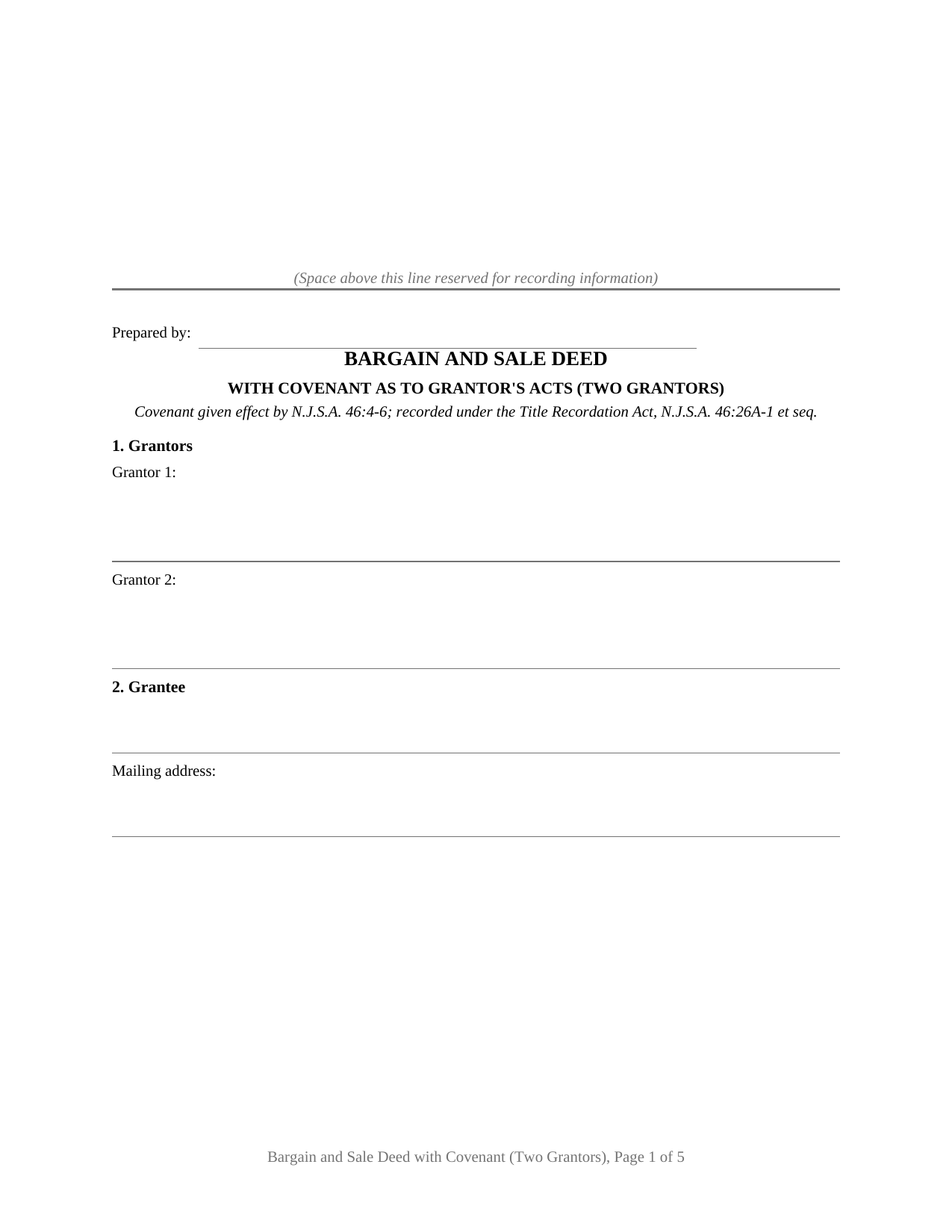
Most New Jersey homes change hands on a bargain and sale deed with covenant as to grantor's acts, and the reason is the covenant's precise size. The deed conveys the grantors' entire interest, and it makes exactly one promise about title: that the grantors themselves have done nothing to encumber the property. This form prepares that deed for two grantors, the married couples, civil union partners, and co-owner pairs who hold most jointly owned New Jersey titles.
A covenant measured by the grantors' own acts
New Jersey writes title covenants by formula. Under N.J.S.A. 46:4-6, a covenant that the grantor "has done no act to encumber" the lands carries the full statutory effect: the grantors have not made, and have not knowingly permitted, any act that changes, charges, or encumbers the title. The Supreme Court of New Jersey reads the covenant narrowly; in Shotmeyer v. New Jersey Realty Title Insurance Co., 195 N.J. 72 (2008), it covers only the grantors' own acts and omissions, not defects that predate their ownership. That places this deed between the general warranty deed, which covenants against the claims of all persons across the whole chain of title, and the quitclaim deed, which releases an interest with no title covenant at all. The form states the covenant for both grantors, identifies it by its statutory name on the face of the deed, and states that it is the deed's only title covenant.
Two grantors, one conveyance
The deed carries a separate block for each grantor, signature lines with the printed names New Jersey requires beneath every signature, and a separate acknowledgment certificate for each grantor, so the two can appear before different officers, on different dates, in different states. For spouses or civil union partners holding as tenants by the entirety, N.J.S.A. 46:3-17.4 bars either from affecting the other's interest without the written consent of both; a two-signature deed is how entireties property moves. The grantee entry accepts vesting words as well, since New Jersey grantees take as tenants in common unless the deed states survivorship or entireties language.
What New Jersey checks at the recording counter
Title 46 makes several items recording prerequisites: the consideration recited in the deed or annexed by affidavit, the municipal lot and block reference, the name of the person who prepared the deed, and the grantee's mailing address. The form carries a dedicated blank for each. The deed records with the county clerk or register of deeds in the county where the property is located, and New Jersey's race-notice statute makes prompt recording the protection against later purchasers and judgment creditors without notice.
The paperwork that travels with the deed
A New Jersey deed rarely records alone. The Realty Transfer Fee is paid when the deed is offered for recording, with Form RTF-1 annexed when an exemption is claimed or the full consideration is not recited; sales over $1,000,000 in covered property classes carry the grantor-paid Graduated Percent Fee under the 2025 amendments; and every deed arrives with a GIT/REP seller residency form. The guide included with this form walks through each item, every numbered section of the deed, and the signing formalities, and a completed example shows the entire deed filled in for a realistic Middlesex County sale. The materials are informational and are not legal advice.
Important: County-Specific Forms
Our bargain and sale deed with covenant (two grantors) forms are specifically formatted for each of the 21 counties in New Jersey.
After selecting your county, you'll receive forms that meet all local recording requirements, ensuring your documents will be accepted without delays or rejection fees.