New Jersey Bargain and Sale Deed with Covenant Against Grantors Acts (Individual)
County Specific Legal Forms Validated as recently as October 2, 2026 by our Forms Development Team
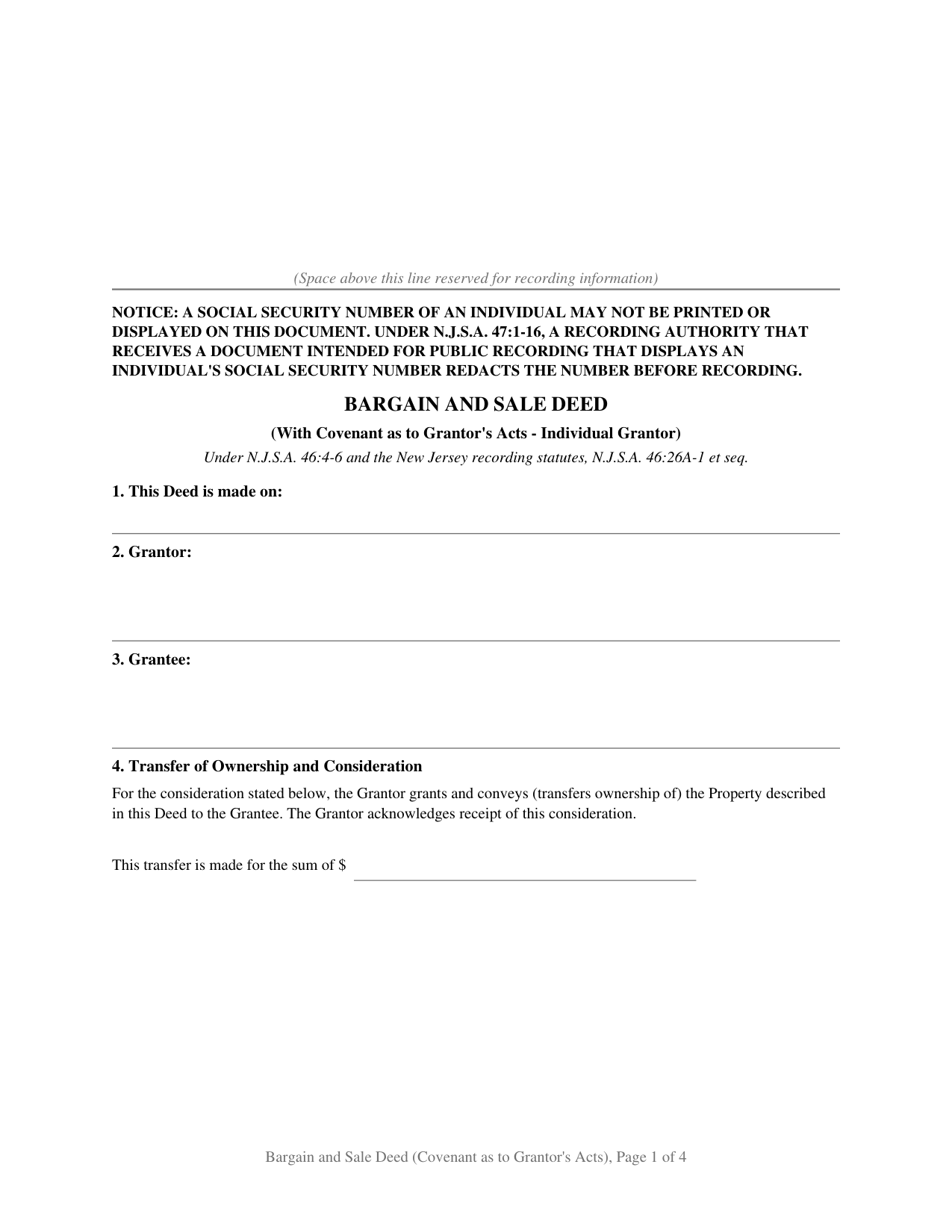
About the New Jersey Bargain and Sale Deed with Covenant Against Grantors Acts (Individual)
How to Use This Form
- Select your county from the list
- Download the county-specific form
- Fill in the required information
- Have the document notarized if required
- Record with your county recorder's office
What Others Like You Are Saying
"Worked well with clear guide!"
"Very convenient!"
"Easy to request. Fast response"
"Easy to find the form I needed. And the instructions helpful on how to fill out the form."
"Absolutely amazing throughout the whole process"
4.8/5 from 4,824 reviews. Read all
In most ordinary New Jersey home sales, the seller neither warrants the whole history of the title nor refuses every assurance. The seller gives one promise: that the seller personally has done nothing to encumber the property. That promise is the covenant as to grantor's acts under N.J.S.A. 46:4-6, and the deed that carries it is the bargain and sale deed with covenant as to grantor's acts. This package prepares that deed for one individual grantor.
The One Promise the Deed Makes
N.J.S.A. 46:4-6 gives a short phrase legal weight: when the grantor states that the grantor has done no act to encumber the land, the statute treats it as a promise that the grantor has not done or knowingly allowed any act that charges, alters, or encumbers the title or estate. The New Jersey Supreme Court read the covenant narrowly in Shotmeyer v. New Jersey Realty Title Insurance Co., 195 N.J. 72 (2008): it reaches the grantor's own acts and omissions, not defects that arose before the grantor owned the property. The buyer relies on a title search and title insurance for the rest of the chain.
Where It Sits Among New Jersey Deeds
This deed is the middle path. A general warranty deed, built from the statutory covenant words in N.J.S.A. 46:4-3 through 46:4-10, warrants against the acts of every prior owner. A quitclaim deed, under N.J.S.A. 46:5-1 and 46:5-3, passes whatever the grantor can lawfully convey and makes no covenant of title at all. The bargain and sale deed with covenant as to grantor's acts gives more than a quitclaim and less than a full warranty, which is why it is the everyday instrument for New Jersey residential closings.
Effectiveness, Recording, and Priority
A deed is effective between the parties when it meets the Statute of Frauds at N.J.S.A. 25:1-11 and is delivered; recording is the separate step that protects the buyer. New Jersey follows a race-notice rule under N.J.S.A. 46:26A-12, so a deed recorded promptly defeats a later claimant without notice. To be accepted, a deed conveying title meets the prerequisites of N.J.S.A. 46:26A-3, including the acknowledgment, the printed names beneath the signatures, the consideration recital, the lot and block reference, the preparer's name, and the grantee's mailing address.
The Recording Package Is More Than the Deed
New Jersey collects its real estate taxes at the recording counter, so the deed travels with company. The Realty Transfer Fee under N.J.S.A. 46:15-5 and following is paid on a sale, with the seller's Affidavit of Consideration on Form RTF-1 annexed where the full price is not recited or an exemption is claimed. For covered transfers over one million dollars, the Graduated Percent Fee enacted by P.L.2025, c.69 falls on the grantor and uses Form RTF-1EE. A GIT/REP form, required by N.J.S.A. 54A:8-9 and 54A:8-10, also accompanies the deed.
Who Signs, and What the Package Includes
One individual grantor signs before a notarial officer, who completes the acknowledgment under N.J.S.A. 46:14-2.1; the customary New Jersey certificate also states the consideration defined in N.J.S.A. 46:15-5, and remote notarization is available under N.J.S.A. 52:7-10.10. Where the property is a married grantor's principal matrimonial residence, a non-titled spouse or civil union partner holds a joint right of possession under N.J.S.A. 3B:28-3 that survives the conveyance unless released under the statutory methods. The package includes the fillable deed, a completed example set in Bergen County, and a plain language guide that walks through every section, the covenant, signing, recording, and the transfer-fee and GIT/REP forms. The materials are informational and are not legal advice.
Important: County-Specific Forms
Our bargain and sale deed with covenant against grantors acts (individual) forms are specifically formatted for each of the 21 counties in New Jersey.
After selecting your county, you'll receive forms that meet all local recording requirements, ensuring your documents will be accepted without delays or rejection fees.