New Jersey Warranty Deed
County Specific Legal Forms Validated as recently as September 23, 2026 by our Forms Development Team
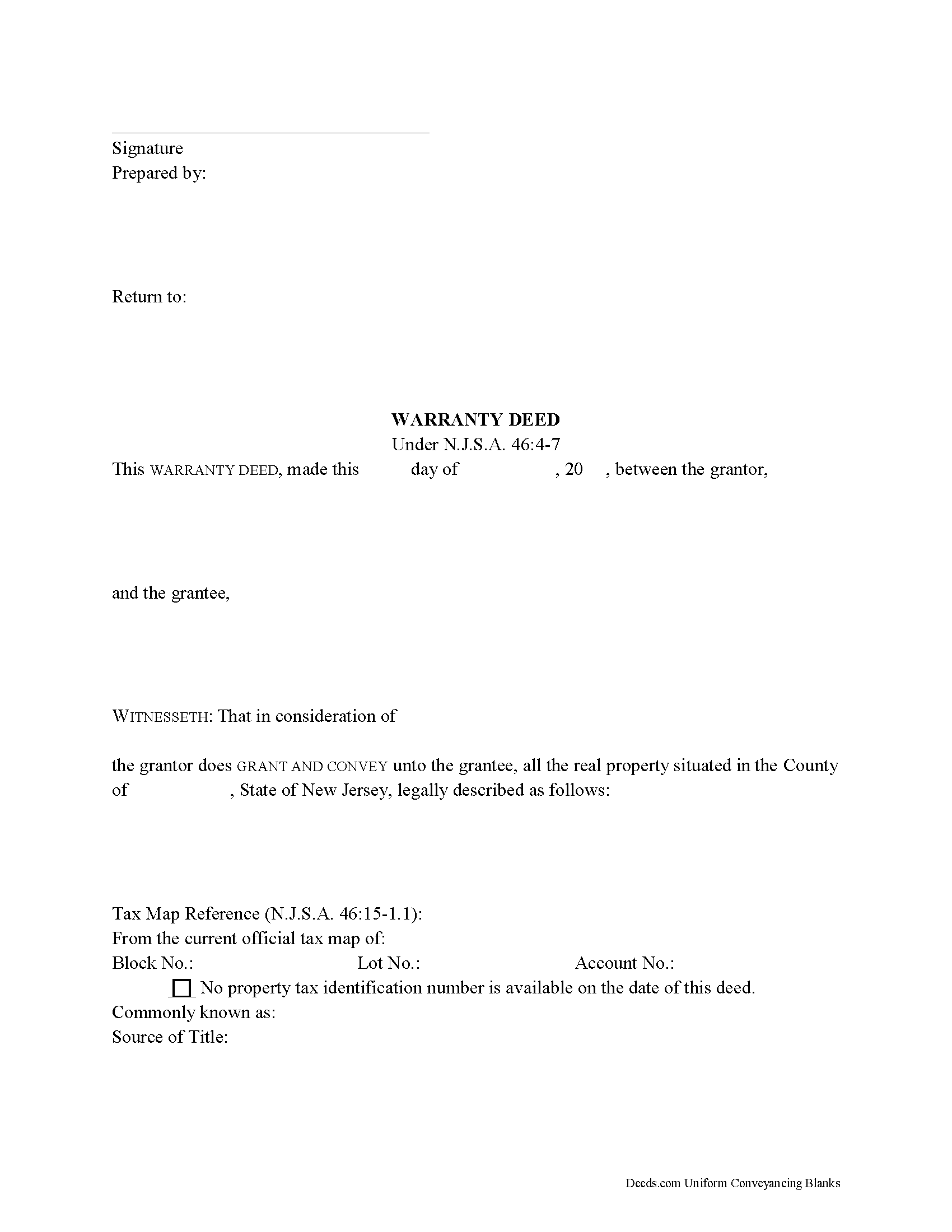
About the New Jersey Warranty Deed
How to Use This Form
- Select your county from the list
- Download the county-specific form
- Fill in the required information
- Have the document notarized if required
- Record with your county recorder's office
What Others Like You Are Saying
"Not sure whether the two forms I printed will be helpful or not. Will find out when I go to a place …"
"Downloaded perfect. Can hardly wait to get them done."
"Great service. It had all the forms I needed."
"Very happy with the forms. Ease of use and price were points for high marks."
"recently joined Deeds.com. still exploring the site. has been very helpful in providing local inform…"
4.8/5 from 4,828 reviews. Read all
New Jersey writes its title covenants in shorthand. A few words placed in the granting clause of a deed, with general warranty, carry a promise the legislature spelled out in full, and this fillable New Jersey warranty deed is built around that machinery. It conveys New Jersey real property with the strongest title assurance a deed in this state carries, and it is drafted as the general version of the form: one or two owners on the conveying side, one or two on the receiving side.
Short phrases the legislature made long
Chapter 4 of Title 46 is captioned Short Form Deeds and Covenants, and the caption is literal. N.J.S.A. 46:4-9 provides that the words with general warranty in the granting part of a deed are deemed to be the grantor's covenant to warrant generally the property conveyed, and N.J.S.A. 46:4-7 expands that covenant into a promise to forever warrant and defend the property against the claims and demands of all persons whomsoever. Companion sections do the same for seisin, the power to convey, peaceable possession unburdened by liens, and the later paperwork a title sometimes needs. N.J.S.A. 46:4-11 sits underneath: a deed that fails to take effect through the short form sections still binds the parties so far as its terms allow. This form places the deeming words in the granting clause and states the express covenant phrases as well.
The deed New Jersey closings usually do not use
Most New Jersey transfers are papered on a bargain and sale deed with covenant against grantor's acts, whose operative phrase promises only that the grantor has done no act to encumber the land. In Shotmeyer v. New Jersey Realty Title Insurance Co., 195 N.J. 72 (2008), the New Jersey Supreme Court read that covenant narrowly, holding that it does not reach a defect predating the grantor's ownership. A general warranty deed answers a different question: its warranty runs to the whole chain, so a stranger's claim rooted in a conveyance made three owners ago is one the grantor has undertaken to defend. Electing that warranty is a deliberate choice in this state rather than a default, which is why the covenant language sits in its own numbered section here.
One form, one or two people on each side
The party blocks are open lines. Nothing about marital status, civil union status, or the form of co-ownership is preprinted, so the grantor entry receives one or two names with whatever status recital the parties use, and the grantee entry receives one or two names followed by the vesting words the grantees have chosen, whether that is a tenancy by the entirety, a joint tenancy with right of survivorship, or nothing, in which case New Jersey's tenancy in common default supplies the answer. The execution area carries two grantor signature blocks, each with a printed name line and its own acknowledgment certificate; a conveyance by a single owner leaves the second block and second certificate empty. Sole owners, co-owners taking title together, and owners adding or removing a name all appear in the land records in this shape. The form is not set up for an entity, a trustee, an attorney-in-fact, or three or more owners on a side, each of which recites a capacity and an authority this instrument does not carry.
Signing it, and the blanks the clerk reads first
Each grantor signs before a notarial officer, who completes a certificate using the sentence from New Jersey's statutory short form at N.J.S.A. 52:7-10.12: this record was acknowledged before me on a stated date by a named individual. Since P.L.2021, c.179, that officer may act for a remotely located signer through communication technology, with identity proofing and an audiovisual recording, and the certificate then says so. Four blanks are recording prerequisites rather than conveniences: the printed name under every signature, the preparer's name, the grantee's mailing address, and the municipal block and lot. The Realty Transfer Fee, the affidavit of consideration, the GIT/REP certification, and the county cover sheet or electronic synopsis are prepared separately at the recording counter and are not part of this package; the guide covers each of them.
Inside the download
The package delivers the fillable deed, a completed example working a Camden County conveyance through every blank, and a plain-language guide covering the statutory covenants, the vesting choices open to the grantees, the signing rules, and the county recording steps and costs. These materials describe New Jersey law in general terms and are not legal advice.
Important: County-Specific Forms
Our warranty deed forms are specifically formatted for each of the 21 counties in New Jersey.
After selecting your county, you'll receive forms that meet all local recording requirements, ensuring your documents will be accepted without delays or rejection fees.