New Mexico Quitclaim Deed (Individual Grantor by Attorney-in-Fact)
County Specific Legal Forms Validated as recently as October 23, 2026 by our Forms Development Team
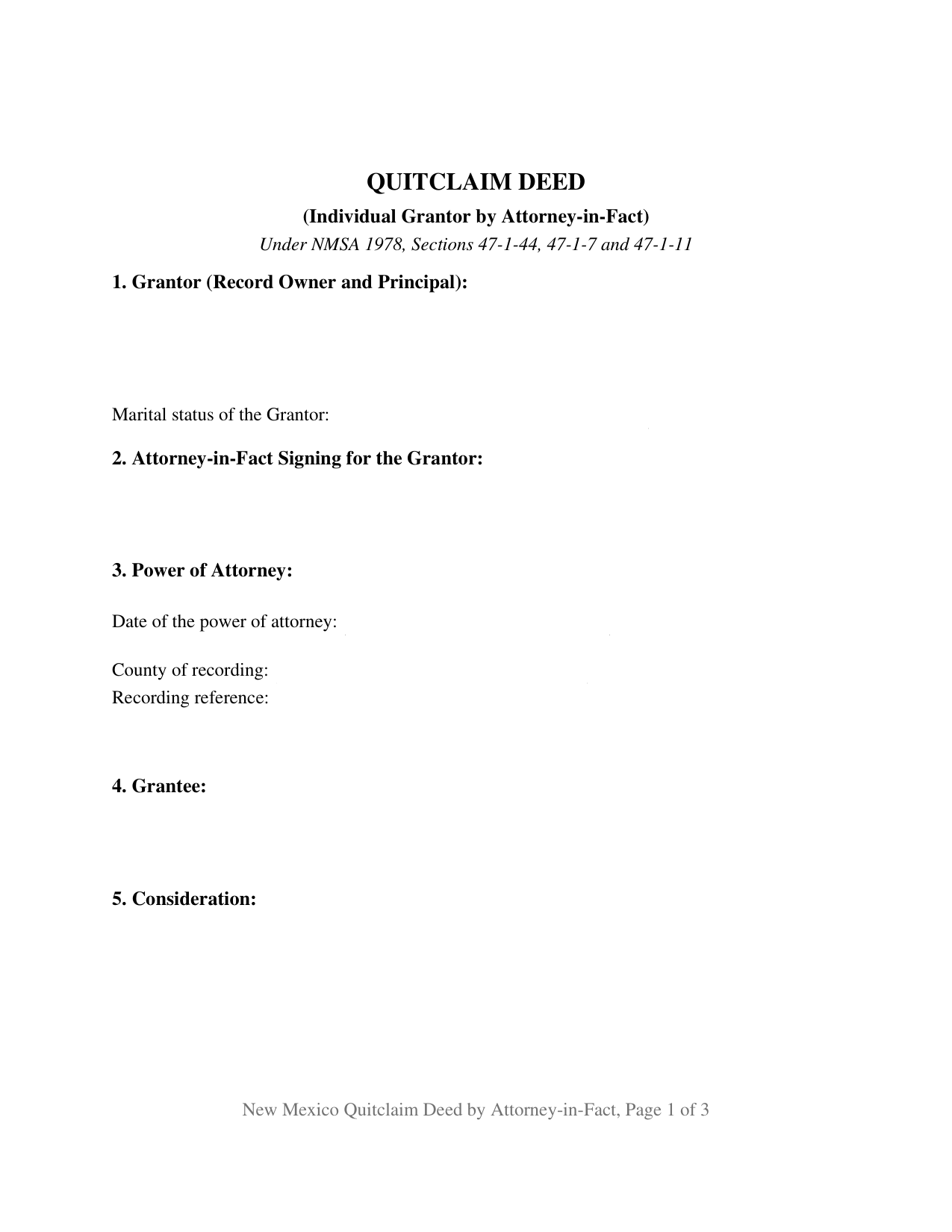
About the New Mexico Quitclaim Deed (Individual Grantor by Attorney-in-Fact)
How to Use This Form
- Select your county from the list
- Download the county-specific form
- Fill in the required information
- Have the document notarized if required
- Record with your county recorder's office
What Others Like You Are Saying
"It would be helpful to have a frequently asked questions section. That would make it easier to know …"
"No fuss-No muss. Very easy!"
"I like using Deeds.com for all of our out-of-state deeds because they make the process almost comple…"
"Using the Gift Deed form from Deeds.com, along with the example and instructions thy provided, saved…"
"It was easy to complete the deed but on the third page I only need one signature in stead of 3 I nee…"
4.8/5 from 4,836 reviews. Read all
The owner's name sits in the granting language; the owner's signature sits nowhere on the page. On this New Mexico quitclaim deed the signer is an attorney-in-fact acting for the individual who holds the record title, and NMSA 1978, Section 47-1-11 gives that signature the same force and effect as though the owner had subscribed the deed. The form is the statutory quitclaim deed of Section 47-1-44, arranged for one principal and one agent.
The authority is a second recorded instrument
Many states leave a power of attorney in a drawer; New Mexico puts it in the land records. Section 47-1-7 provides that a power of attorney containing authority to convey real estate is acknowledged, certified, filed and recorded in the manner other writings affecting real estate are acknowledged, and that a revocation does not operate as one until the revoking instrument is itself acknowledged and recorded in the same county office. Section 3 of this deed identifies that document by date, county of recording, and recording reference. The power of attorney is recorded separately and is not part of this package.
What a general grant of real property authority carries
Authority is read from the power of attorney, never from the deed. Under the Uniform Power of Attorney Act, Section 45-5B-204 describes what general authority with respect to real property reaches, and its list of authorized acts names quitclaiming beside selling, exchanging, conveying with or without covenants, and encumbering. Section 45-5B-201 pulls eight acts back out of general language, among them making a gift, creating or changing rights of survivorship, and changing a beneficiary designation, each reaching an agent only through an express grant; and an agent who is not the principal's ancestor, spouse or descendant has no authority to create an interest in the principal's property in that agent.
One principal, one agent, one certificate
The form takes one individual grantor, described as the record owner and principal, with a marital status entry, and one attorney-in-fact with a mailing address. One signature line follows under the heading GRANTOR, BY ATTORNEY-IN-FACT, and the deed closes with a single acknowledgment certificate worded to the representative-capacity short form of Section 14-14A-15, whose blank after the date holds the individual who appeared, that individual's capacity, and the person for whom the signature was made. An owner who has moved to an out-of-state care facility, an owner abroad whose agent finishes a pending sale, and an agent releasing an interest under a power drawn for one closing present the one-principal pattern this deed carries. Two record owners signing together, an entity grantor, and a conservator acting under a court order present configurations it does not carry.
Community property runs through the same recorded power
Section 40-3-13(A) voids a transfer of community real property attempted by one spouse alone, and Subsection B leaves that transfer open where a spouse acts under a validly executed and recorded power of attorney as provided in Section 47-1-7, the same recording step described above. Because this form names a single grantor and a single power, real estate spouses hold together answers to authority reaching both interests; the guide traces the joinder statute and its presumptions.
No covenants, and a flat fee at the clerk's window
Implied covenants of title reach a New Mexico deed only through two defined phrases, which Sections 47-1-37 and 47-1-38 give their meaning. This instrument uses neither, says so in capital letters, and passes the interest the grantor holds at delivery, with recorded liens and easements riding along. The acknowledged original is presented to the clerk of the county where the land lies, at the Section 14-8-15 fee of twenty five dollars where index entries number ten or fewer; acknowledgment is the only statutory condition of recording. New Mexico levies neither a transfer tax nor a documentary stamp. A parcel classified residential adds one companion filing: a confidential declaration of the transfer terms, due to the county assessor within thirty days.
What the package includes
The package delivers this attorney-in-fact configuration as a fillable PDF, with a completed example for an Otero County lot and a plain-language guide covering each numbered section, the authority statutes behind the signature block, the vesting forms open to grantees, and the recording steps. Buyers reach it searching for a quit claim deed or quick claim deed signed under a power of attorney; the statutes spell it quitclaim. This is general information, not legal advice; a New Mexico attorney can read a power of attorney against a title.
Important: County-Specific Forms
Our quitclaim deed (individual grantor by attorney-in-fact) forms are specifically formatted for each of the 33 counties in New Mexico.
After selecting your county, you'll receive forms that meet all local recording requirements, ensuring your documents will be accepted without delays or rejection fees.