New Mexico Quitclaim Deed
County Specific Legal Forms Validated as recently as October 21, 2026 by our Forms Development Team
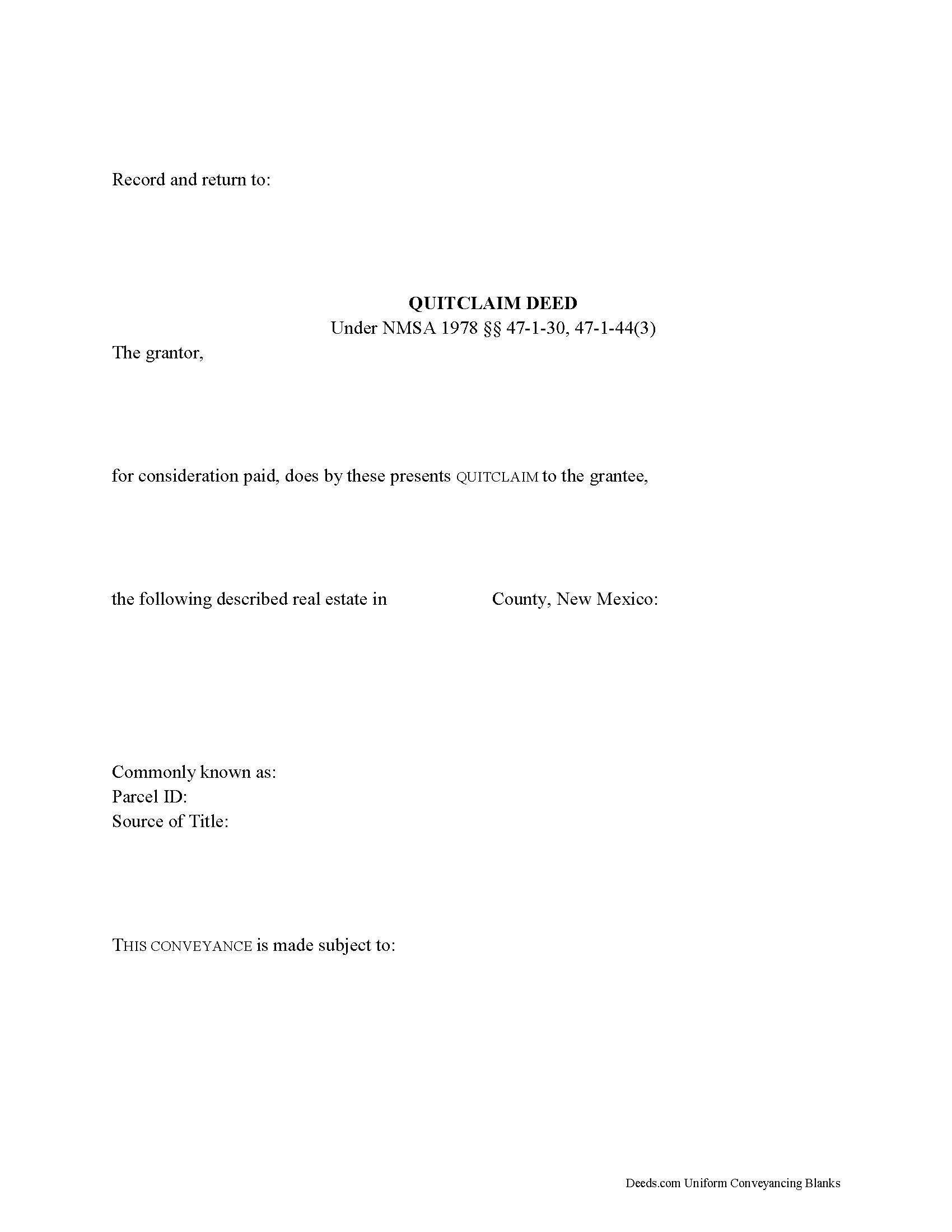
About the New Mexico Quitclaim Deed
How to Use This Form
- Select your county from the list
- Download the county-specific form
- Fill in the required information
- Have the document notarized if required
- Record with your county recorder's office
What Others Like You Are Saying
"Fast and easy to use. Great update communications"
"Really solid system for determining what may prevent your documents from being accepted. I love the …"
"Website is very informative and user friendly!"
"great service, quick and easy!"
"Thanks for such great service!"
4.8/5 from 4,833 reviews. Read all
New Mexico's quitclaim deed is one sentence long in the statute book. The legislature printed it at NMSA 1978, Section 47-1-44(3) in 1947 and left it there: the grantor, for consideration paid, quitclaims to the grantee, whose address is stated, the described real estate in the named county. Section 47-1-30 supplies the force behind that sentence, giving a deed that follows the form the effect of a fee simple conveyance of whatever interest the grantor owns, without warranty. This form is that sentence, opened out into numbered blanks.
What the statutory form leaves out is the point of it
Two defined phrases carry every implied covenant of title in this state. Section 47-1-37 attaches the full package to the words warranty covenants, Section 47-1-38 a narrower one to special warranty covenants. The quitclaim form prints neither, and that silence is the disclaimer: nothing is promised about the condition of the title, and no words of exclusion are needed to withhold a promise. Section 11 prints the posture in capital letters even so, naming both statutes. Recorded mortgages, judgments, easements, and mineral reservations pass through untouched.
One or two grantors, one or two grantees
The party entries are open four line blocks rather than fixed name lines, and nothing about marital status, capacity, or form of ownership is preprinted anywhere on the instrument. Four count patterns fit: one grantor to one grantee, one to two, two to one, and two to two. Two signature blocks follow, headed GRANTOR and SECOND GRANTOR (if applicable), each closing with its own certificate in the officer neutral short form wording of Section 14-14A-15, so signers appearing on different days or in different states are accommodated. Where a single grantor conveys, the second block and its certificate stay blank. Those four counts are what this base configuration recites; a grantor signing through a company office, a trusteeship, or a power of attorney, and three or more owners on either side, are configurations it is not set up as.
The grantee blank is where ownership form is decided
Because nothing is preprinted, the words that fix co-ownership are typed into the grantee entry. Section 47-1-15 leaves two or more grantees as tenants in common by default, Section 47-1-36 demands an express declaration before a joint tenancy exists, and Section 47-1-16 makes that recital conclusive in favor of purchasers and encumbrancers for value. Spousal title runs on a second track, where Swink v. Fingado holds one parcel can be community property and joint tenancy property at once. Tenancy by the entirety has no existence here. The guide lays out each recognized form and the words that create it.
The signature the Community Property Act counts
Marriage, rather than the name carried on the record, characterizes land here. Section 40-3-12(A) attaches a community presumption to whatever was acquired while married, and a sole name vesting displaces it only as a matter of rebuttable proof. Section 40-3-13(A) then directs both spouses to join in a transfer of community real property, extends the same demand to separate real property they hold as cotenants, and calls a one spouse attempt void and of no effect. Both signatures land in the two grantor entries and the two signature blocks when that rule reaches a transfer, and the guide traces the narrow openings the statute leaves.
Twenty five dollars, and a filing that goes somewhere else
Section 14-8-15 fixes one fee for the whole state: twenty five dollars for a document carrying ten or fewer index entries, plus twenty five for each further block of ten. Indexed names and separate description units both count, so a multi lot description can reach a second block. Nothing else is collected, there being no transfer tax and no documentary stamp here, and no surveyed clerk asks for a cover sheet. Format lives in county practice rather than statute, and this form is drawn inside the strictest published county figures in the state.
The download prepares this base configuration as a fillable PDF, a completed example filled in for a Santa Fe County lot moving from two grantors to two grantees under an express survivorship declaration, and a plain language guide covering the statutory framework, every numbered section, the joinder analysis, the ownership forms open to grantees, and recording, the residential declaration the county assessor holds included. Buyers reach it typing quit claim deed or quick claim deed; the New Mexico statutes spell it quitclaim. The materials are informational and are not legal advice.
Important: County-Specific Forms
Our quitclaim deed forms are specifically formatted for each of the 33 counties in New Mexico.
After selecting your county, you'll receive forms that meet all local recording requirements, ensuring your documents will be accepted without delays or rejection fees.