New Mexico Transfer on Death Deed (Sole Owner, Multiple Beneficiaries (Equal Shares))
County Specific Legal Forms Validated as recently as November 18, 2026 by our Forms Development Team
About the New Mexico Transfer on Death Deed (Sole Owner, Multiple Beneficiaries (Equal Shares))
How to Use This Form
- Select your county from the list
- Download the county-specific form
- Fill in the required information
- Have the document notarized if required
- Record with your county recorder's office
What Others Like You Are Saying
"Great, but I'd like to see the actual filings/documents in my account, PDF, not only the blank forms…"
"easy to use"
"It's convenience."
"The guide and example provided made it so easy to complete the form. All was in order when I took it…"
"I used your TOD document to deed my home to my daughter. Your sample document was very helpful. I ha…"
4.8/5 from 4,860 reviews. Read all
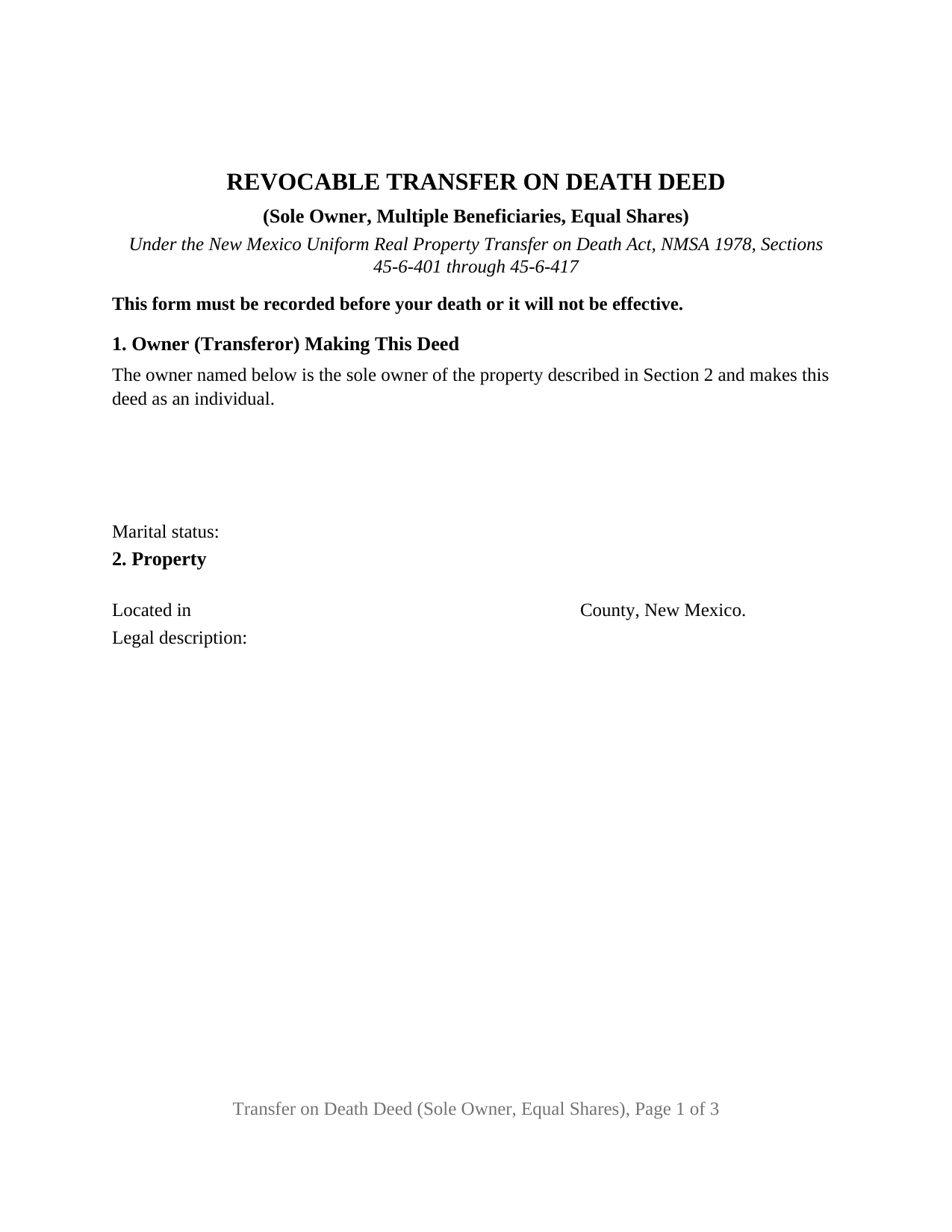
One New Mexico owner, several people to take the property at death, and an even split among them: that is the arrangement this New Mexico transfer on death deed recites. The owner who signs it is the sole owner of the property, the beneficiaries named in it take in equal and undivided shares with no right of survivorship among them, and nothing passes until the owner dies. The deed is prepared under the New Mexico Uniform Real Property Transfer on Death Act, NMSA 1978, Sections 45-6-401 through 45-6-417, the chapter that governs every TOD deed, sometimes called a beneficiary deed, recorded in the state.
Equal shares, and what happens to a share that lapses
Section 45-6-413 supplies the rules that operate at the owner's death unless the deed says otherwise. Where two or more beneficiaries take concurrent interests, the chapter transfers those interests in equal and undivided shares with no right of survivorship, and the share of a beneficiary who does not survive the owner, or whose share fails for any other reason, passes to the other designated beneficiaries in proportion to their interests. This deed prints that arrangement as fixed text in its beneficiary section rather than leaving it to a blank: three beneficiaries named in Section 5 take undivided thirds, and if one of them dies first the two survivors take undivided halves. Because the shares carry no survivorship among the beneficiaries, each beneficiary's undivided share, once received, passes under that beneficiary's own estate plan. Survival itself is measured under Section 45-2-702, which deems an individual not established by clear and convincing evidence to have survived the owner by one hundred twenty hours to have predeceased.
An optional alternate for the case where no primary beneficiary survives
The optional statutory form at Section 45-6-416 designates an alternate beneficiary to take if the primary beneficiary does not survive the owner. With several primary beneficiaries, a lapsed share goes first to the remaining primaries under the chapter's own rule, so this deed's alternate section operates only where no primary beneficiary survives, and any alternates named in it take in the same equal and undivided shares. The section is optional; where it is left unused, the entry None designated records that it was considered.
A deed that changes nothing until death
During the owner's life a New Mexico transfer on death deed creates no legal or equitable interest in the beneficiaries, does not affect the owner's right to sell, mortgage, or lease the property, does not affect the owner's creditors, and does not affect eligibility for public assistance (Section 45-6-412). The owner's capacity to make it is the capacity to make a will (Section 45-6-408), and the deed needs no consideration and no notice to or acceptance by the beneficiaries (Section 45-6-410). It remains revocable for the owner's entire life even if it says otherwise (Section 45-6-406), and revocation takes a recorded instrument acknowledged after the deed and recorded before death: a later transfer on death deed, an instrument of revocation, or a lifetime deed that expressly revokes it (Section 45-6-411). A will does not revoke a recorded transfer on death deed. The revocation instrument is a separate document, recorded on its own, and is not included in this package.
Recording before death is the condition that gives the deed effect
Section 45-6-409 requires the deed to carry the essential elements and formalities of a properly recordable inter vivos deed, to state that the transfer occurs at the owner's death, and to be recorded before the owner's death with the county clerk of the county where the property is located. An unrecorded deed, however carefully signed and acknowledged, transfers nothing, which is why the form carries the statutory form's own notice under its title: the form must be recorded before the owner's death or it will not be effective. New Mexico makes acknowledgment the gate to recording under Section 14-8-4, so the deed carries one acknowledgment certificate in the short form of the Revised Uniform Law on Notarial Acts, Section 14-14A-15, with lines for the notary's commission number and expiration that Section 14-14A-14 makes certificate content. The recording fee is a flat twenty-five dollars per document for up to ten index entries under Section 14-8-15, and New Mexico imposes no transfer tax on a deed.
What the sole-owner configuration carries
The form recites exactly one owner, identified in Section 1 as the sole owner of the described property and signing as an individual, with the owner's name, mailing address, and marital status as factual entries. It carries one signature block, one acknowledgment certificate, and no second owner block of any kind. Its beneficiary section recites two or more primary beneficiaries, who may be natural persons, trusts, or entities under the chapter's definition of a person, taking in equal and undivided shares with no right of survivorship, and it carries no blank or selection control for unequal shares, successive interests, or survivorship among the beneficiaries. A widowed parent naming three adult children, a single owner naming two siblings, and an unmarried owner naming a partner and a niece in equal thirds present the pattern this deed recites. The form is not set up as a deed by two record owners, a deed of community property signed by both spouses, a joint tenant's deed, a deed signed by a trustee or attorney-in-fact, or a deed that names a single beneficiary or divides the property unevenly. Because New Mexico is a community property state, the guide describes how Sections 40-3-8, 40-3-12, and 40-3-13 bear on a married owner whose name alone appears on the title, and the marital status entry is where that question comes into view.
The deed is built for New Mexico recording practice: letter size, 12 point type, a 1.5 inch top margin on the first page with a clear block for the clerk's recording label, and 1 inch margins elsewhere, with the legal description, property address, source of title, and beneficiary entries sized for realistic content and an exhibit convention for anything longer. The package includes the fillable transfer on death deed form, a completed example filled in for a Bernalillo County fact pattern, and the guide that walks through every numbered section, the signing and notarization rules, the recording process, and the residential transfer declaration affidavit the assessor may ask about. This description and the guide describe the form and the governing statutes in general terms; they are not legal advice.
Important: County-Specific Forms
Our transfer on death deed (sole owner, multiple beneficiaries (equal shares)) forms are specifically formatted for each of the 33 counties in New Mexico.
After selecting your county, you'll receive forms that meet all local recording requirements, ensuring your documents will be accepted without delays or rejection fees.