New Mexico Transfer on Death Deed (Sole Owner, Primary and Alternate Beneficiary)
County Specific Legal Forms Validated as recently as November 18, 2026 by our Forms Development Team
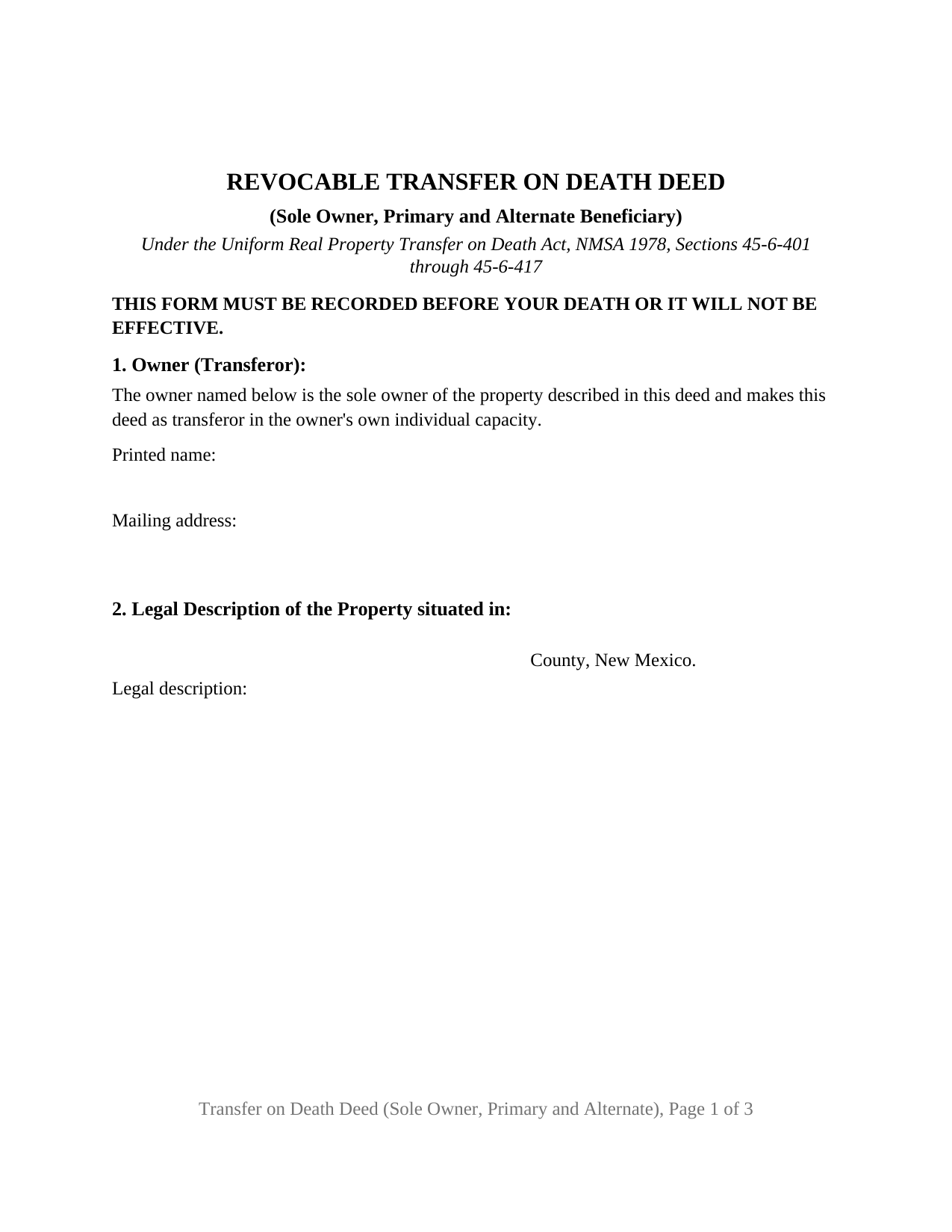
About the New Mexico Transfer on Death Deed (Sole Owner, Primary and Alternate Beneficiary)
How to Use This Form
- Select your county from the list
- Download the county-specific form
- Fill in the required information
- Have the document notarized if required
- Record with your county recorder's office
What Others Like You Are Saying
"Great. Thank you. Received information quickly. Helped out a lot."
"This was the easiest web page ive ever navigated .Found just what i needed fast !"
"Received the quit claim form as ordered. Seemed clear and concise, easy to follow instructions and t…"
"EasyPeasy!"
"Very fast and smooth process, thank you for your quick answers and follow up."
4.8/5 from 4,860 reviews. Read all
A New Mexico transfer on death deed with a second name standing behind the first. This fillable form is drawn for one owner who holds New Mexico real property alone and designates one primary beneficiary, with one alternate beneficiary who takes only if the primary beneficiary does not survive the owner. The two-tier designation is the one the optional statutory form at NMSA 1978, Section 45-6-416 prints, and this deed carries both of its designation sentences word for word under Sections 45-6-401 through 45-6-417, the Uniform Real Property Transfer on Death Act. Buyers searching for a New Mexico TOD deed or beneficiary deed with a backup beneficiary will find that configuration, and only that configuration, on this instrument.
Why the alternate changes what happens at death
Under Section 45-6-413(A) the interest of a designated beneficiary who fails to survive the transferor lapses. On a deed naming a single beneficiary with nobody behind that person, a lapse leaves the deed with nothing to transfer. The alternate designation is the deed's own answer, and the act expressly leaves room for it: Section 45-6-413(A) opens with the words except as otherwise provided in the transfer on death deed. Section 6 of this form provides otherwise in the statute's own sentence, if my primary beneficiary does not survive me, I designate the following alternate beneficiary if that beneficiary survives me. At the owner's death the deed therefore runs one of three ways: the primary beneficiary survives and takes the owner's interest; the primary beneficiary does not survive, the alternate does, and the alternate takes; or neither survives and no designated beneficiary takes under the deed. Survival has a statutory measure. Section 45-6-413(A) is subject to Section 45-2-702, under which an individual not established by clear and convincing evidence to have survived the owner by one hundred twenty hours is deemed to have predeceased the owner, and the guide sets out that rule, its exceptions, and the other construction sections the act lists beside the deed's own words.
One owner, one signature, nothing moves until death
The deed recites, as fixed text, that the owner named in Section 1 is the sole owner of the described property and makes the deed as transferor in the owner's own individual capacity. One signature block under the heading OWNER follows the operative section, and one acknowledgment certificate in the New Mexico statutory short form of Section 14-14A-15(A), This record was acknowledged before me on, carries the commission number and expiration lines that Section 14-14A-14 makes certificate content. No witness signs a New Mexico deed; acknowledgment before a notarial officer is the statutory gate to recording under Section 14-8-4, and an instrument that is not duly acknowledged may not be recorded. While the owner lives the recorded deed changes nothing: Section 45-6-412 leaves the owner free to sell, mortgage, lease, or give away the property, and Section 45-6-406 keeps the deed revocable whatever it says. Revocation is by recorded instrument only under Section 45-6-411, acknowledged after the deed being revoked and recorded before the owner's death; a will does not revoke a recorded transfer on death deed.
Recorded before death, in the county where the land lies
Section 45-6-409 makes recording before the transferor's death, with the county clerk of the county where the property is located, a condition of the deed's effect, and the form prints the statutory form's own warning under its title so the condition is never buried. The recording itself is an ordinary New Mexico deed recording: the fee is the statewide flat twenty-five dollars per document under Section 14-8-15, with a further twenty-five dollars for each additional block of ten or fewer index entries, and New Mexico levies no deed transfer tax, documentary stamp tax, or mortgage recording tax. No statute sets page size, margins, or type size; the form reserves the top of its first page for the clerk's recording label and renders at twelve point type, and the guide notes the two counties whose published margin figures exceed what the later pages carry. At the owner's death the beneficiary takes the interest the owner could then transfer, subject to every recorded mortgage, lien, and other interest affecting the property at that moment, without covenant or warranty of title, the rule Section 45-6-413(B) and (D) state and the deed repeats on its face.
The primary-and-alternate configuration
Section 5 takes exactly one primary beneficiary and Section 6 exactly one alternate beneficiary, each by printed name and mailing address, the captions the statutory form itself prints. The act's definition of person in Section 45-6-402 admits an individual, a trust, or a private or public entity in either place, so the deed accommodates a child named first with a grandchild behind, a partner named first with a sibling behind, or a trust named first with an individual behind. An owner naming one adult child with that child's own child as the backup, and an owner naming a partner with a relative standing second, present the primary-and-alternate pattern this deed recites. The form is not set up as a deed with two or more primary beneficiaries sharing the property, a chain of successive alternates, or a designation with no alternate; each of those carries different designation text. On the owner side the deed fixes a sole owner signing in an individual capacity and fixes no marital status. New Mexico community property is held by both spouses in undivided one-half interests and is presumed from acquisition during marriage whatever name is on the deed, so a married owner's community property sits outside the sole-owner recital; the guide walks through Sections 40-3-8, 40-3-12, and 40-3-13 on that point. Two owners on one deed, a joint tenant or tenant in common, an entity or trustee as transferor, and an agent signing under a power of attorney are configurations the form is not set up as.
What arrives in the download
The download delivers three files: the fillable transfer on death deed, behind a non-recorded instructions cover page; a completed example filled in for a Santa Fe County fact pattern, a mother naming her son as primary beneficiary and her granddaughter as the alternate; and the guide, which explains every numbered section, the acknowledgment certificate, the recording fee and the assessor's transfer declaration affidavit, and what the deed does not do. This description and the guide are general information about the form and the New Mexico statutes behind it, not legal advice.
Important: County-Specific Forms
Our transfer on death deed (sole owner, primary and alternate beneficiary) forms are specifically formatted for each of the 33 counties in New Mexico.
After selecting your county, you'll receive forms that meet all local recording requirements, ensuring your documents will be accepted without delays or rejection fees.