New Mexico Transfer on Death Deed (Sole Owner, Trust Beneficiary)
County Specific Legal Forms Validated as recently as November 18, 2026 by our Forms Development Team
About the New Mexico Transfer on Death Deed (Sole Owner, Trust Beneficiary)
How to Use This Form
- Select your county from the list
- Download the county-specific form
- Fill in the required information
- Have the document notarized if required
- Record with your county recorder's office
What Others Like You Are Saying
"Lots of Info. Forms seem straightforward. Easy to Fill out."
"it worked. fantastic. thanks!"
"was good choice for me but did not realize notary had to witness all 3 signatures at the same luckil…"
"I will be going through title, so didn't order deed, but I think your website is wonderful. It's gre…"
"I had trouble at first printing out the forms but once I figured out what to do, all went well. Than…"
4.8/5 from 4,860 reviews. Read all
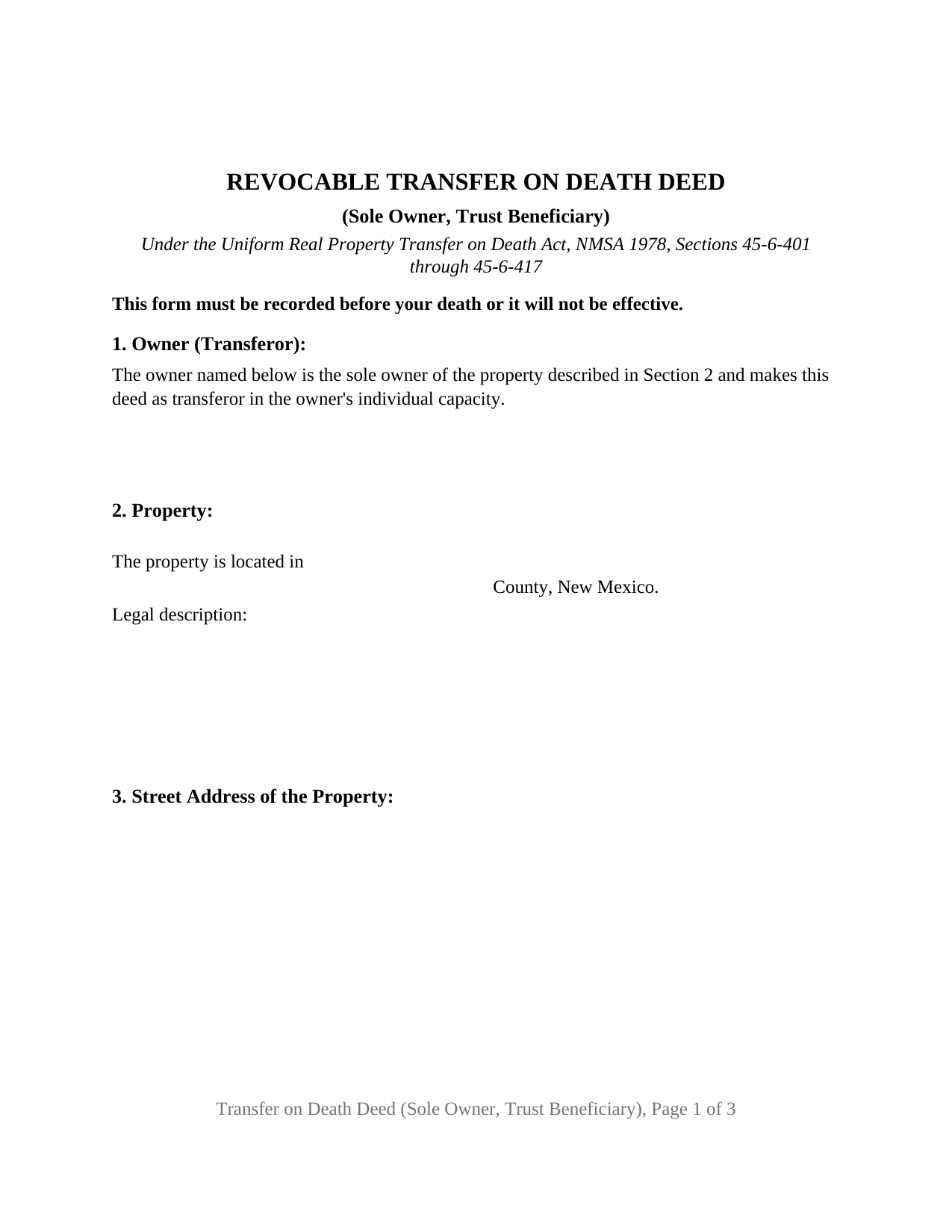
A trust as the beneficiary of a New Mexico transfer on death deed: that is the whole design of this form. It is drawn for an owner who holds real property alone and already has a trust, usually a revocable living trust, that is meant to receive the property when the owner dies. Rather than deeding the property into the trust now, the owner records this deed, keeps full ownership for life, and at death the property passes to the trustee of that trust to be held under the trust instrument, with no probate in between. The deed is made under the Uniform Real Property Transfer on Death Act, NMSA 1978, Sections 45-6-401 through 45-6-417, and it carries one signature block and one acknowledgment certificate.
A trust can be the beneficiary
New Mexico's act defines a designated beneficiary as a person designated in the deed to receive property, and its definition of a person reaches a trust, an estate, a corporation, a limited liability company, and other entities as well as an individual (Section 45-6-402(B) and (E)). The deed names the trust by three identifiers that New Mexico title practice uses for property held in trust: the name of the trust, the date of its trust instrument, and its trustee, with the trustee's mailing address. The fixed deed text then provides that at the owner's death title passes to the trustee of that trust then serving, including any successor trustee, to be held under the terms of the trust instrument. The trust instrument, not the deed, decides what happens after that. The trustee does not sign, because Section 45-6-410 makes the deed effective without notice or delivery to, or acceptance by, the beneficiary during the owner's life.
An alternative to deeding the house into the trust
A lifetime deed into a trust moves title to the trustee today. A transfer on death deed to the same trust moves nothing today: under Section 45-6-412 the recorded deed does not affect the owner's right to sell, mortgage, or lease the property, does not affect the owner's creditors, and gives the trust and its trustee no interest. The owner may revoke the deed at any time, and Section 45-6-406 keeps it revocable whatever it says. The two paths are alternatives, not companions, because Section 45-6-413 reaches only property the transferor owns at death, and property already titled in a trustee is no longer owned by the owner individually.
Recorded before death, in the county where the land lies
The act's one condition that outweighs the rest is recording. Under Section 45-6-409(C), a transfer on death deed is effective only if it has been placed of record, during the owner's lifetime, with the county clerk of the county in which the property lies; the optional statutory form at Section 45-6-416 opens with a sentence to that effect, which this deed carries word for word under its title. The recording itself follows New Mexico's ordinary deed rules: Section 14-8-4 admits only a duly acknowledged instrument to the record, Section 14-8-15 fixes the clerk's fee at twenty-five dollars for a document with up to ten index entries, and no deed transfer tax exists in New Mexico. The deed's acknowledgment certificate is the New Mexico short form of Section 14-14A-15(A), with the commission number and expiration lines that Section 14-14A-14 makes certificate content.
Sole owner, trust beneficiary: what the configuration recites
The form prints its configuration as fixed deed text rather than leaving it to blanks. Section 1 recites that the owner is the sole owner of the property and makes the deed as transferor in the owner's individual capacity; the owner's name and mailing address are the only entries, and no signature line exists for a spouse or a co-owner. Section 5 opens with the statutory form's designation sentence and fixes the designated beneficiary as the trust identified in its four entries; the section closes with the statement that no alternate beneficiary is designated. Section 6 carries the statutory transfer and revocation sentences as the statute prints them, together with the rule of Section 45-6-413(D) that the deed transfers the property without covenant or warranty of title.
The ownership patterns that present this recital are an owner who took title alone and has never married, a widowed or divorced owner who holds the whole title of record, and a married owner whose property is separate property within Section 40-3-8(A): property acquired before the marriage, received by gift or inheritance, or designated as separate property by a written agreement between the spouses or a deed designation under Section 40-3-8(A)(5). Property acquired during a New Mexico marriage is presumed community property under Sections 40-3-8(B) and 40-3-12(A), each spouse holding an undivided one-half of it, and Section 40-3-13(A) voids a transfer of community real property by one spouse alone; the guide describes those statutes and what they leave unstated about a transfer on death deed. On the beneficiary side, the form is not set up for one or more individuals, for several trusts, or for an alternate beneficiary; it names one trust. The guide describes what Section 45-6-413(A)(2) provides about a designated beneficiary that fails to survive the transferor, and notes that the act states that rule for every designated beneficiary without separately addressing a trust.
What the guide covers
The guide walks through each numbered section with the completed example's entry beside it, explains why the owner signs as an individual even when the owner is also the trustee of the trust, describes the certification of trust a trustee may furnish under Section 46A-10-1013 when dealing with the property after the owner's death, and describes the county assessor's residential transfer declaration affidavit and the exemptions Section 7-38-12.1(D) lists. It also describes revocation under Section 45-6-411, which requires a later acknowledged and recorded instrument and is never accomplished by a will or by marking the recorded deed.
The package includes the fillable transfer on death deed with its non-recorded instructions cover page, a completed example filled in for a Santa Fe County fact pattern, and the guide. This description and the guide describe the form and the governing New Mexico statutes in general terms; they are not legal advice.
Important: County-Specific Forms
Our transfer on death deed (sole owner, trust beneficiary) forms are specifically formatted for each of the 33 counties in New Mexico.
After selecting your county, you'll receive forms that meet all local recording requirements, ensuring your documents will be accepted without delays or rejection fees.