Ohio Correction Deed (Individual Grantor)
County Specific Legal Forms Validated as recently as November 3, 2026 by our Forms Development Team
About the Ohio Correction Deed (Individual Grantor)
How to Use This Form
- Select your county from the list
- Download the county-specific form
- Fill in the required information
- Have the document notarized if required
- Record with your county recorder's office
What Others Like You Are Saying
"The paperwork for our transfer on death deed was easy to fill out and the county has excepted it for…"
"Easy to use and fee is reasonable."
"Good format. Timely response. Adding a photo of the property would be a good improvement."
"I have looked and finally found a reliable source of updated legal documents that are current with l…"
"User friendly. Smooth transaction. I saved a lot of time"
4.8/5 from 4,842 reviews. Read all
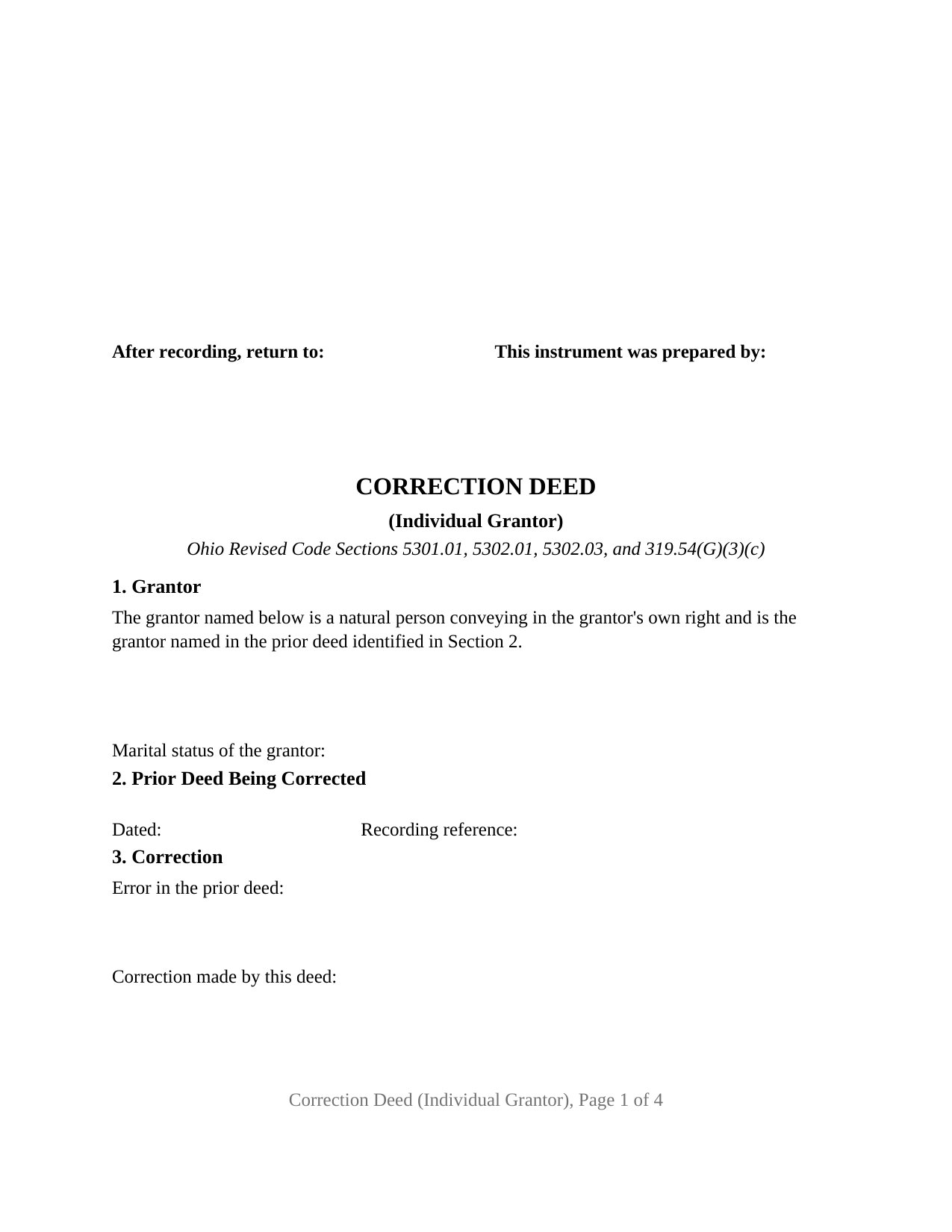
A recorded Ohio deed cannot be edited, so a misspelled grantee name or a wrong plat book page stays in the record until a new instrument replaces it. This Ohio Correction Deed (Individual Grantor) is that instrument for one natural person who signed the earlier deed as its grantor: the same grantor signs again, in the grantor's own right, re-conveying the property to the grantee with the error identified and corrected on the face of the deed.
One grantor, signing a second time
Section 1 prints the configuration as fixed text: the grantor is a natural person conveying in the grantor's own right and is the grantor named in the prior deed. Ohio county auditors review every deed before the recorder accepts it, and the Franklin County conveyance standards effective March 2, 2026 describe a corrective deed as a newly executed deed with the original grantors as grantor and the correct grantees as grantee, explaining on its first page what is corrected and citing the defective deed. The form places the prior deed's date and recording reference, the error, and the correction on recorded page one.
A married grantor's spouse signs too. Ohio dower under Revised Code Section 2103.02 gives the spouse a life interest in one third of real property the grantor owned during the marriage, so the Section 5302.11 form carries a release sentence for the spouse, and this deed carries it verbatim in Section 9 with its own signature block and acknowledgment certificate. An unmarried grantor leaves that section blank.
Correct and confirm, without a new warranty
The operative paragraph conveys and confirms. To correct the prior deed as stated and to confirm the conveyance it made, the grantor GRANTS the described property to the grantee; under Section 5302.03 the word grant is a sufficient word of conveyance and implies no covenant. Except as corrected, the prior deed remains in effect according to its terms, its covenants, if any, are neither released nor diminished, and this deed creates no covenant of title in addition to them. A grantee holding a general warranty deed with a typo keeps the warranty that deed gave; a grantee holding a quitclaim deed gains none.
No conveyance fee for a correction
Ohio charges a state conveyance fee of ten cents per hundred dollars of value on most deeds, and a county may add a permissive fee. Section 319.54(G)(3)(c) excepts a transfer made to confirm or correct a deed previously executed and recorded, and the Department of Taxation's exemption statement, form DTE 100EX, lists that reason as line 5(c). The grantee files the DTE 100EX with the county auditor, the auditor stamps the deed and endorses it under Section 317.22, and the deed then goes to the county recorder.
What this deed is and is not set up as
The form is set up for a single individual grantor correcting a deed that grantor signed, with one or more grantees named as corrected and the vesting words the prior deed carried. It is not set up as a deed from two or more original grantors, from a corporation, limited liability company, or trustee, or from an attorney in fact, each of which signs in a capacity with its own statutory acknowledgment form. It does not perform a major correction, a deed of the wrong parcel or to the wrong person, which runs from the grantee back to the grantor, and it is not the affidavit of facts relating to title under Section 5301.252, which records evidence rather than conveying; those instruments are prepared separately and are not included in this package.
Built to Ohio's recording format
The deed is letter size with the three inch blank top margin Section 317.114 reserves on the first page for the auditor's and recorder's endorsements, the statutory side, bottom, and continuation margins, and twelve point type above the ten point minimum, so it records without a format fee. It carries the preparer statement of Section 317.111, the grantee's tax mailing address and prior instrument reference of Section 319.20, and the survey statement of Section 5301.25(B), and each signature block sits on the same page as its acknowledgment certificate.
The package includes the fillable correction deed form, a completed example filled in for a Franklin County deed whose grantee's first name was misspelled, and a guide that walks through each section and the recording process. The example and the guide describe the form and the governing Ohio law in general terms; they are not legal advice.
Important: County-Specific Forms
Our correction deed (individual grantor) forms are specifically formatted for each of the 88 counties in Ohio.
After selecting your county, you'll receive forms that meet all local recording requirements, ensuring your documents will be accepted without delays or rejection fees.