Ohio Correction Deed (Married Couple as Grantors)
County Specific Legal Forms Validated as recently as October 30, 2026 by our Forms Development Team
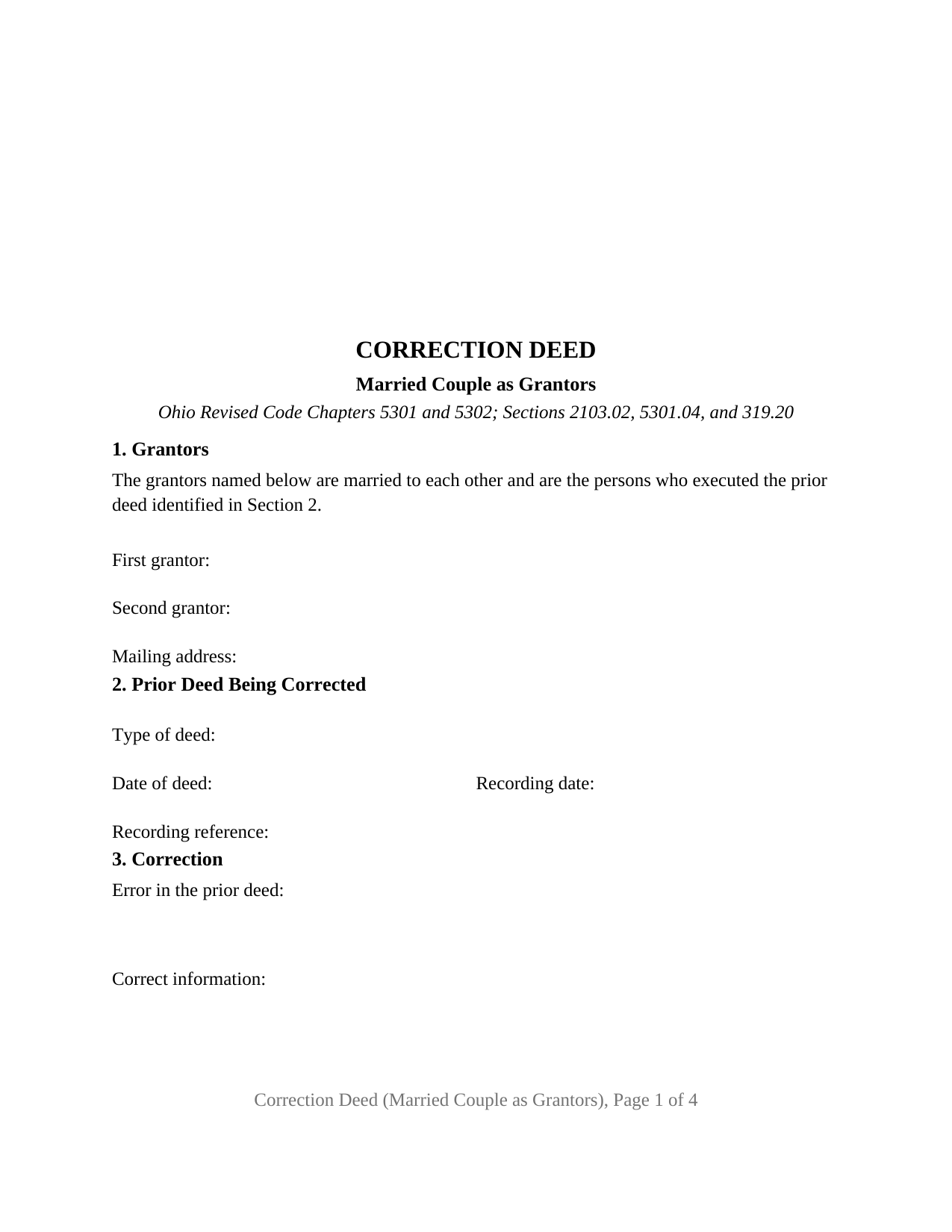
About the Ohio Correction Deed (Married Couple as Grantors)
How to Use This Form
- Select your county from the list
- Download the county-specific form
- Fill in the required information
- Have the document notarized if required
- Record with your county recorder's office
What Others Like You Are Saying
"Excellent and timely responses. Do you offer an annual rate? Thank you."
"Very helpful."
"The Quit Claim form was submitted, accepted, and processed by Davidson County with no hiccups. Recom…"
"Nice and easy"
"Your PDF form Personal Representative's Deed was exceedingly helpful."
4.8/5 from 4,837 reviews. Read all
When a recorded Ohio deed given by a married couple carries a mistake, the instrument that repairs the record is a correction deed both spouses sign again, and under Ohio law each spouse signs it in two capacities at once: as a grantor confirming the conveyance, and as the other grantor's spouse releasing dower in the property. This form prepares that instrument for exactly two grantors who are married to each other, with the marital recital fixed as deed text and a signature block and an acknowledgment certificate for each spouse.
Two grantors, one dower sentence
Ohio's dower statute, Revised Code Section 2103.02, gives a spouse a life estate in one third of the real property the other spouse owned as an estate of inheritance during the marriage unless that dower has been released or barred, and Section 5301.04 requires a deed of a married person's interest in real property to be signed and acknowledged as Section 5301.01 provides. The statutory deed forms in Chapter 5302 handle dower with one sentence in which the grantor's wife or husband releases all rights of dower therein. On a deed given by a couple together that sentence runs in both directions, so this form states it once, inside the operative section, for each grantor as the spouse of the other. Section 1 recites that the grantors are married to each other and are the persons who executed the prior deed; the recital has no blank, and the form carries no separate joinder block, because neither spouse is joining another person's conveyance.
Confirming the conveyance as corrected
Section 2 identifies the recorded deed by type, date, recording date, and recording reference, and Section 3 states the error and the correct information in two short blanks, which is the statement of changes the Ohio State Bar Association's Title Standard 3.19 looks for on the face of a corrected instrument. The operative section then grants, conveys, and confirms the property to the grantee as corrected, with the same covenants, if any, and subject to the same encumbrances, reservations, and exceptions, that the prior deed states; it ratifies the prior deed in every respect not corrected, and it states that the deed neither revokes the prior deed nor diminishes any title the prior deed conveyed. The word grant implies no covenant under Section 5302.03, so the warranty posture is the prior deed's.
Married then, both signing now
The form recites exactly two grantors, married to each other, who both executed the deed being corrected. Spouses who held title together and conveyed by one deed, and spouses of whom one held record title while the other signed the prior deed to release dower, present the pattern the deed recites; in either case both execute the correction and each releases dower as the other's spouse. The form is not set up as a single-grantor correction, a correction by former spouses whose dower ended with the divorce under Section 2103.02, or a correction by an entity, a trustee, an attorney-in-fact, or three or more grantors. The grantee side stays free-form: it receives the grantee's name as the prior deed intended it, one or two grantees, and any survivorship words the prior deed was meant to carry, so a corrected deed to survivorship grantees under Section 5302.17 and a corrected deed to a single grantee complete the same blank.
Two certificates, then the auditor
Both grantors sign, and each signing is acknowledged before an officer Section 5301.01 names, with no subscribing witnesses. The two certificates print the Section 147.55(A) short form, the foregoing instrument was acknowledged before me, with the certificate content Section 147.542(F) fixes, so the spouses may acknowledge on different dates, before different officers, or in different states. A transfer made to confirm or correct a deed previously executed and recorded is exempt from the conveyance fee under Section 319.54(G)(3)(c); the exemption is marked on form DTE 100EX at the county auditor's office, where the auditor may request an affidavit of facts, a separate instrument not included in this package, and the recorder accepts the deed only after the auditor's stamp appears under Section 317.22. The preparer statement Section 317.111 requires closes the form.
The package includes the fillable form, a completed example filled in for a Hamilton County couple, and the guide, which covers each numbered section, the grantee vesting forms, dower, the auditor step, and recording. The description and guide explain the form and Ohio law in general terms; they are not legal advice.
Important: County-Specific Forms
Our correction deed (married couple as grantors) forms are specifically formatted for each of the 88 counties in Ohio.
After selecting your county, you'll receive forms that meet all local recording requirements, ensuring your documents will be accepted without delays or rejection fees.