Oklahoma Transfer on Death Deed (Sole Owner, Primary and Alternate Beneficiary)
County Specific Legal Forms Validated as recently as November 21, 2026 by our Forms Development Team
About the Oklahoma Transfer on Death Deed (Sole Owner, Primary and Alternate Beneficiary)
How to Use This Form
- Select your county from the list
- Download the county-specific form
- Fill in the required information
- Have the document notarized if required
- Record with your county recorder's office
What Others Like You Are Saying
"Extremely easy site to use. We had our document e-recorded the same day and we didn't have to make a…"
"Thanks"
"Our notary. Marie was prompt, courteous and professional. Would definitely use again and reccomend"
"Easy to navigate Efficient Service"
"I LOVE THIS SITE KEEP UP THE GREAT WORK YOUR DOING THNKS KEVIN"
4.8/5 from 4,862 reviews. Read all
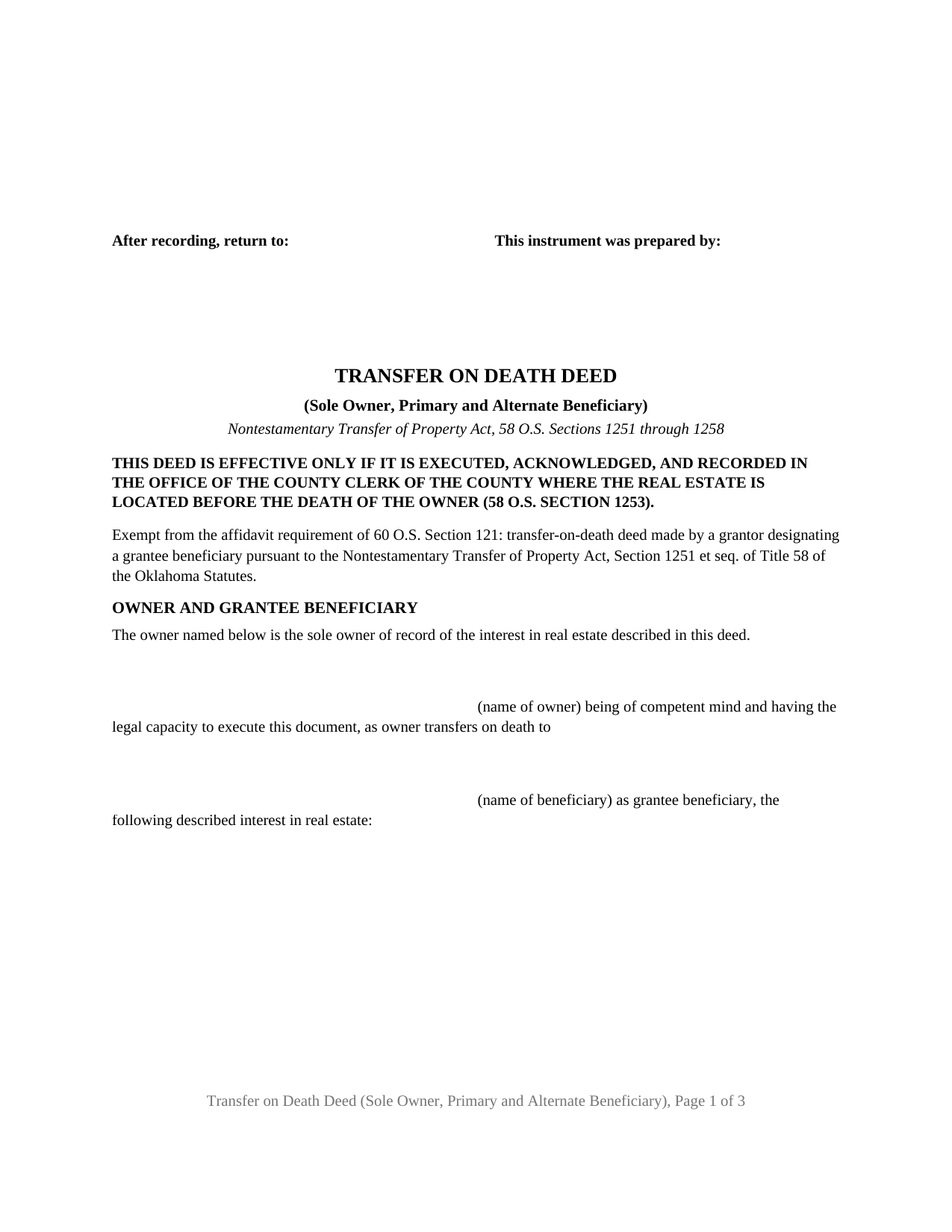
An Oklahoma transfer on death deed names who receives the owner's real estate at death, outside probate, and the Oklahoma statute has a blunt rule for a beneficiary who dies first: the transfer to that beneficiary lapses. This form prepares a transfer on death deed for one record owner, the sole owner of record, that names a grantee beneficiary and an alternate grantee beneficiary who takes the interest if the first beneficiary dies prior to the death of the owner. It follows the deed form printed in Section 1253 of Title 58 of the Oklahoma Statutes, the Nontestamentary Transfer of Property Act.
A second name for the event the statute leaves open
Section 1255(B) of Title 58 provides that if a grantee beneficiary dies prior to the death of the grantor owner, the transfer to that beneficiary lapses. The chapter supplies no substitute taker, so a deed that names one person and stops there leaves the interest to pass through the owner's estate if that person dies first. This deed adds a fixed sentence after the legal description: if the grantee beneficiary named above dies prior to the death of the owner, the owner transfers on death to the named alternate as grantee beneficiary the interest in real estate described above. The condition is the same event Section 1255(B) describes, so the alternate's designation operates exactly where the chapter would otherwise let the transfer lapse. Section 1252(A) speaks of a deed designating a grantee beneficiary or beneficiaries, and Section 1253 calls for a deed in substantially the printed form; the alternate sentence sits inside that latitude, with the primary designation printed in the statute's own words.
The sentence answers that one event and no other. An alternate who also dies before the owner, a beneficiary who survives but never records the acceptance affidavit, and deaths at nearly the same time are situations the deed does not address; the guide describes what the chapter says and does not say about each.
One owner, the sole owner of record
The form recites that the owner named in it is the sole owner of record of the interest the deed describes, and it carries one owner signature line. Section 1252(A) requires a deed signed by the record owner of the interest, and the sole-owner recital states the configuration this deed is built for: a single person holding the whole record title, naming one beneficiary and one alternate. A person who holds title together with another owner, an entity or trustee owner, an owner signing through an attorney-in-fact, and a deed naming two or more concurrent beneficiaries all present a different signer, recital, or vesting rule from the ones printed here, and this form is not set up as any of them. A married owner's homestead raises a separate question under Section 4 of Title 16, which the guide describes beside the chapter's own statements that the owner remains the absolute owner during life and that the deed is nontestamentary.
The statutory form, printed as the statute prints it
Oklahoma is one of the states whose transfer on death deed statute prints the deed itself. The operative sentence of the Section 1253 form appears on this deed word for word, with the owner's name and the beneficiary's name as its two blanks: the owner, being of competent mind and having the legal capacity to execute this document, as owner transfers on death to the named grantee beneficiary the described interest in real estate. The statute's legal description instruction, its warning in capital letters that the deed is revocable and transfers no ownership until the owner's death, and its certificate all follow. The certificate is the unusual part. The Section 1253 form places the owner's signature line and two witness signature lines inside the notarial certificate, between a paragraph reciting that the owner and the witnesses appeared before the officer and declared the deed to be a revocable transfer on death, and a closing sentence that the owner and the witnesses subscribed and acknowledged the deed before the officer. This deed prints that certificate as the statute prints it, with THE STATE OF OKLAHOMA as its venue line, and Section 118(B)(2) of Title 49 makes a certificate in a form prescribed by Oklahoma law sufficient.
Recorded before death, accepted after
Recording is what makes the deed effective. Section 1253 titles an interest in transfer-on-death form by executing, acknowledging, and recording the deed in the office of the county clerk of the county where the real estate is located before the owner's death; the deed prints that condition in capital letters under its title. The deed also states on its face the exemption from the land-ownership affidavit of Section 121 of Title 60, which otherwise accompanies a deed recorded in Oklahoma, since that section lists a transfer on death deed among the deeds that need no affidavit. The page geometry follows Section 298 of Title 19: a two inch top margin on every page and one inch elsewhere, on letter size paper.
After the owner's death, the chapter requires one more recorded instrument. Under Section 1252(E), the beneficiary who takes, whether the first beneficiary or the alternate, records an affidavit of acceptance with a copy of the death certificate within nine months of the owner's death, and the interest otherwise reverts to the estate. That affidavit is prepared and recorded separately and is not included in this package. Revocation is likewise a separate recorded instrument under Section 1254, or a later transfer on death deed; a will does not revoke a recorded TOD deed.
What the package includes
The package includes the fillable form, a completed example filled in for a realistic Oklahoma County fact pattern with an owner, a grantee beneficiary, an alternate, two witnesses, and a completed certificate, and the guide that walks through every part of the deed, the statutes behind it, the signing structure, and the recording steps. Oklahoma practice also calls this instrument a beneficiary deed or a TOD deed. This description and the guide describe the form and the governing statutes in general terms; they are not legal advice.
Important: County-Specific Forms
Our transfer on death deed (sole owner, primary and alternate beneficiary) forms are specifically formatted for each of the 77 counties in Oklahoma.
After selecting your county, you'll receive forms that meet all local recording requirements, ensuring your documents will be accepted without delays or rejection fees.