Oklahoma Transfer on Death Deed (Two Joint Owners with Right of Survivorship, Last Survivor)
County Specific Legal Forms Validated as recently as November 21, 2026 by our Forms Development Team
About the Oklahoma Transfer on Death Deed (Two Joint Owners with Right of Survivorship, Last Survivor)
How to Use This Form
- Select your county from the list
- Download the county-specific form
- Fill in the required information
- Have the document notarized if required
- Record with your county recorder's office
What Others Like You Are Saying
"It was very easy to navigate and very fast response time."
"Easy and affordable. I would recommend deeds.com"
"Wow that was easy"
"Your site is simple, easy to use, and an outstanding service."
"Quick and easy!"
4.8/5 from 4,862 reviews. Read all
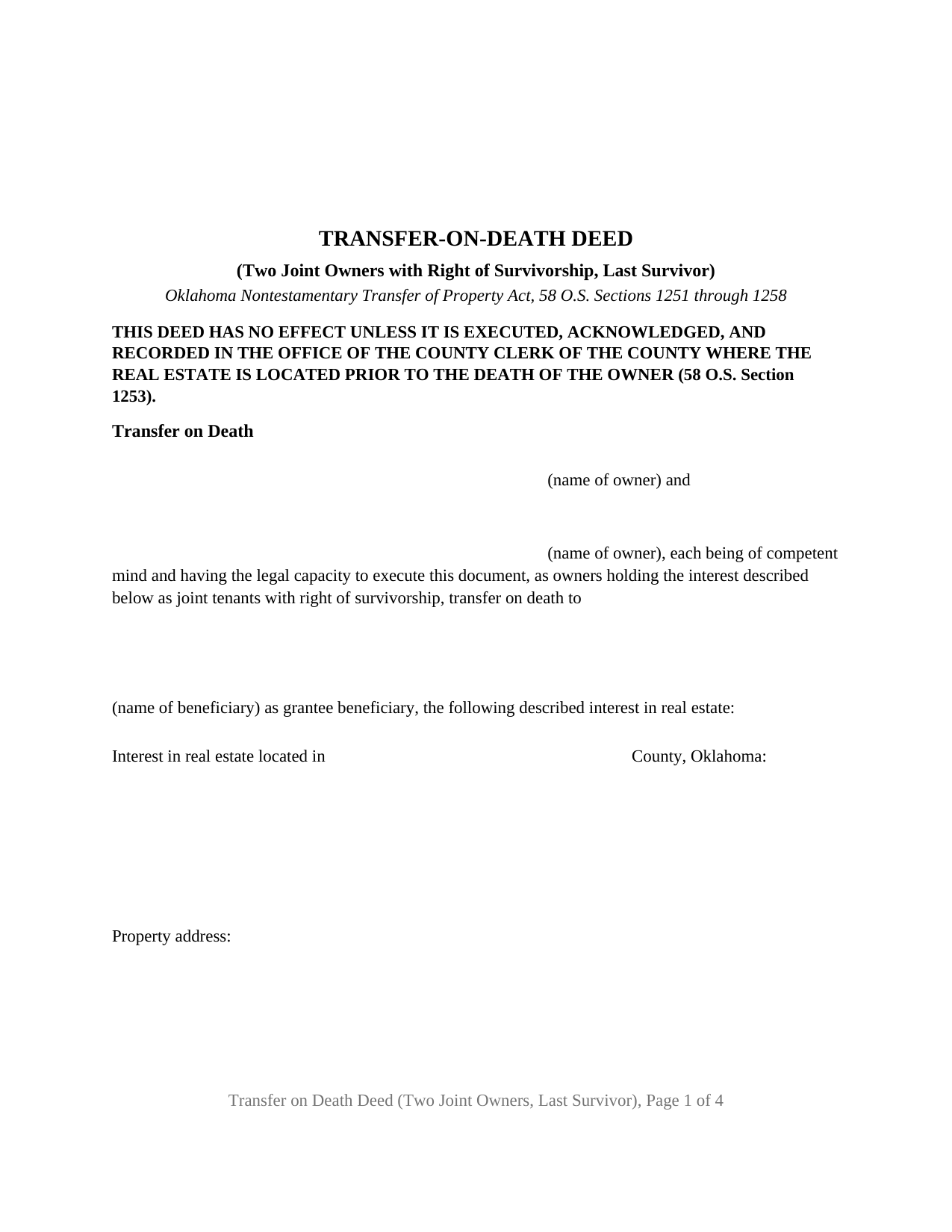
Two Oklahoma co-owners who hold title as joint tenants with right of survivorship can sign one transfer on death deed that names who takes the property after both of them have died. This fillable form prepares that deed under the Oklahoma Nontestamentary Transfer of Property Act, 58 O.S. Sections 1251 through 1258, for exactly two record joint owners, and it states on its face that the transfer takes effect at the death of the last surviving owner.
A deed that waits for the second death
The rule this configuration is built around sits in 58 O.S. Section 1256. A record joint owner may use the act to title an interest in transfer on death form, but title vests in the grantee beneficiary only if that joint owner is the last to die of all of the record joint owners, and a deed in transfer on death form does not sever the joint tenancy. A deed signed by one of two joint tenants therefore operates only if that signer happens to outlive the other. When both owners sign the same deed, whichever of them dies last is an owner who made the designation, so the deed operates at that death no matter which owner it turns out to be.
The first death changes nothing on the deed. The surviving owner takes the whole interest under the joint tenancy, exactly as the vesting deed provides under 60 O.S. Section 74, and the recorded transfer on death deed stays of record as the survivor's own designation. The survivor remains the legal and equitable owner for life (Section 1257), free to sell, mortgage, lease, revoke the designation by a recorded instrument, or replace it with a later transfer on death deed under Section 1254. A will cannot revoke it. At the second death the named grantee beneficiary takes the interest, subject to the mortgages, liens, and other recorded interests then affecting it (Section 1255), outside probate.
What both owners sign
The form recites exactly two record owners holding the described interest as joint tenants with right of survivorship. The operative sentence of the statutory form in 58 O.S. Section 1253 is carried with two owner name blanks, each followed by the statute's caption, and restated in the plural: each owner, being of competent mind and having the legal capacity to execute the document, as owners holding the interest as joint tenants with right of survivorship, transfers on death to the grantee beneficiary named in the next box. A separate paragraph repeats the Section 1256 rule in the statute's words, so a title examiner reading the deed years later sees why the transfer waited for the last death and that the joint tenancy was not severed. The statutory warning follows word for word in capital letters.
Married couples who took title as joint tenants with right of survivorship and name their children, and unmarried co-owners whose vesting deed expressly declares survivorship between them, present the two-owner pattern this deed recites. The form fixes no marital status, because the Oklahoma definition of joint owner turns on the joint tenancy, not on marriage; where the two owners are spouses, both of them sign as owners, which also answers the homestead subscription rule of 16 O.S. Section 4 on a homestead parcel. A sole owner's designation, a tenancy in common, and a title held by three or more joint owners follow different patterns, and this form is not set up as any of them.
One Oklahoma certificate for each owner
Oklahoma's statutory form does something most states' transfer on death forms do not: it places the owner's signature inside the notary's certificate, beside the signatures of two witnesses, and has the certificate recite that the owner declared to the notary and the witnesses that the deed is a revocable transfer on death of the described real estate. This deed carries that certificate once for each owner, captioned for the first owner and the second owner, each with its own blanks for the owner, the two witnesses, the county, and the date, under the preprinted venue THE STATE OF OKLAHOMA that the statute prints. The two owners may appear together before one notary with the same two witnesses, as the completed example shows, or at different times with different witnesses, each owner's page recording that owner's own ceremony.
Recording before death, and two statements the county clerk reads
Recording is a condition of the deed's effect. Under Section 1253 the deed is executed, acknowledged, and recorded with the county clerk of the county where the real estate is located prior to the death of the owner; for this configuration that means before the death of the last surviving owner, and the usual pattern is to record promptly after signing while both owners are living. The form is built to the margins 19 O.S. Section 298(B) requires, two inches of blank space at the top of every page and one inch on the other sides, with the legal description, the indexing information, and the return mailing address Section 298(A) requires on the instrument.
Two short statements near the end of the deed address gates that apply to every Oklahoma deed at the counter. The first shows on the face of the deed the transfer on death exemption of 60 O.S. Section 121(C)(3) from the land ownership affidavit the county clerk otherwise requires as an exhibit to a deed. The second is a box for the documentary stamp tax notation under 68 O.S. Sections 3201 and 3202, since a transfer on death deed need not be supported by consideration and county clerks read a notation of the exemption claimed rather than requiring separate documentation under the Oklahoma Tax Commission's rule.
What happens after the deaths
At the first death, the surviving joint tenant's title is established of record as 60 O.S. Section 74 provides, with an affidavit and death certificate that are recorded separately and not included in this package. At the last death, each grantee beneficiary who wishes to accept executes the affidavit 58 O.S. Section 1252 describes, attaches the death certificate, and records them with the county clerk within nine months of the death; otherwise the interest reverts to the estate. That beneficiary affidavit, like any revocation instrument under Section 1254, is prepared and recorded separately and is not included in this package. The deed names the beneficiary, or several beneficiaries, and the act lets the owners designate several beneficiaries as joint tenants with right of survivorship among themselves so that a beneficiary's early death does not lapse that share.
Oklahoma owners also search for this instrument as a TOD deed or a beneficiary deed; the statute's name for it is a transfer-on-death deed, and the statute permits the abbreviation TOD on the face of the deed. The package includes the fillable transfer on death deed, a completed example filled in for a Tulsa County fact pattern with two owners, two beneficiaries, and two completed certificates, and a guide that walks through each part of the form and the Oklahoma statutes behind it. This description and the guide describe the form and the governing law in general terms; they are not legal advice.
Important: County-Specific Forms
Our transfer on death deed (two joint owners with right of survivorship, last survivor) forms are specifically formatted for each of the 77 counties in Oklahoma.
After selecting your county, you'll receive forms that meet all local recording requirements, ensuring your documents will be accepted without delays or rejection fees.