Oklahoma Trustee Deed
County Specific Legal Forms Validated as recently as October 6, 2026 by our Forms Development Team
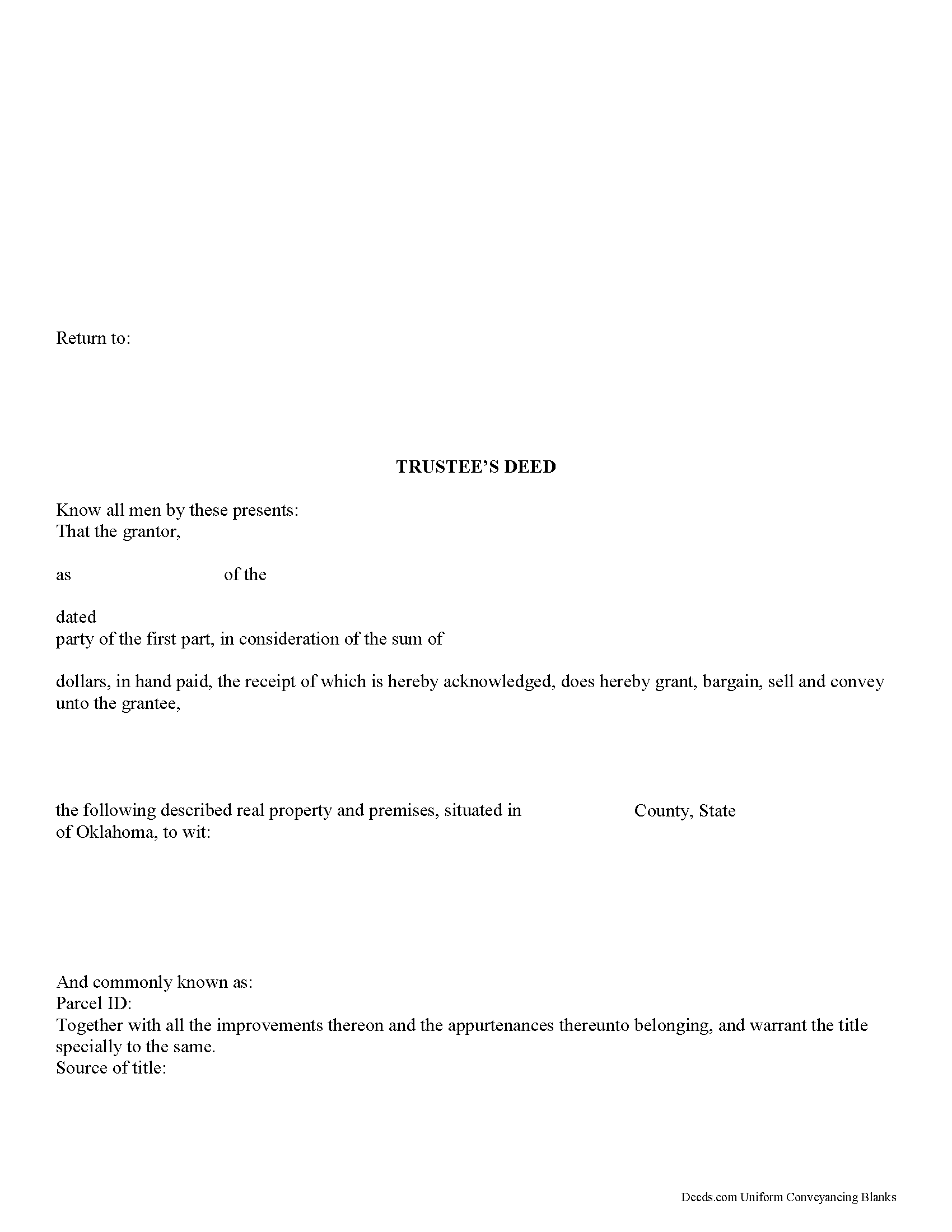
About the Oklahoma Trustee Deed
How to Use This Form
- Select your county from the list
- Download the county-specific form
- Fill in the required information
- Have the document notarized if required
- Record with your county recorder's office
What Others Like You Are Saying
"Paperwork very easy to retrieve. Hope going to get it recorded will be this easy."
"I got what I expected. Thank you"
"Well written form, and the guidance document and example supplied were very helpful."
"I was able to use your website for the purpose I was looking for. I was able to conclude the transac…"
"I appreciate the very quick response that I received and I am very impressed with the access that yo…"
4.8/5 from 4,823 reviews. Read all
Oklahoma Conveyances of Real Property to and from Express Trusts
The Oklahoma Trust Act, codified at 60 O.S. 175.1 et seq., governs express trusts in the State of Oklahoma (60 O.S. 175.3(F)). An express trust is one "created with the settlor's express intent, usually declared in writing," and is sometimes referred to as a direct trust or declared trust.
Real property may be titled in the name of a trust, an arrangement whereby one person (the settlor; also called a trustor or grantor) conveys title to another person (the trustee) for the benefit of a third (the beneficiary). The various methods of creating a trust in Oklahoma are specified at 60 175.6, and include a transfer made during the settlor's lifetime to a trustee either for the settlor or for a third person (60 175.6(B)). In this type of trust, called an inter vivos (living) trust, the roles of settlor, trustee, and beneficiary are sometimes combined in one individual, on the condition that the settlor cannot also be the sole beneficiary (see 60 175.6(A)). Testamentary trusts, specified by a will to take effect upon the settlor's death, are another option (60 O.S. 175.3(C)).
In Oklahoma, a trust containing real property is invalid without "a written instrument subscribed by the trustor" and witnessing its existence (60 O.S. 175.6(F)). The trust instrument establishes the terms of the trust, enumerates the trust's assets, designates the trustee and the trustee's powers and restrictions, and identifies the trust beneficiaries. While this document is generally unrecorded to maintain privacy, a settlor may record a trust instrument pertaining to real property, particularly when he wishes to give notice to the public of restrictions on the trustee's powers (60 O.S. 175.45(c)).
To convey real property into trust, the settlor executes and records a deed, granting title to the trustee as representative of the trust. The property should be titled in the name the trustee, referencing the trust and execution date of the trust instrument. A memorandum of trust under 60 O.S. 175.6a may be required. See 60 O.S. 156 for problems arising with conveyances into trust, and consult a lawyer with questions.
Once the trustee holds legal title to the property, he is presumed to have all the powers of an individual person holding absolute title unless specified otherwise by the trust instrument (60 O.S. 161, 171). This includes the specific power "to sell real or personal property at public auction or at private sale for cash" (60 O.S. 175.24(A)(2)). In order to convey real property from the trust, the trustee must execute a deed.
The trustee's deed is descriptively named for the granting party, rather than for the type of warranty conveyed (as in a "warranty deed" or "special warranty deed"). The form of a transfer from a representative is generally the same as a statutory deed, with wording varying slightly depending on the type of warranty of title the grantor wishes to convey.
In Oklahoma, a warranty deed, codified at 16 O.S. 40, conveys title with the broadest warranty, guaranteeing that the grantor has not already conveyed the property to someone else; that the property is free from encumbrances apart from those already disclosed; and that the grantor will warrant and defend the title against the claims of all persons. A grant deed transfers title with only the first two warranties listed above. A special warranty provides a lesser warranty, guaranteeing title only against defects arising during the period of the grantor's ownership. A quitclaim deed offers no warranty and merely transfers any interest a grantor may have in the property.
Trustees in Oklahoma generally convey real property from a trust using a special warranty deed, due to the fact that the trustee may not have knowledge of the condition of the title prior to the property's conveyance into trust. It is important to consult a lawyer in determining what level of warranty, if any, is appropriate to convey, as this has significant legal consequences for both the grantor and the grantee.
In any case, the transfer instrument should meet the same requirements for form and content of any instrument pertaining to real property. In the granting clause, the deed should name the trustee, trust, and the trust instrument date, and give the grantee's name, address, and vesting information. The deed should also list the consideration paid for the transfer; the consideration (or the value of the property conveyed) will determine the amount of documentary stamp tax paid. The deed must also include a legal description of the real property being conveyed. Additional documentation, such as a memorandum of trust, may be required (60 175.6a).
All instruments relating to real property must be signed by the granting party in the presence of a notary public before they are recorded in the county in which the subject property is situated.
Consult a lawyer with questions regarding real property transfers to and from trusts in Oklahoma.
(Oklahoma TD Package includes form, guidelines, and completed example)
Important: County-Specific Forms
Our trustee deed forms are specifically formatted for each of the 77 counties in Oklahoma.
After selecting your county, you'll receive forms that meet all local recording requirements, ensuring your documents will be accepted without delays or rejection fees.