Blaine County Trustee Deed Form
Last validated October 6, 2026 by our Forms Development TeamFormatted for recording in Blaine County, for property anywhere in the county: rural and unincorporated areas as well as Canton, Geary, Greenfield, Hitchcock, Longdale, Okeene, Southard, Watonga.
- 3 documents included
- Immediate PDF download
- Formatting guarantee
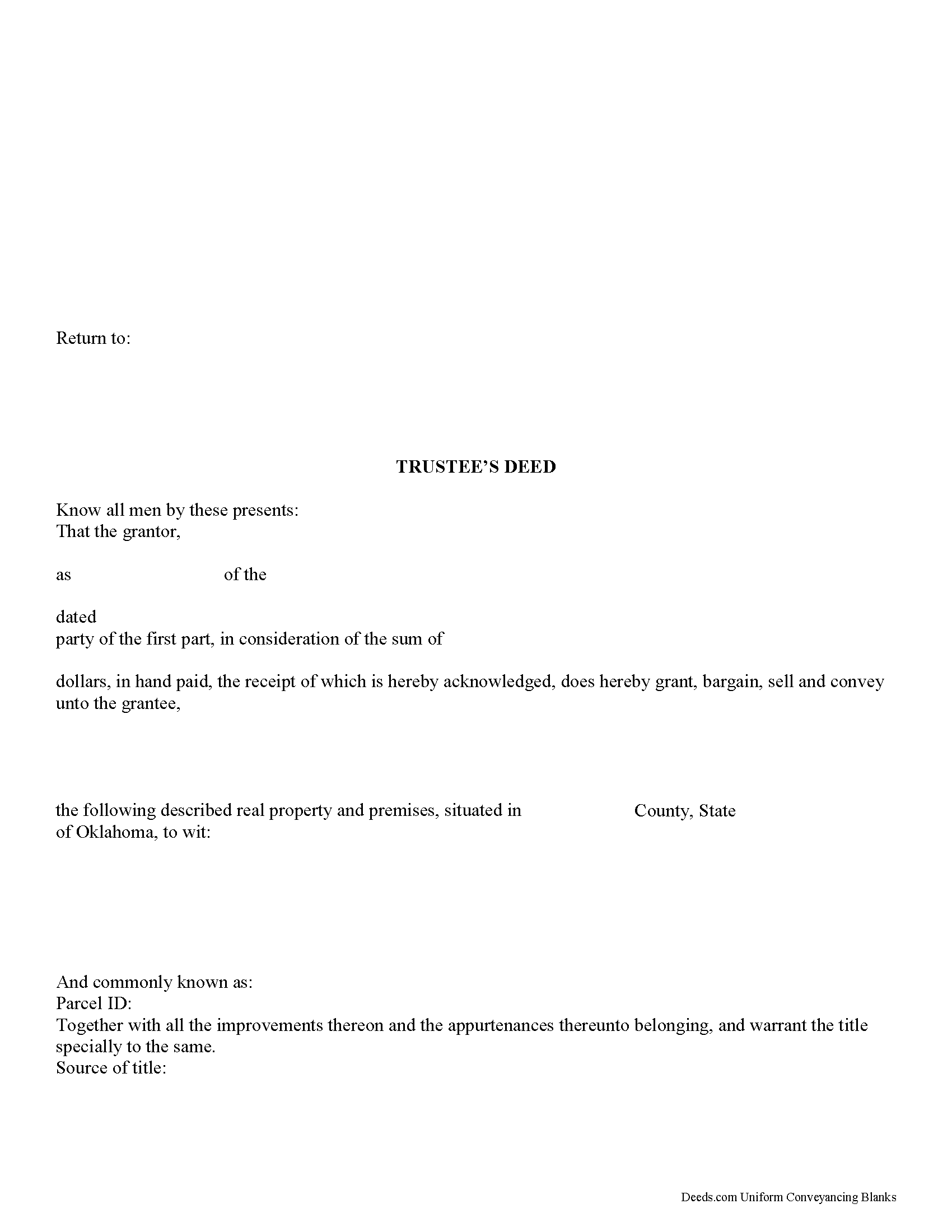
Blaine County Trustee Deed Form
Fill in the blank form formatted to comply with all recording and content requirements.
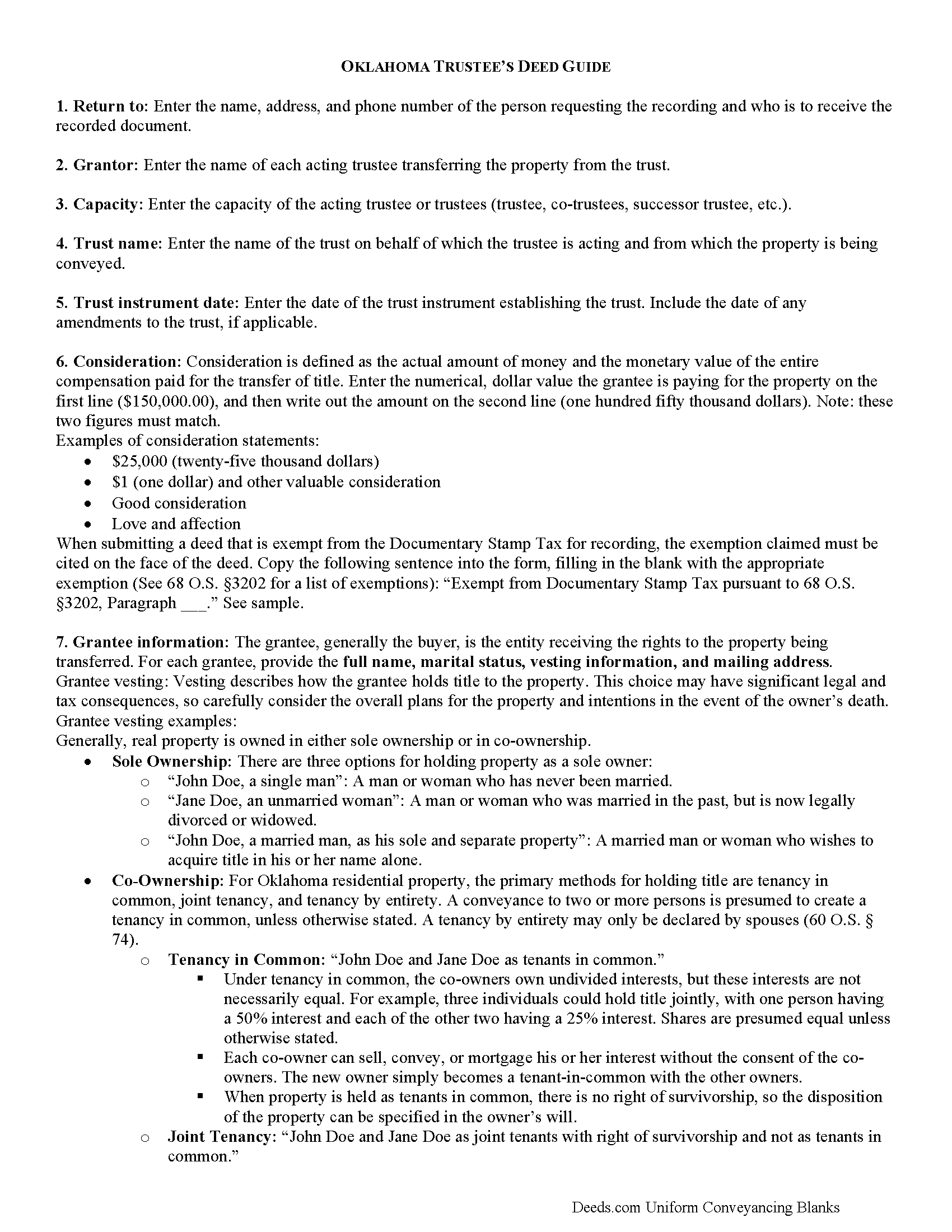
Blaine County Trustee Deed Guide
Line by line guide explaining every blank on the form.
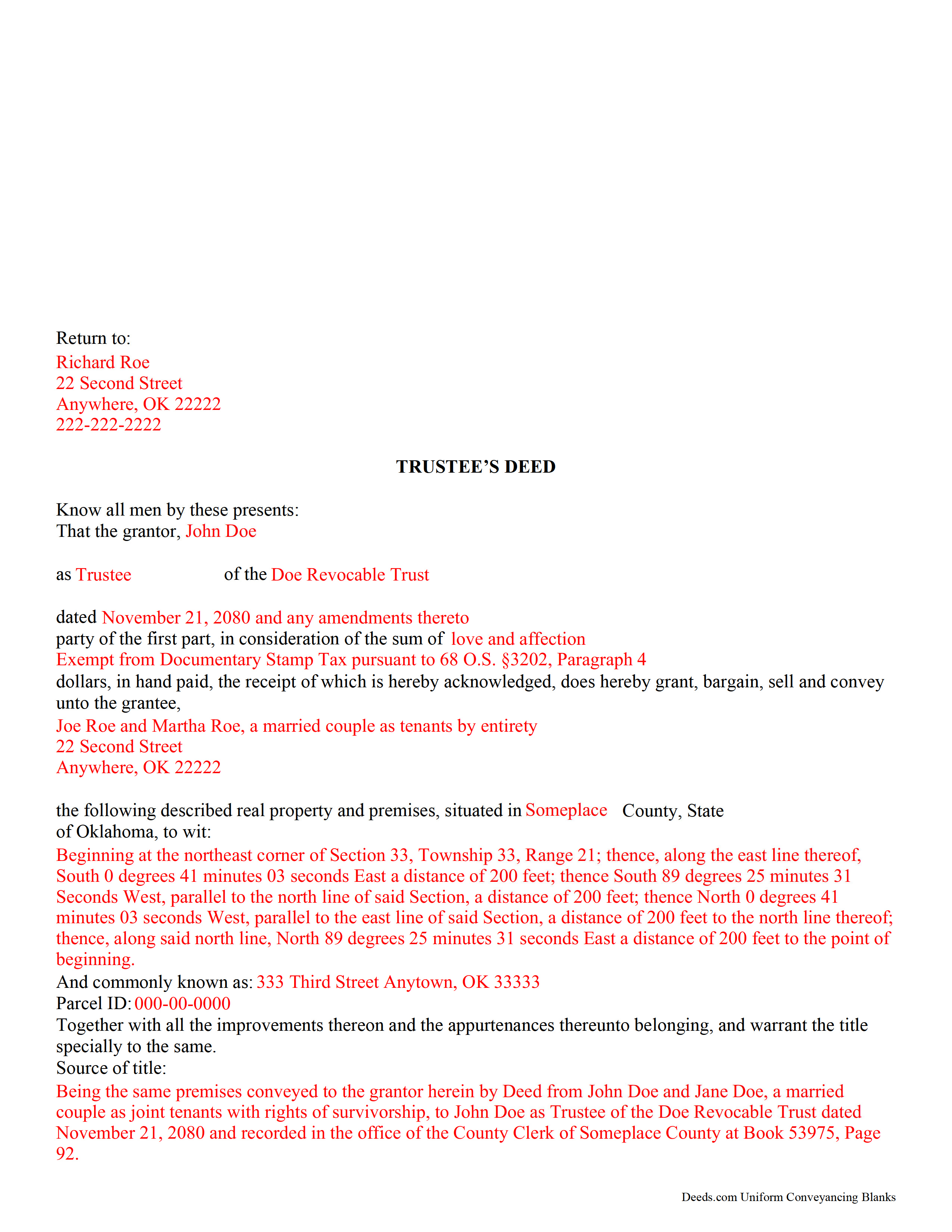
Blaine County Completed Example of the Trustee Deed Document
Example of a properly completed form for reference.
All 3 documents above included • One-time purchase • No recurring fees
Immediate Download • Secure Checkout
Additional Oklahoma and Blaine County documents included at no extra charge:
Where to Record Your Documents
Blaine County Clerk
Watonga, Oklahoma 73772
Hours: 8:00 to 4:00 M-F
Phone: (580) 623-5890
Recording Tips for Blaine County:
- Bring your driver's license or state-issued photo ID
- Ensure all signatures are in blue or black ink
- Ask if they accept credit cards - many offices are cash/check only
- Check that your notary's commission hasn't expired
- Documents must be on 8.5 x 11 inch white paper
Cities and Jurisdictions in Blaine County
Properties in any of these areas use Blaine County forms:
- Canton
- Geary
- Greenfield
- Hitchcock
- Longdale
- Okeene
- Southard
- Watonga
Hours, fees, requirements, and more for Blaine County
How do I get my forms?
Forms are available for immediate download after payment. The Blaine County forms will be in your account ready to download to your computer. An account is created for you during checkout if you don't have one. Forms are NOT emailed.
Are these forms guaranteed to be recordable in Blaine County?
Yes. Our form blanks are guaranteed to meet or exceed the applicable formatting requirements used for recording in Blaine County, including margin requirements, font requirements, and other layout standards. This guarantee applies to formatting, not to the legal sufficiency of information entered by the user or the suitability of a form for a particular transaction.
Can I reuse these forms?
Yes. You can reuse the forms for your personal use. For example, if you have multiple properties in Blaine County you only need to order once.
What do I need to use these forms?
The forms are PDFs that you fill out on your computer. The free Adobe Acrobat Reader is recommended, and most PDF apps also work. You do NOT enter your property information online - you download the blank forms and complete them privately on your own computer.
Are there any recurring fees?
No. This is a one-time purchase. Nothing to cancel, no memberships, no recurring fees.
How much does it cost to record in Blaine County?
Recording fees in Blaine County vary. Contact the recorder's office at (580) 623-5890 for current fees.
Questions answered? Let's get started!
Oklahoma Conveyances of Real Property to and from Express Trusts
The Oklahoma Trust Act, codified at 60 O.S. 175.1 et seq., governs express trusts in the State of Oklahoma (60 O.S. 175.3(F)). An express trust is one "created with the settlor's express intent, usually declared in writing," and is sometimes referred to as a direct trust or declared trust.
Real property may be titled in the name of a trust, an arrangement whereby one person (the settlor; also called a trustor or grantor) conveys title to another person (the trustee) for the benefit of a third (the beneficiary). The various methods of creating a trust in Oklahoma are specified at 60 175.6, and include a transfer made during the settlor's lifetime to a trustee either for the settlor or for a third person (60 175.6(B)). In this type of trust, called an inter vivos (living) trust, the roles of settlor, trustee, and beneficiary are sometimes combined in one individual, on the condition that the settlor cannot also be the sole beneficiary (see 60 175.6(A)). Testamentary trusts, specified by a will to take effect upon the settlor's death, are another option (60 O.S. 175.3(C)).
In Oklahoma, a trust containing real property is invalid without "a written instrument subscribed by the trustor" and witnessing its existence (60 O.S. 175.6(F)). The trust instrument establishes the terms of the trust, enumerates the trust's assets, designates the trustee and the trustee's powers and restrictions, and identifies the trust beneficiaries. While this document is generally unrecorded to maintain privacy, a settlor may record a trust instrument pertaining to real property, particularly when he wishes to give notice to the public of restrictions on the trustee's powers (60 O.S. 175.45(c)).
To convey real property into trust, the settlor executes and records a deed, granting title to the trustee as representative of the trust. The property should be titled in the name the trustee, referencing the trust and execution date of the trust instrument. A memorandum of trust under 60 O.S. 175.6a may be required. See 60 O.S. 156 for problems arising with conveyances into trust, and consult a lawyer with questions.
Once the trustee holds legal title to the property, he is presumed to have all the powers of an individual person holding absolute title unless specified otherwise by the trust instrument (60 O.S. 161, 171). This includes the specific power "to sell real or personal property at public auction or at private sale for cash" (60 O.S. 175.24(A)(2)). In order to convey real property from the trust, the trustee must execute a deed.
The trustee's deed is descriptively named for the granting party, rather than for the type of warranty conveyed (as in a "warranty deed" or "special warranty deed"). The form of a transfer from a representative is generally the same as a statutory deed, with wording varying slightly depending on the type of warranty of title the grantor wishes to convey.
In Oklahoma, a warranty deed, codified at 16 O.S. 40, conveys title with the broadest warranty, guaranteeing that the grantor has not already conveyed the property to someone else; that the property is free from encumbrances apart from those already disclosed; and that the grantor will warrant and defend the title against the claims of all persons. A grant deed transfers title with only the first two warranties listed above. A special warranty provides a lesser warranty, guaranteeing title only against defects arising during the period of the grantor's ownership. A quitclaim deed offers no warranty and merely transfers any interest a grantor may have in the property.
Trustees in Oklahoma generally convey real property from a trust using a special warranty deed, due to the fact that the trustee may not have knowledge of the condition of the title prior to the property's conveyance into trust. It is important to consult a lawyer in determining what level of warranty, if any, is appropriate to convey, as this has significant legal consequences for both the grantor and the grantee.
In any case, the transfer instrument should meet the same requirements for form and content of any instrument pertaining to real property. In the granting clause, the deed should name the trustee, trust, and the trust instrument date, and give the grantee's name, address, and vesting information. The deed should also list the consideration paid for the transfer; the consideration (or the value of the property conveyed) will determine the amount of documentary stamp tax paid. The deed must also include a legal description of the real property being conveyed. Additional documentation, such as a memorandum of trust, may be required (60 175.6a).
All instruments relating to real property must be signed by the granting party in the presence of a notary public before they are recorded in the county in which the subject property is situated.
Consult a lawyer with questions regarding real property transfers to and from trusts in Oklahoma.
(Oklahoma TD Package includes form, guidelines, and completed example)
Important: Your property must be located in Blaine County to use these forms. Documents should be recorded at the county recording office listed above.
This Trustee Deed meets all recording requirements specific to Blaine County.
Our Promise
The documents you receive here are guaranteed to meet or exceed the applicable Blaine County recording format requirements. If there is a rejection caused by our formatting, we will correct the issue or refund your payment. This guarantee applies to document formatting only and does not extend to information entered by the user, the selection of the form, or the legal effect of the completed document.
Save Time and Money
Get your Blaine County Trustee Deed form done right the first time with Deeds.com Uniform Conveyancing Blanks. At Deeds.com, we understand that your time and money are valuable resources, and we don't want you to face a penalty fee or rejection imposed by a county recorder for submitting nonstandard documents. We constantly review and update our forms to meet rapidly changing state and county recording requirements for roughly 3,500 counties and local jurisdictions.
4.8 out of 5 - ( 4,828 Reviews )
Paul W. 5 out of 5 stars
Exceptionally easy site to navigate. Forms and related documents downloaded quickly and were helpful in completing the forms, which have already been filed with the County Registrar of Deeds. Many thanks for an extremely useful site!
We appreciate your business and value your feedback. Thank you. Have a wonderful day!
Alberta W. 5 out of 5 stars
Deeds.com was user-friendly, clear, specific and complete. I used the site to create and submit a Notice of Termination form, and was able to walk it to my local county court with no major issues. It worked out perfectly.
We appreciate your business and value your feedback. Thank you. Have a wonderful day!
janice b. 5 out of 5 stars
This is a very helpful site when you don't know exactly what to do. Very clear in explaining the wording on deeds. Thank you it made a big difference knowing the right way to do things.
Thank you for your feedback. We really appreciate it. Have a great day!
Christine P. 5 out of 5 stars
I was hoping to find information of a property belonging to my grandparents. Your site says it can go back 10-20 years I will just have to go to the courthouse and research. But very good site if your looking for recent information.
Thank you for your feedback. We really appreciate it. Have a great day!
Traci R. 1 out of 5 stars
I was disappointed in the form received. The language was not clear and for the price, one would think we would receive a Word version rather than a PDF.
Sorry to hear of your struggle Traci. We have canceled your order and payment. We do hope that you find something more suitable to your needs elsewhere. Have a wonderful day.
Jennifer A. 5 out of 5 stars
Great site
Thank you!
Stacey S. 4 out of 5 stars
The system was easy to use and download my documents but the way the packages are set up it was confusing and I wish there was a way to delete an item from a package if you make a mistake.
Thank you for your feedback. We really appreciate it. Have a great day!
Richard T. 5 out of 5 stars
Amazing service from competent individuals that really go above and beyond to get you documents processed.
Thank you!
Raymond L. 5 out of 5 stars
Delivered as promised. Highly recommend!
Great to hear — thank you for taking the time to write a review.
John L. 5 out of 5 stars
excellent...exactly what i need....
Thank you!
Dawna M. 3 out of 5 stars
Easy to use website and immediate documents appropriate for my area. My only complaint is that the forms had an alignment problem where the fields that were filled in by me did not line up with the template text. I tried to correct it to no avail so I ended up having to retype the entire document. I purchased two templates and both had the same issue.
We appreciate your business and value your feedback. Thank you. Have a wonderful day!
Sam A. 5 out of 5 stars
The form is just what I needed! Super easy access and user friendly. Exactly what I needed. Worth every dollar!!
Thank you for your feedback. We really appreciate it. Have a great day!
Paula S. 5 out of 5 stars
I highly recommend this website. It was quick and easy with very helpful guides and examples! I am so very thankful that I stumbled across the Deed website! Definitely worth every penny spent!
We appreciate your business and value your feedback. Thank you. Have a wonderful day!
John W. 5 out of 5 stars
The forms were easy to acquire and easy to use
Thank you for your feedback. We really appreciate it. Have a great day!
Sherilyn L. 5 out of 5 stars
Easy to use & cost is great Thank you
We appreciate your business and value your feedback. Thank you. Have a wonderful day!