Multnomah County Transfer on Death Deed (Married Owners, Tenancy by the Entirety, Last Survivor) Form
Last validated November 22, 2026 by our Forms Development TeamFormatted for recording in Multnomah County, for property anywhere in the county: rural and unincorporated areas as well as Bridal Veil, Corbett, Fairview, Gresham, Portland, Troutdale.
- 3 documents included
- Immediate PDF download
- Formatting guarantee
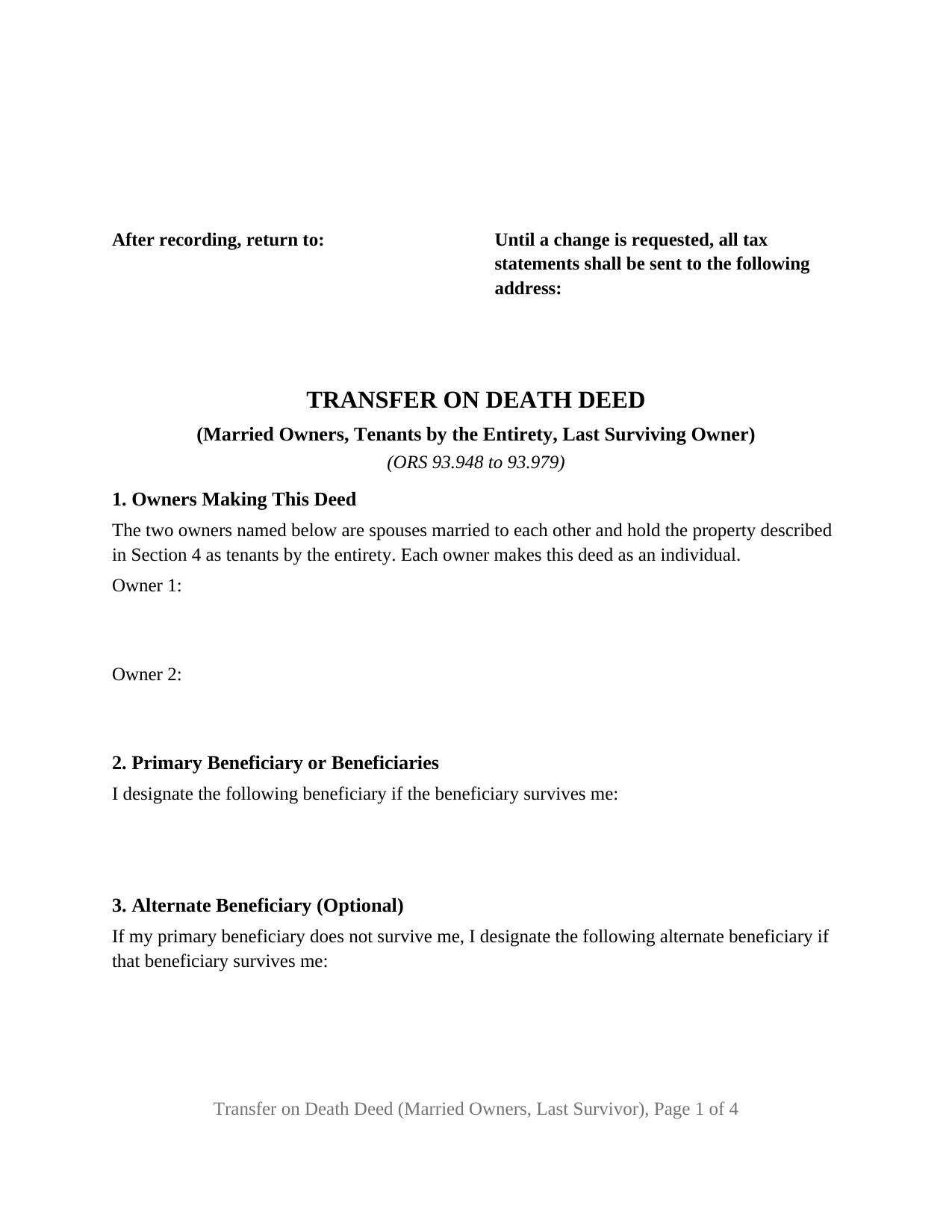
Multnomah County Transfer on Death Deed (Married Owners, Tenancy by the Entirety, Last Survivor) Form
Fill in the blank Transfer on Death Deed (Married Owners, Tenancy by the Entirety, Last Survivor) form formatted to comply with all Oregon recording and content requirements.
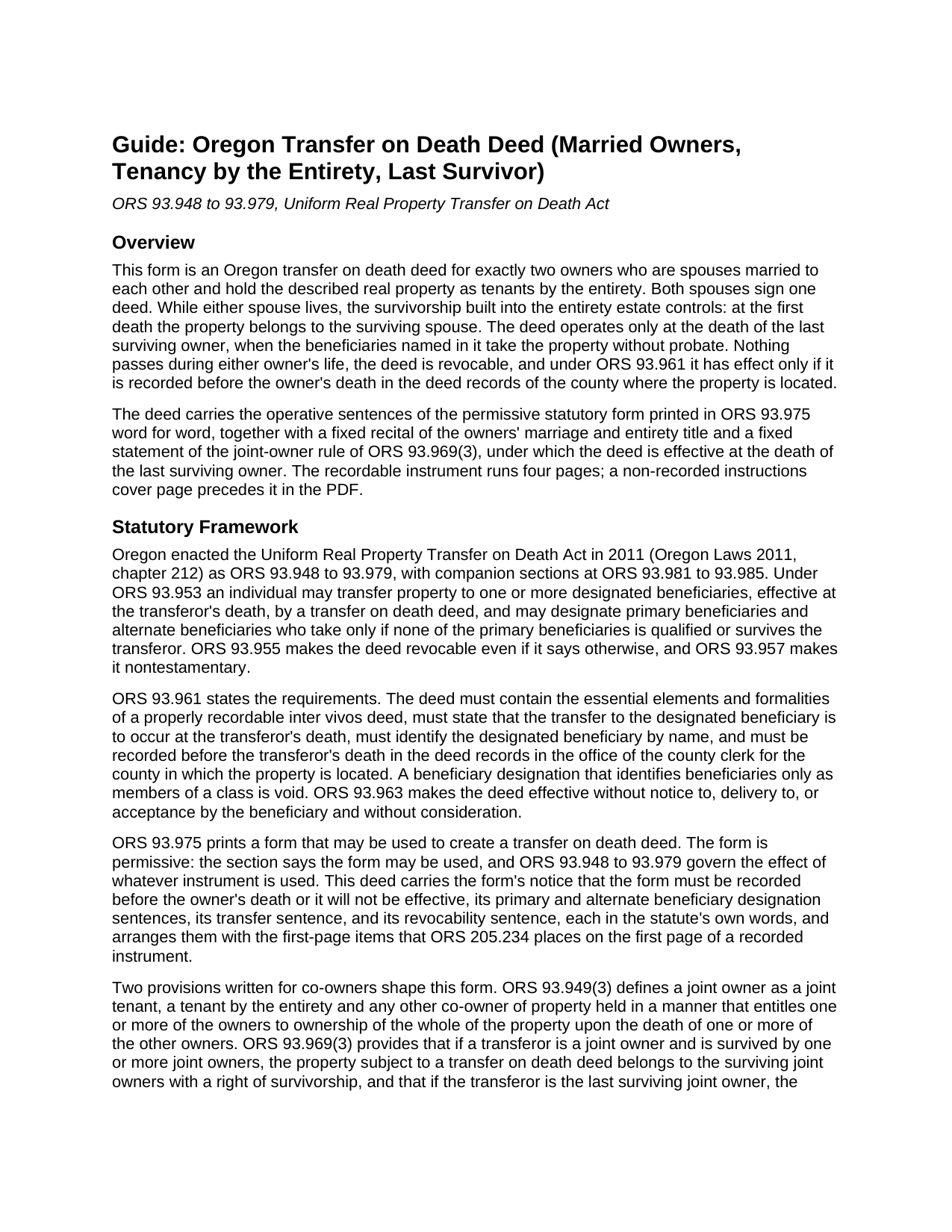
Multnomah County Transfer on Death Deed (Married Owners, Tenancy by the Entirety, Last Survivor) Guide
Line by line guide explaining every blank on the Transfer on Death Deed (Married Owners, Tenancy by the Entirety, Last Survivor) form.
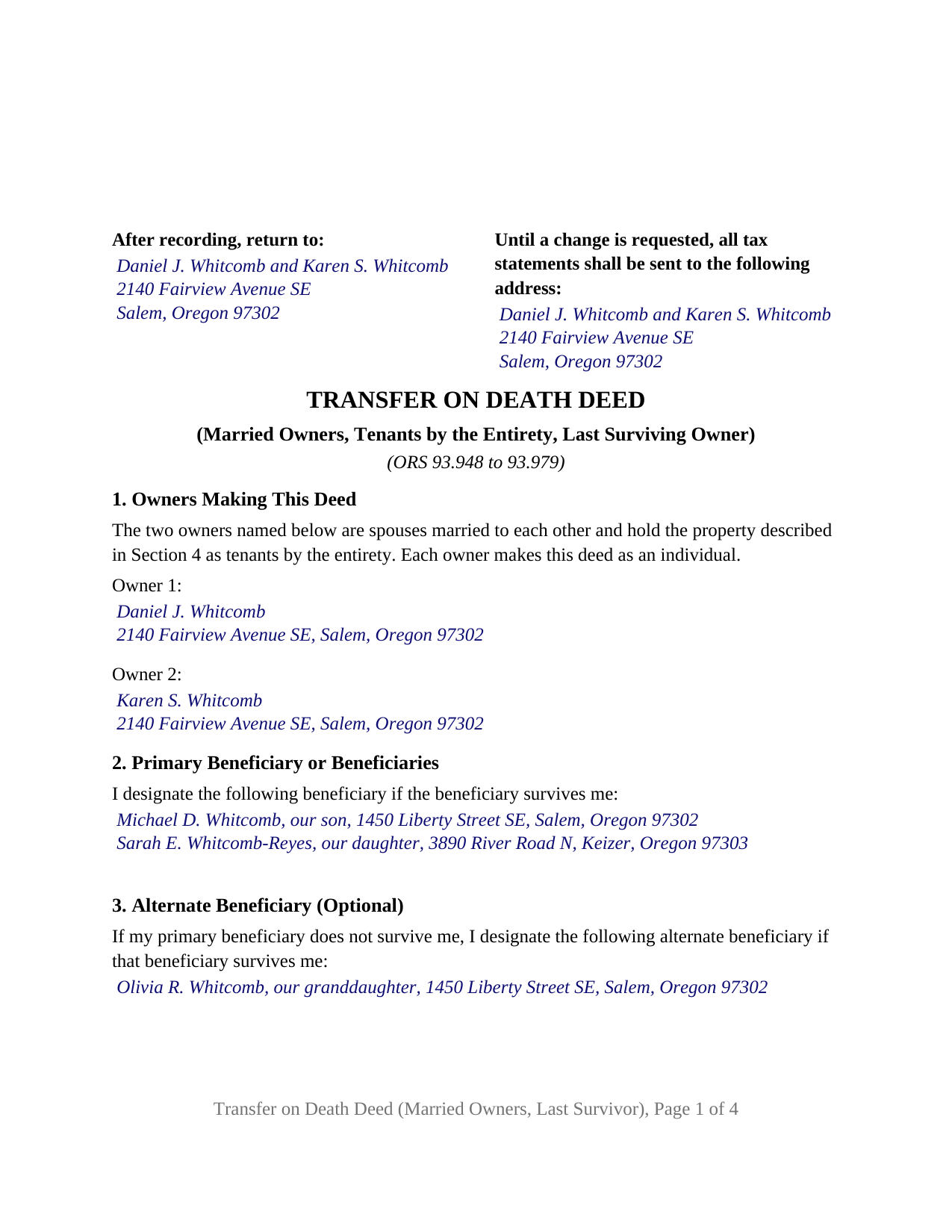
Multnomah County Completed Example of the Transfer on Death Deed (Married Owners, Tenancy by the Entirety, Last Survivor) Document
Example of a properly completed Oregon Transfer on Death Deed (Married Owners, Tenancy by the Entirety, Last Survivor) document for reference.
All 3 documents above included • One-time purchase • No recurring fees
Immediate Download • Secure Checkout
Additional Oregon and Multnomah County documents included at no extra charge:
Where to Record Your Documents
County Recorder
Portland, Oregon 97214
Hours: 9:00am-4:30pm M-F
Phone: (503) 988-3326
Mail to: Multnomah County Recorder
Portland, Oregon 97208-2716
Hours:
Phone: N/A
Recording Tips for Multnomah County:
- Bring your driver's license or state-issued photo ID
- Ensure all signatures are in blue or black ink
- Bring extra funds - fees can vary by document type and page count
- Check margin requirements - usually 1-2 inches at top
- Leave recording info boxes blank - the office fills these
Cities and Jurisdictions in Multnomah County
Properties in any of these areas use Multnomah County forms:
- Bridal Veil
- Corbett
- Fairview
- Gresham
- Portland
- Troutdale
Hours, fees, requirements, and more for Multnomah County
How do I get my forms?
Forms are available for immediate download after payment. The Multnomah County forms will be in your account ready to download to your computer. An account is created for you during checkout if you don't have one. Forms are NOT emailed.
Are these forms guaranteed to be recordable in Multnomah County?
Yes. Our form blanks are guaranteed to meet or exceed the applicable formatting requirements used for recording in Multnomah County, including margin requirements, font requirements, and other layout standards. This guarantee applies to formatting, not to the legal sufficiency of information entered by the user or the suitability of a form for a particular transaction.
Can I reuse these forms?
Yes. You can reuse the forms for your personal use. For example, if you have multiple properties in Multnomah County you only need to order once.
What do I need to use these forms?
The forms are PDFs that you fill out on your computer. The free Adobe Acrobat Reader is recommended, and most PDF apps also work. You do NOT enter your property information online - you download the blank forms and complete them privately on your own computer.
Are there any recurring fees?
No. This is a one-time purchase. Nothing to cancel, no memberships, no recurring fees.
How much does it cost to record in Multnomah County?
Recording fees in Multnomah County vary. Contact the recorder's office at (503) 988-3326 for current fees.
Questions answered? Let's get started!
Two spouses, one Oregon deed, and a transfer that waits for the second death. This transfer on death deed is written for a married couple who hold Oregon real property as tenants by the entirety, and it names the beneficiary or beneficiaries who take that property when the last surviving spouse dies, under ORS 93.948 to 93.979, Oregon's Uniform Real Property Transfer on Death Act. Both spouses sign the same instrument, and the deed prints its configuration as fixed text: the owners are spouses married to each other, they hold as tenants by the entirety, and the deed is effective at the death of the last surviving owner.
A deed that waits for the second death
The entirety estate does the first death's work. ORS 93.949(3) defines a joint owner to include a tenant by the entirety, and ORS 93.969(3) then supplies the timing: when a transferor who is a joint owner dies survived by the other joint owner, the property belongs to the survivor with a right of survivorship, and when the transferor is the last surviving joint owner, the transfer on death deed is effective. Nothing in the deed moves at the first death, because the survivor already owns the whole. The beneficiary deed, as this instrument is also searched, operates once, at the second death, and transfers whatever interest the last surviving spouse then holds, subject to the mortgages, liens and other interests on the property at that time under ORS 93.969(2).
Section 5 of the deed carries that rule in the deed's own words beside the statutory transfer sentence from ORS 93.975, so the record shows on its face which death the designation waits for. During both lives the recorded deed changes nothing: under ORS 93.967 the spouses keep every right to sell, mortgage, or otherwise deal with the property, the beneficiaries acquire no interest, and the spouses' creditors and public assistance eligibility are unaffected.
What this two-spouse configuration prints and recites
The deed recites exactly two owners, identified by name and mailing address, with a fixed statement that they are spouses married to each other, that they hold the property described in the deed as tenants by the entirety, and that each makes the deed as an individual. That recital is deed text, not a selector or a blank: the owners' names, the beneficiaries, the county, and the legal description are the factual entries, and the configuration is already written. Under ORS 93.180(1)(b) a conveyance to spouses married to each other creates a tenancy by the entirety unless the instrument clearly and expressly declares otherwise, so a vesting deed to the two spouses with no contrary declaration is the record that presents this pattern. Spouses whose vesting deed expressly declared a tenancy in common hold without survivorship and present a different pattern, as do a single owner, unmarried co-owners holding the ORS 93.180(2) survivorship estate, an owner acting as trustee, an owner signing through an attorney-in-fact, and three or more owners on one instrument.
The form carries two signature blocks, one for each spouse, and a separate acknowledgment certificate for each, each certificate using the ORS 194.285(1) short form sentence with a reserved area for the notary's official stamp. The separate certificates are the form's arrangement so the spouses may sign on different days or before different officers; Oregon's short form is written for one or more individuals and no statute requires a certificate per signer. Oregon has no community property regime and ORS 112.685 abolished dower and curtesy, so the two spouses on the title are the only people who sign.
Beneficiaries, survival, and the 120-hour rule
The primary beneficiary block receives one or more beneficiaries, each identified by name as ORS 93.961(1)(c) requires, and the optional alternate block receives the beneficiaries who take only if no primary beneficiary is qualified or survives, the ORS 93.953(2)(b) rule. A natural person, a trust named through its trustee, or an entity by its legal name may be a beneficiary, because ORS 93.949(4) defines a person that broadly, and a class designation such as children without names is void under ORS 93.961(2). Where several primary beneficiaries are named, ORS 93.969(1)(b) gives them equal undivided shares with no survivorship among them and passes a lapsed share to the others in proportion; the deed carries no special terms blank, so those defaults apply as written.
Survival on this deed is measured at the death that makes it effective, the death of the last surviving spouse. ORS 93.969(1) is expressly subject to Oregon's survivorship rules in ORS 112.570 to 112.590: a transfer on death deed is a governing instrument under ORS 112.570(2)(c), a beneficiary is deemed to have died first unless clear and convincing evidence shows survival by at least 120 hours under ORS 112.578, and where both spouses die without that showing between them, ORS 112.580(1) passes one-half of the property as if each had survived the other.
Revocation with two transferors
ORS 93.965 revokes a recorded deed only by a later instrument that is acknowledged after the deed being revoked and recorded before the transferor's death: a later transfer on death deed, an instrument of revocation, or an inter vivos deed of the property. A will does not revoke it, and a revocatory act on the recorded deed itself has no effect. Oregon's section adds one rule for a deed made by more than one transferor, in ORS 93.965(3): revocation by one transferor does not affect the transfer of the other transferor's interest. The section states no requirement that both spouses join in one revoking instrument. The deed grants no agent authority to revoke, which ORS 93.965(2) allows only where the deed expressly grants it. The ORS 93.977 revocation form is a separate instrument, prepared separately and not included in this package.
First-page items and the recording condition
Recording is the condition of the deed's effect. ORS 93.961(1)(d) requires recording before the transferor's death in the deed records of the county clerk for the county where the property lies, and the deed prints the ORS 93.975 notice that the form must be recorded before the owner's death or it will not be effective at the head of its operative section. Because ORS 205.234(1) places named items on the first page of a recorded instrument, the deed's first page carries the title, both owners, the primary and alternate beneficiaries, the return address, and the ORS 93.260 tax statement address, with two inches open at the top for the clerk's label; ORS 93.030(6) and 93.040(6) keep the consideration statement and the land use statements off a transfer on death deed. The body is 12 point type on letter paper, over the 10 point floor of ORS 205.232, and the recordable deed runs four pages. Each county clerk publishes its own fee schedule, and several counties raised their Public Land Corner Preservation fee on July 1, 2026 under Oregon Laws 2025, chapter 98.
Three files make up the package: the fillable deed, preceded in the PDF by an instructions cover page that is not recorded; a completed example, filled in for a fictional Marion County couple who name their two children as primary beneficiaries and a granddaughter as the alternate; and a seven-page guide covering every section of the deed, the signing and recording steps, and the sections of ORS chapter 93 that govern it. Everything in this description and in the guide is general information about the form and the statutes; none of it is applied to any particular property or family, and none of it is legal advice.
Important: Your property must be located in Multnomah County to use these forms. Documents should be recorded at the county recording office listed above.
This Transfer on Death Deed (Married Owners, Tenancy by the Entirety, Last Survivor) meets all recording requirements specific to Multnomah County.
Our Promise
The documents you receive here are guaranteed to meet or exceed the applicable Multnomah County recording format requirements. If there is a rejection caused by our formatting, we will correct the issue or refund your payment. This guarantee applies to document formatting only and does not extend to information entered by the user, the selection of the form, or the legal effect of the completed document.
Save Time and Money
Get your Multnomah County Transfer on Death Deed (Married Owners, Tenancy by the Entirety, Last Survivor) form done right the first time with Deeds.com Uniform Conveyancing Blanks. At Deeds.com, we understand that your time and money are valuable resources, and we don't want you to face a penalty fee or rejection imposed by a county recorder for submitting nonstandard documents. We constantly review and update our forms to meet rapidly changing state and county recording requirements for roughly 3,500 counties and local jurisdictions.
4.8 out of 5 - ( 4,862 Reviews )
Catherine W. 5 out of 5 stars
I appreciate your prompt and honest response. You did not find what I was looking for but You also did not charge Me. It was a pleasure working with You.
Thank you for your feedback Catherine, sorry we were unable to find what you needed. Have a wonderful day.
Marilyn J. 5 out of 5 stars
Just what I needed!
Thank you!
Patrick R. 5 out of 5 stars
I was satisfied and would refer this website to others.
Thank you for your feedback. We really appreciate it. Have a great day!
Maria M. 5 out of 5 stars
The requested documents I needed were provided and also complete instructions on how to fill them out. I definitely will you this service again.
We appreciate your business and value your feedback. Thank you. Have a wonderful day!
Linda P. 5 out of 5 stars
Once I found this site the rest was easy. I read through the guide but the example really helped the most. Very easy!!!
We appreciate your business and value your feedback. Thank you. Have a wonderful day!
Ivory J. 5 out of 5 stars
Haven't processed any deed documents so far. I do agree that Deed.com website browsing tool will be helpful.
Thank you!
Jeremy C. 5 out of 5 stars
Really impressed with the speed and professionalism of the service. I would recommend putting a grey background on the form field inputs as I had trouble seeing them in the user interface, but otherwise I was really impressed and would happily return as a customer.
Thank you for your feedback. We really appreciate it. Have a great day!
Paula V. 5 out of 5 stars
Fast, easy, helpful instructions. I’ll use them again!
Thank you for your feedback. We really appreciate it. Have a great day!
Rachel C. 5 out of 5 stars
This service is a game-changer. I work all over and being able to e-record so easily has been so effective for my business.
Thank you for your feedback. We really appreciate it. Have a great day!
Lawrence D. 5 out of 5 stars
My first time using it; very fast service. I am an estate planning attorney (44 years). None of my old title company contacts are around anymore to provide deed copies, so this is a great source. I will be using it again.
Thank you Lawrence, we appreciate your feedback. Have a fantastic day!
Hugh B R. 5 out of 5 stars
Very user friendly and fast. Pleasure using this site.
Thank you for your feedback. We really appreciate it. Have a great day!
Steven M. 5 out of 5 stars
They always get me the information I need, in a timely manner.
We appreciate your business and value your feedback. Thank you. Have a wonderful day!
Randy T. 5 out of 5 stars
I gave your site and forms 5 stars because it is very easy to use and included all the information needed to complete the form without having had a legal background.
Thank you Randy. Have a great day!
Claude F. 5 out of 5 stars
quick and easy to use, thank you
Thank you!
Wanda B. 5 out of 5 stars
Great prompt and efficient service!
Thank you for your feedback. We really appreciate it. Have a great day!