Oregon Transfer on Death Deed (Sole Owner, Trust Beneficiary)
County Specific Legal Forms Validated as recently as November 22, 2026 by our Forms Development Team
About the Oregon Transfer on Death Deed (Sole Owner, Trust Beneficiary)
How to Use This Form
- Select your county from the list
- Download the county-specific form
- Fill in the required information
- Have the document notarized if required
- Record with your county recorder's office
What Others Like You Are Saying
"EXCELLENT WEBSITE AND SERVICE, HIGHLY RECOMMENDED."
"Super easy and quick. Love the service-"
"Great system!"
"Using an I pad and cannot type on form that was downloaded. I do not have a computer Charles"
"I needed a Missouri Notice of Intent to Sell without a named designated buyer. Mo Statutes require n…"
4.8/5 from 4,864 reviews. Read all
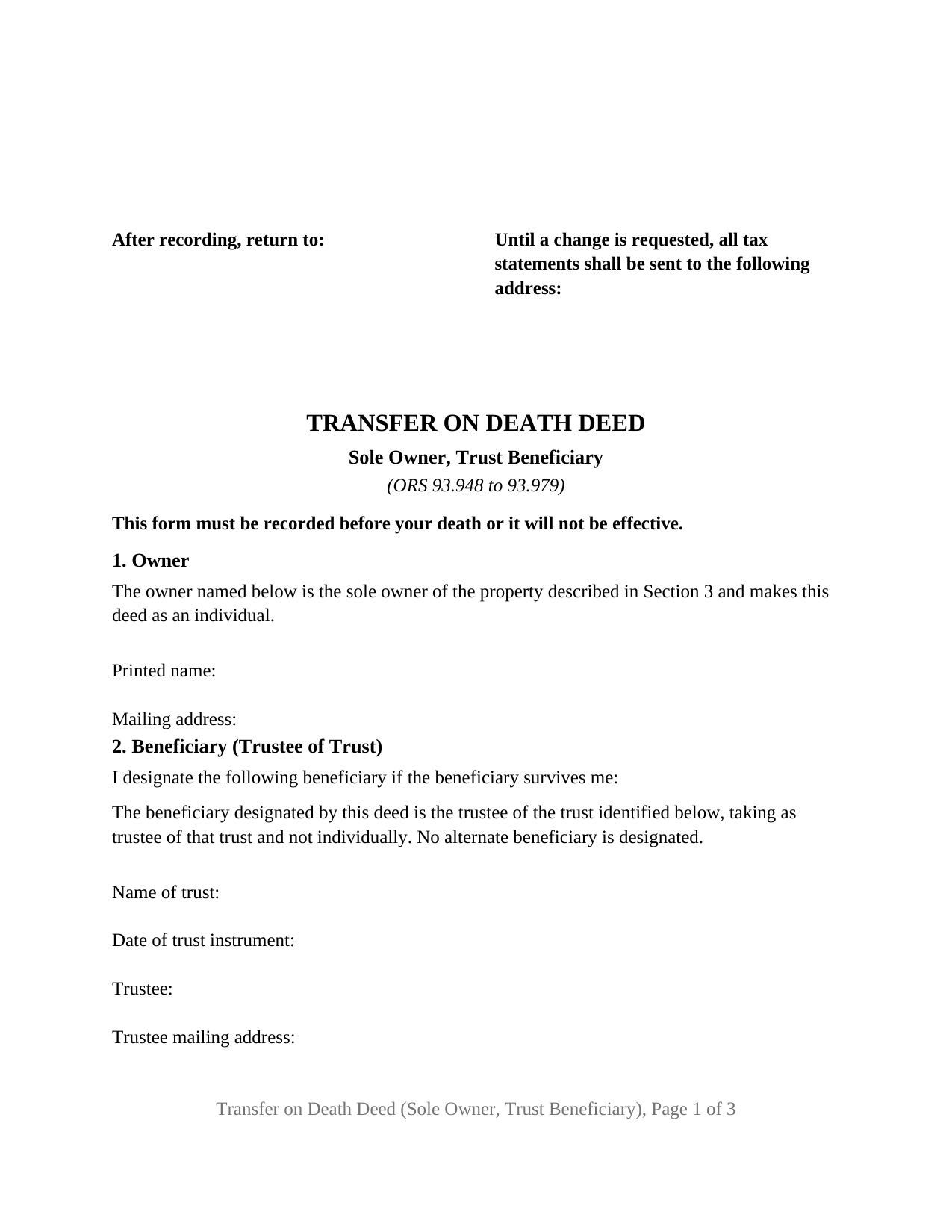
A trustee, named by name, is the person this Oregon transfer on death deed designates to take the property at the owner's death. The form is written for one owner who holds Oregon real property alone and who wants the property to pass, outside probate, into a trust that already exists: the deed identifies the trust by its name and the date of its trust instrument, identifies the trustee by name, and states as fixed deed text that the trustee takes as trustee of that trust and not individually. It is the Oregon transfer on death deed, the instrument also searched as a beneficiary deed or TOD deed, in the one configuration where the taker is a fiduciary rather than a person taking for himself or herself, under ORS 93.948 to 93.979, Oregon's Uniform Real Property Transfer on Death Act.
A trustee is a person under the chapter
Oregon's chapter does not speak of naming a trust. It speaks of designating a person, and ORS 93.949(4) defines a person to include a trustee, in the same list as an individual, a corporation, a business trust, a partnership, and a limited liability company. A beneficiary under ORS 93.949(1) is a person that receives property under a transfer on death deed, and a designated beneficiary under ORS 93.949(2) is a person designated to receive it. So a deed made for the benefit of a trust designates the trustee, and that is what this deed does. Under ORS 93.961(1)(c) the deed must identify the designated beneficiary by name, and under ORS 93.961(2) a designation that names only a class of beneficiaries, and no person, is void; the deed meets that rule by printing the trust's name and date and the trustee's own name on separate lines in its beneficiary section, under the designation sentence the permissive statutory form in ORS 93.975 prints.
What the chapter leaves open, the deed leaves open too. ORS 93.969(1)(a) transfers a designated beneficiary's interest if the beneficiary survives the transferor and lapses it otherwise, and nothing in the chapter states how that rule reads where the named trustee has resigned, died, or been replaced, or where the trust itself has been revoked, before the owner's death. Oregon's trust code defines trustee to include a successor trustee (ORS 130.010(23)), but that definition is written for ORS chapter 130. The guide describes the question as the chapter leaves it; the deed adds no sentence of its own about successor trustees, because the statute supplies none, and it designates no alternate beneficiary.
What the deed fixes and what it asks for
The deed recites exactly one owner, who is the sole owner of the described property and makes the deed as an individual, and exactly one beneficiary, the trustee of the trust identified in it. Those two statements are printed deed text, not a selector and not a blank. The factual entries are the owner's name and mailing address, the trust's name and the date of its instrument, the trustee's name and mailing address, the county, and the legal description copied from the vesting deed. An owner who created a trust for grandchildren and appointed an adult child as its trustee, and an owner who holds a rental house alone and wants it administered under an existing trust after death, present the pattern this deed recites. An owner who is the trustee of the owner's own revocable trust presents the open question described above, and the guide says so rather than resolving it.
The deed is not set up as a designation of an individual, an entity, or several beneficiaries in shares, as a designation with an alternate, or as a deed by two owners, by an owner who already holds title as trustee, by an entity owner, or by an owner signing through an attorney in fact. ORS 93.965(2) lets a designated agent revoke a transfer on death deed only where the deed expressly grants that authority, and this deed grants none. The ORS 93.975 form's optional SPECIAL TERMS blank is omitted as well, so the chapter's own rules apply as written.
Signed by the owner alone, acknowledged once
One signature block and one acknowledgment certificate are all the deed carries. ORS 93.961(1)(a) applies the formalities of a properly recordable inter vivos deed, and ORS 93.410 supplies them for a deed executed in Oregon: the grantor's signature, acknowledged before a qualified officer, with no seal and no subscribing witnesses. The certificate uses the ORS 194.285(1) short form sentence and reserves an area for the official stamp ORS 194.280(3) requires on a tangible record. Oregon has no community property regime and ORS 112.685 abolished dower and curtesy, so a spouse who is not on the title has no signature line, and the trustee does not sign at all; ORS 93.963 makes the deed effective without acceptance by the beneficiary during the owner's life. The owner's marital status is neither printed nor asked for.
Recorded before death, and taken subject to the record
The one condition that decides whether the designation works is recording. ORS 93.961(1)(d) requires the deed to be recorded before the transferor's death in the deed records of the county clerk for the county where the property is located, and the deed prints the statutory form's recording notice in bold directly under its title. Because ORS 205.234(1) places named items on the first page of a recorded instrument, the first page carries the title, the owner, the trust and its trustee, the return address, and the ORS 93.260 tax statement address, which ordinarily carries the owner's own address since the owner remains the taxpayer; the true and actual consideration statement and the land use statements are absent under ORS 93.030(6) and 93.040(6). The body is 12 point type on letter paper over the 10 point floor of ORS 205.232, two inches are left open at the top of page one for the clerk's label, and the recorded deed runs three pages plus any exhibit.
At the owner's death the trustee takes what the owner then holds, subject under ORS 93.969(2) to every mortgage, lien, and other interest of record and to a state claim for public or medical assistance reimbursement where the probate estate cannot pay it, and under ORS 93.969(4) without covenant or warranty of title. During the owner's life, under ORS 93.967, the recorded deed changes nothing: the owner keeps every right to sell or encumber the property, the trust acquires no interest, and the owner's creditors and public assistance eligibility are unaffected. A recorded deed is revoked only as ORS 93.965 provides, by a later transfer on death deed, an instrument of revocation, or a lifetime deed, each acknowledged after this deed and recorded before the owner's death; a will does not revoke it, and the instrument of revocation is prepared separately and is not part of this package.
The download delivers three files: the fillable transfer on death deed behind its non-recorded instructions cover page, a completed example filled in for a fictional Clackamas County owner who designates the trustee of a family trust, and a seven page guide that explains each section of the deed and the Oregon statutes it rests on. This description and the guide are general information about the form and the governing law, not an application of that law to any owner, trust, or property, and not legal advice.
Important: County-Specific Forms
Our transfer on death deed (sole owner, trust beneficiary) forms are specifically formatted for each of the 36 counties in Oregon.
After selecting your county, you'll receive forms that meet all local recording requirements, ensuring your documents will be accepted without delays or rejection fees.