Hood River County Transfer on Death Deed (Sole Owner, Trust Beneficiary) Form
Last validated November 22, 2026 by our Forms Development TeamFormatted for recording in Hood River County, for property anywhere in the county: rural and unincorporated areas as well as Cascade Locks, Hood River, Mount Hood Parkdale, Odell.
- 3 documents included
- Immediate PDF download
- Formatting guarantee
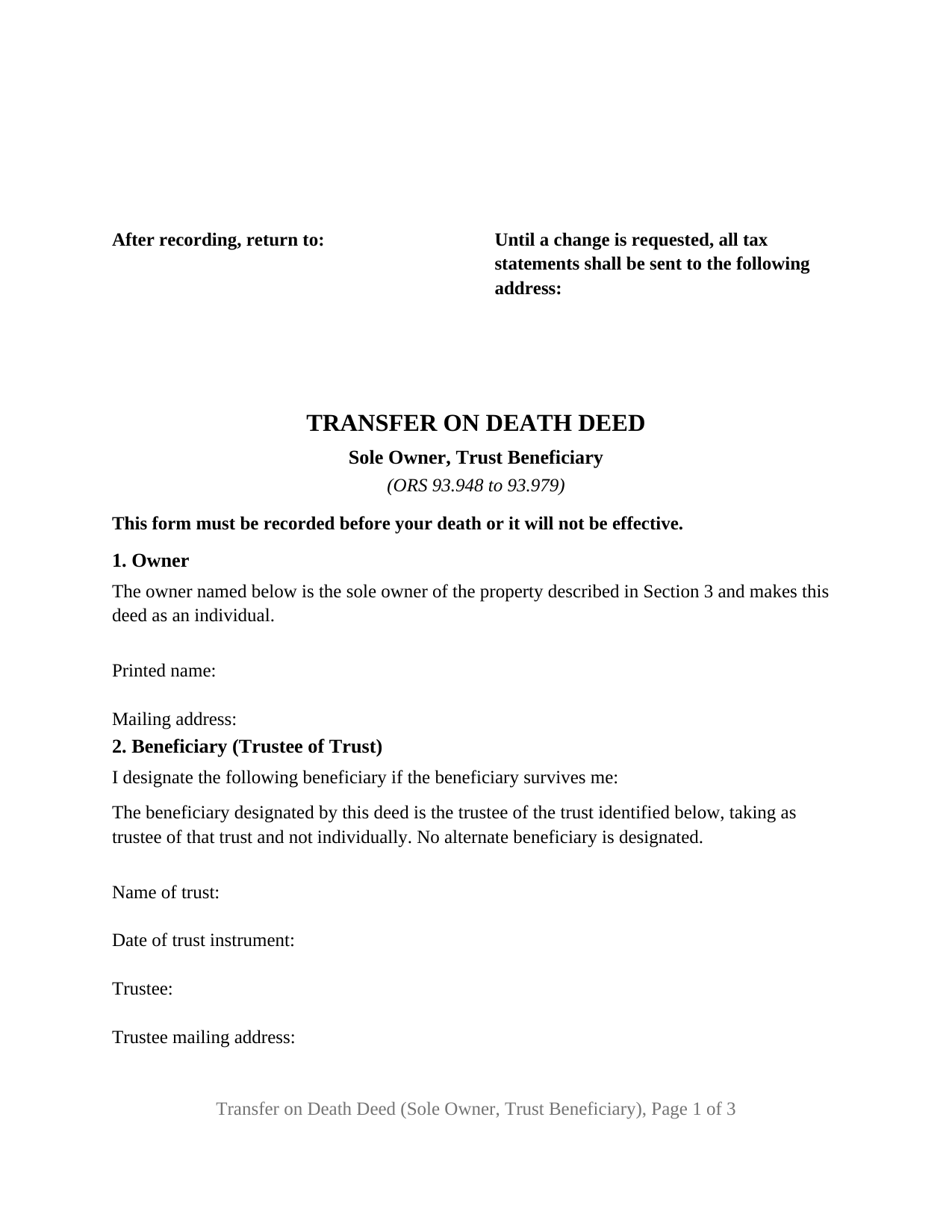
Hood River County Transfer on Death Deed (Sole Owner, Trust Beneficiary) Form
Fill in the blank Transfer on Death Deed (Sole Owner, Trust Beneficiary) form formatted to comply with all Oregon recording and content requirements.
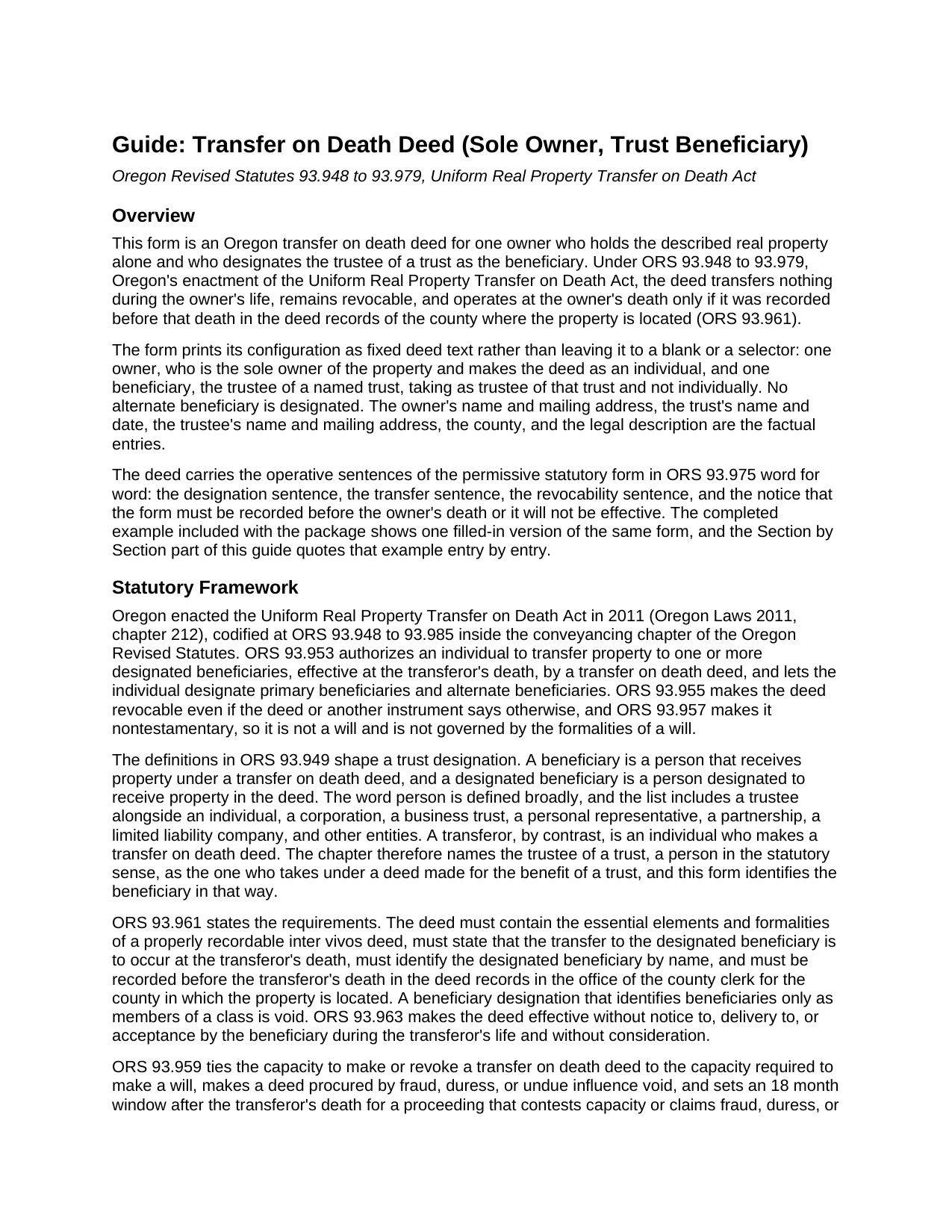
Hood River County Transfer on Death Deed (Sole Owner, Trust Beneficiary) Guide
Line by line guide explaining every blank on the Transfer on Death Deed (Sole Owner, Trust Beneficiary) form.
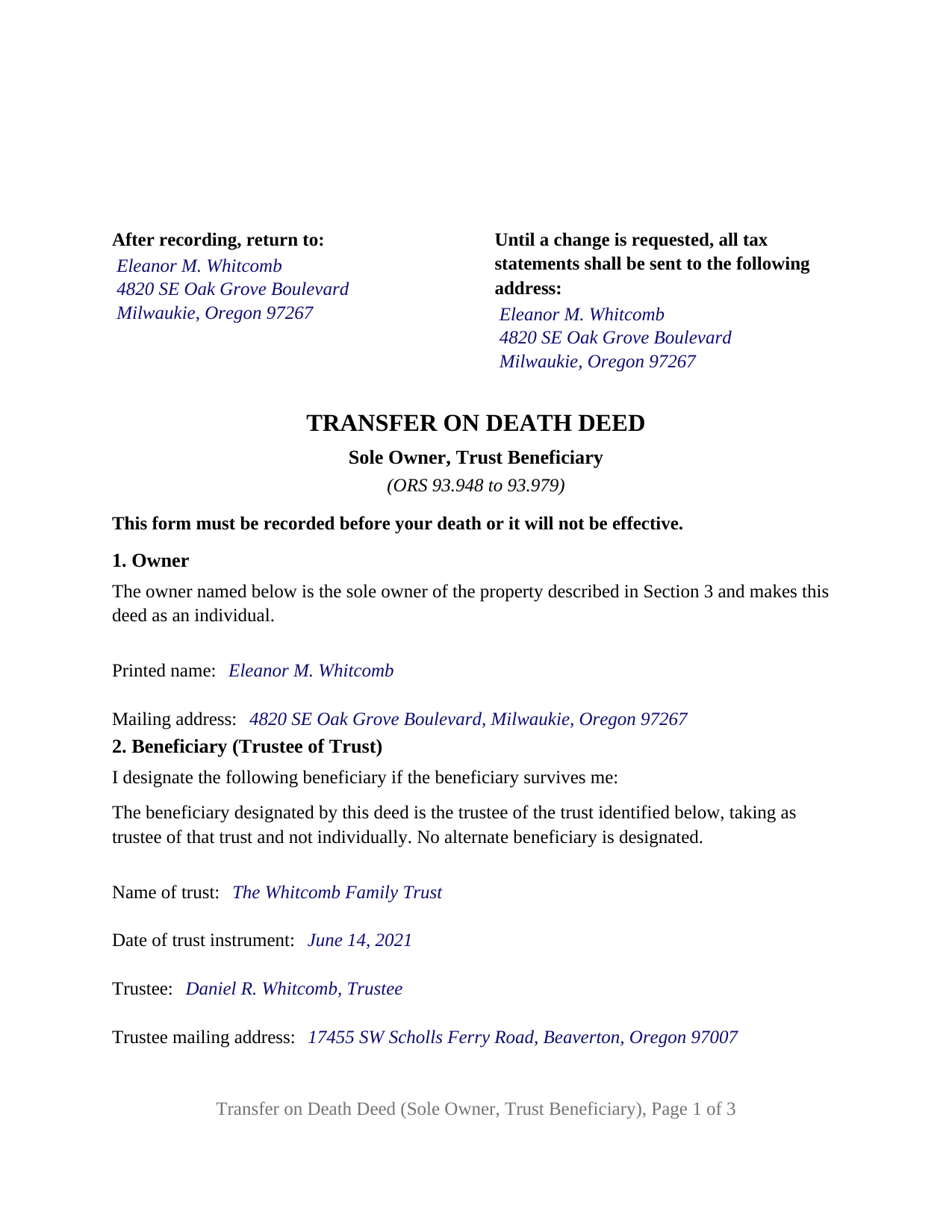
Hood River County Completed Example of the Transfer on Death Deed (Sole Owner, Trust Beneficiary) Document
Example of a properly completed Oregon Transfer on Death Deed (Sole Owner, Trust Beneficiary) document for reference.
All 3 documents above included • One-time purchase • No recurring fees
Immediate Download • Secure Checkout
Additional Oregon and Hood River County documents included at no extra charge:
Where to Record Your Documents
County Department of Records
Hood River, Oregon 97031
Hours: 8:00 to 5:00 M-F / Recording: 9:00 to 4:00
Phone: (541) 386-1442
Recording Tips for Hood River County:
- Bring your driver's license or state-issued photo ID
- Ensure all signatures are in blue or black ink
- Check that your notary's commission hasn't expired
- Documents must be on 8.5 x 11 inch white paper
- Double-check legal descriptions match your existing deed
Cities and Jurisdictions in Hood River County
Properties in any of these areas use Hood River County forms:
- Cascade Locks
- Hood River
- Mount Hood Parkdale
- Odell
Hours, fees, requirements, and more for Hood River County
How do I get my forms?
Forms are available for immediate download after payment. The Hood River County forms will be in your account ready to download to your computer. An account is created for you during checkout if you don't have one. Forms are NOT emailed.
Are these forms guaranteed to be recordable in Hood River County?
Yes. Our form blanks are guaranteed to meet or exceed the applicable formatting requirements used for recording in Hood River County, including margin requirements, font requirements, and other layout standards. This guarantee applies to formatting, not to the legal sufficiency of information entered by the user or the suitability of a form for a particular transaction.
Can I reuse these forms?
Yes. You can reuse the forms for your personal use. For example, if you have multiple properties in Hood River County you only need to order once.
What do I need to use these forms?
The forms are PDFs that you fill out on your computer. The free Adobe Acrobat Reader is recommended, and most PDF apps also work. You do NOT enter your property information online - you download the blank forms and complete them privately on your own computer.
Are there any recurring fees?
No. This is a one-time purchase. Nothing to cancel, no memberships, no recurring fees.
How much does it cost to record in Hood River County?
Recording fees in Hood River County vary. Contact the recorder's office at (541) 386-1442 for current fees.
Questions answered? Let's get started!
A trustee, named by name, is the person this Oregon transfer on death deed designates to take the property at the owner's death. The form is written for one owner who holds Oregon real property alone and who wants the property to pass, outside probate, into a trust that already exists: the deed identifies the trust by its name and the date of its trust instrument, identifies the trustee by name, and states as fixed deed text that the trustee takes as trustee of that trust and not individually. It is the Oregon transfer on death deed, the instrument also searched as a beneficiary deed or TOD deed, in the one configuration where the taker is a fiduciary rather than a person taking for himself or herself, under ORS 93.948 to 93.979, Oregon's Uniform Real Property Transfer on Death Act.
A trustee is a person under the chapter
Oregon's chapter does not speak of naming a trust. It speaks of designating a person, and ORS 93.949(4) defines a person to include a trustee, in the same list as an individual, a corporation, a business trust, a partnership, and a limited liability company. A beneficiary under ORS 93.949(1) is a person that receives property under a transfer on death deed, and a designated beneficiary under ORS 93.949(2) is a person designated to receive it. So a deed made for the benefit of a trust designates the trustee, and that is what this deed does. Under ORS 93.961(1)(c) the deed must identify the designated beneficiary by name, and under ORS 93.961(2) a designation that names only a class of beneficiaries, and no person, is void; the deed meets that rule by printing the trust's name and date and the trustee's own name on separate lines in its beneficiary section, under the designation sentence the permissive statutory form in ORS 93.975 prints.
What the chapter leaves open, the deed leaves open too. ORS 93.969(1)(a) transfers a designated beneficiary's interest if the beneficiary survives the transferor and lapses it otherwise, and nothing in the chapter states how that rule reads where the named trustee has resigned, died, or been replaced, or where the trust itself has been revoked, before the owner's death. Oregon's trust code defines trustee to include a successor trustee (ORS 130.010(23)), but that definition is written for ORS chapter 130. The guide describes the question as the chapter leaves it; the deed adds no sentence of its own about successor trustees, because the statute supplies none, and it designates no alternate beneficiary.
What the deed fixes and what it asks for
The deed recites exactly one owner, who is the sole owner of the described property and makes the deed as an individual, and exactly one beneficiary, the trustee of the trust identified in it. Those two statements are printed deed text, not a selector and not a blank. The factual entries are the owner's name and mailing address, the trust's name and the date of its instrument, the trustee's name and mailing address, the county, and the legal description copied from the vesting deed. An owner who created a trust for grandchildren and appointed an adult child as its trustee, and an owner who holds a rental house alone and wants it administered under an existing trust after death, present the pattern this deed recites. An owner who is the trustee of the owner's own revocable trust presents the open question described above, and the guide says so rather than resolving it.
The deed is not set up as a designation of an individual, an entity, or several beneficiaries in shares, as a designation with an alternate, or as a deed by two owners, by an owner who already holds title as trustee, by an entity owner, or by an owner signing through an attorney in fact. ORS 93.965(2) lets a designated agent revoke a transfer on death deed only where the deed expressly grants that authority, and this deed grants none. The ORS 93.975 form's optional SPECIAL TERMS blank is omitted as well, so the chapter's own rules apply as written.
Signed by the owner alone, acknowledged once
One signature block and one acknowledgment certificate are all the deed carries. ORS 93.961(1)(a) applies the formalities of a properly recordable inter vivos deed, and ORS 93.410 supplies them for a deed executed in Oregon: the grantor's signature, acknowledged before a qualified officer, with no seal and no subscribing witnesses. The certificate uses the ORS 194.285(1) short form sentence and reserves an area for the official stamp ORS 194.280(3) requires on a tangible record. Oregon has no community property regime and ORS 112.685 abolished dower and curtesy, so a spouse who is not on the title has no signature line, and the trustee does not sign at all; ORS 93.963 makes the deed effective without acceptance by the beneficiary during the owner's life. The owner's marital status is neither printed nor asked for.
Recorded before death, and taken subject to the record
The one condition that decides whether the designation works is recording. ORS 93.961(1)(d) requires the deed to be recorded before the transferor's death in the deed records of the county clerk for the county where the property is located, and the deed prints the statutory form's recording notice in bold directly under its title. Because ORS 205.234(1) places named items on the first page of a recorded instrument, the first page carries the title, the owner, the trust and its trustee, the return address, and the ORS 93.260 tax statement address, which ordinarily carries the owner's own address since the owner remains the taxpayer; the true and actual consideration statement and the land use statements are absent under ORS 93.030(6) and 93.040(6). The body is 12 point type on letter paper over the 10 point floor of ORS 205.232, two inches are left open at the top of page one for the clerk's label, and the recorded deed runs three pages plus any exhibit.
At the owner's death the trustee takes what the owner then holds, subject under ORS 93.969(2) to every mortgage, lien, and other interest of record and to a state claim for public or medical assistance reimbursement where the probate estate cannot pay it, and under ORS 93.969(4) without covenant or warranty of title. During the owner's life, under ORS 93.967, the recorded deed changes nothing: the owner keeps every right to sell or encumber the property, the trust acquires no interest, and the owner's creditors and public assistance eligibility are unaffected. A recorded deed is revoked only as ORS 93.965 provides, by a later transfer on death deed, an instrument of revocation, or a lifetime deed, each acknowledged after this deed and recorded before the owner's death; a will does not revoke it, and the instrument of revocation is prepared separately and is not part of this package.
The download delivers three files: the fillable transfer on death deed behind its non-recorded instructions cover page, a completed example filled in for a fictional Clackamas County owner who designates the trustee of a family trust, and a seven page guide that explains each section of the deed and the Oregon statutes it rests on. This description and the guide are general information about the form and the governing law, not an application of that law to any owner, trust, or property, and not legal advice.
Important: Your property must be located in Hood River County to use these forms. Documents should be recorded at the county recording office listed above.
This Transfer on Death Deed (Sole Owner, Trust Beneficiary) meets all recording requirements specific to Hood River County.
Our Promise
The documents you receive here are guaranteed to meet or exceed the applicable Hood River County recording format requirements. If there is a rejection caused by our formatting, we will correct the issue or refund your payment. This guarantee applies to document formatting only and does not extend to information entered by the user, the selection of the form, or the legal effect of the completed document.
Save Time and Money
Get your Hood River County Transfer on Death Deed (Sole Owner, Trust Beneficiary) form done right the first time with Deeds.com Uniform Conveyancing Blanks. At Deeds.com, we understand that your time and money are valuable resources, and we don't want you to face a penalty fee or rejection imposed by a county recorder for submitting nonstandard documents. We constantly review and update our forms to meet rapidly changing state and county recording requirements for roughly 3,500 counties and local jurisdictions.
4.8 out of 5 - ( 4,864 Reviews )
ziad k. 5 out of 5 stars
FIRST TIME USER EXCELENT SERVICE.
Thank you for your feedback. We really appreciate it. Have a great day!
Alma S. 5 out of 5 stars
I like the service very much, it's easy and fast, I'm really happy with the service.
Thank you!
ELIZABETH G. 5 out of 5 stars
This site was very easy to use. Great direction on how to complete the form.
We appreciate your business and value your feedback. Thank you. Have a wonderful day!
Timothy K. 5 out of 5 stars
Great company to work with, quick responses.
We appreciate your business and value your feedback. Thank you. Have a wonderful day!
Xochitl B. 5 out of 5 stars
Excellent website, thanks so much.
Thank you!
marc g. 5 out of 5 stars
Nice product and Fillable PDF's :) Thanks Deeds!!
Thank you for your feedback. We really appreciate it. Have a great day!
Gwenevere J. 5 out of 5 stars
Website is very informative and user friendly!
Thank you!
Elverta B. 5 out of 5 stars
Very easy to complete Quitclaim Deed
We’re glad to hear things went well. Thank you for the review.
Kimberly C. 5 out of 5 stars
Very straight forward easy to use. No need to hunt for the information or forms you ate looking for, every thing is right there just click on the link and voila!
Thank you for your feedback. We really appreciate it. Have a great day!
Lana B. 5 out of 5 stars
Website is easy to use. I ordered the form, filled it out and uploaded it for recording. My only critique is that you can't preview the form before ordering and paying for it. I ordered a Deed of Full Reconveyance form only to find out I needed the Substitution of Trustee and Deedn of Reconveyance form instead. So I wasted $22 on the wrong form.
Thank you for your feedback. Order and payment for the incorrect order has been canceled. Have a wonderful day.
Jim D. 5 out of 5 stars
A bit pricey for someone on a fixed income.
Thank you!
L. Candace H. 5 out of 5 stars
So far it's been good & informative. I have not chosen forms for download but I like the site. Thanks
Thank you!
Jason J. 5 out of 5 stars
My first submission was super quick and easy. I had trouble with the second submission, as I was not aware of what the county would require, but the team at Deeds.com walked me through every step of the process. Will definitely use again and refer business partners to Deeds.com!
Thank you, Jason! We’re glad your first submission went smoothly and appreciate your patience with the second. County requirements can vary, and we’re always here to help make the process as simple as possible. We look forward to assisting you — and your business partners — again soon!
Ryan J. 5 out of 5 stars
This was an excellent experience. The jurisdiction I was registering the Deed with, entrusts Deeds.com with their filing needs. And the staff held my hand through the process, and worked to submit the best package, and the Deed was successfully recorded.
We appreciate your business and value your feedback. Thank you. Have a wonderful day!
Debbie K. 5 out of 5 stars
I am very happy with Deeds.com. I found the site easy to use and all the directions I needed were available. I'm so happy I didn't have to go to a title company to get this done. The site is easy to navigate and the documents are easy to download.
Thank you for your feedback. We really appreciate it. Have a great day!