Oregon Warranty Deed (Two Grantors)
County Specific Legal Forms Validated as recently as October 9, 2026 by our Forms Development Team
About the Oregon Warranty Deed (Two Grantors)
How to Use This Form
- Select your county from the list
- Download the county-specific form
- Fill in the required information
- Have the document notarized if required
- Record with your county recorder's office
What Others Like You Are Saying
"Everyone was very responsive and helpful. Thank you. I give you a 5!!"
"The DOCUMENT AND INFORMATION WAS JUST WHAT I WANTED AND NEEDED. HOWEVER, NAVIGATING THE ON LINE PROC…"
"The website and information is fine. The proof in the pudding, of course, is whether the forms I use…"
"One day start to finish and so easy to complete."
"Great products, quick downloads, the "guides" are extremely helpful. Overall 5 stars!"
4.8/5 from 4,828 reviews. Read all
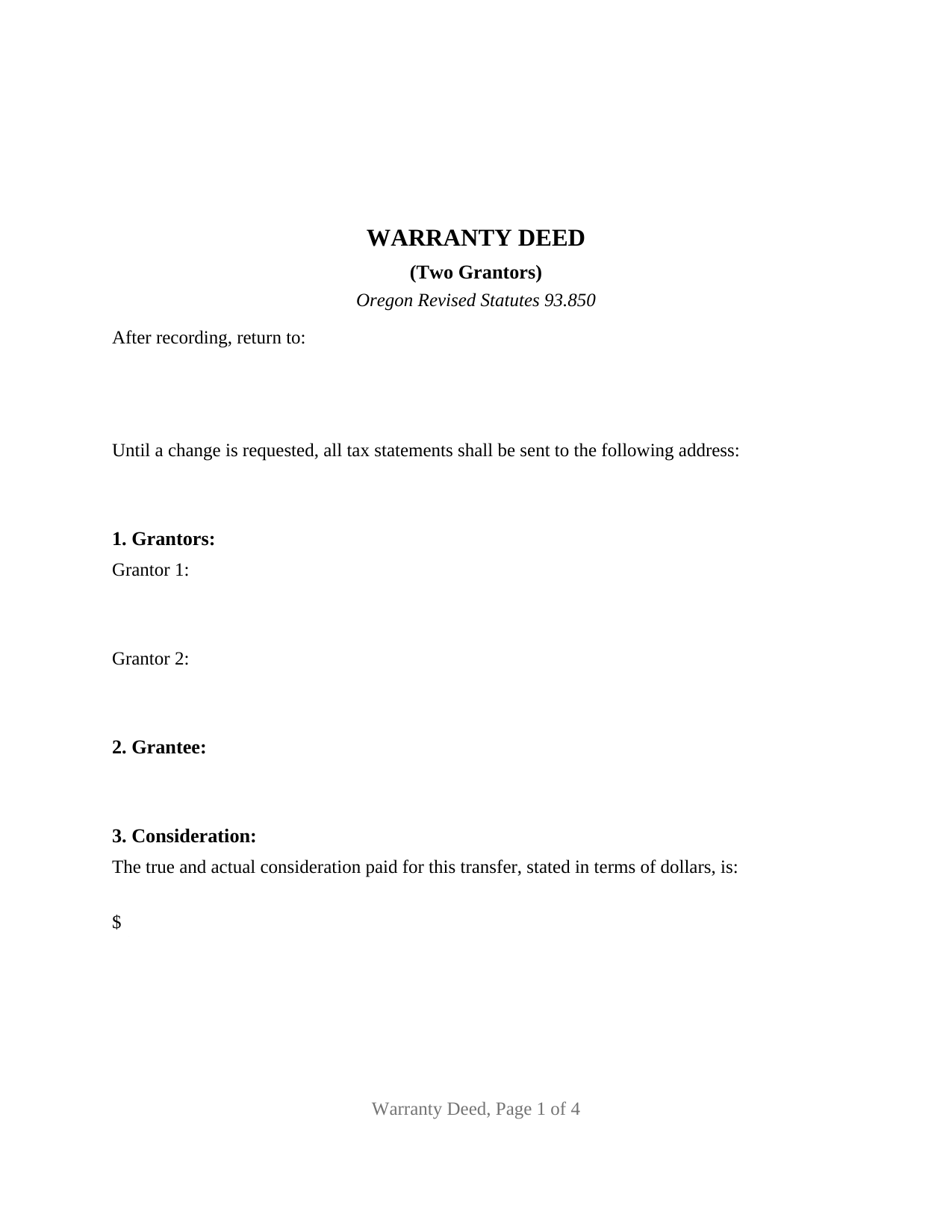
Two names on the title, two signatures on the deed. This Oregon Warranty Deed (Two Grantors) is a statutory form under ORS 93.850 drafted for exactly two people who hold record title together and convey Oregon real property to one grantee with full covenants of title. The form recites both grantors with their mailing addresses, carries a dated signature line for each, and closes with a separate acknowledgment certificate for each signature, so the two owners can appear together before one notary or sign apart, on different dates and in different places.
Two signatures that pass one whole title
When two people hold Oregon land together, each owns an interest the other cannot convey alone; a deed signed by only one of two co-owners moves only that signer's share. This form joins both interests in a single instrument. A married couple selling a home they hold as tenants by the entirety, two tenants in common conveying a whole parcel to one buyer, and siblings passing both halves of an inherited property to a single purchaser all present the two-grantor pattern this deed recites. When the pair together holds the entire fee, their joined signatures pass complete title in one recording, and every covenant in the deed comes from both of them.
Covenants that reach back through the chain
Oregon attaches meaning to deed vocabulary by statute. Because this form uses the operative words conveys and warrants, ORS 93.850 supplies covenants that the grantors are seized of the estate, that they have good right to convey it, that the property is free from encumbrances except those specifically set forth on the deed, and that they will defend the title against all lawful claims. These promises are not limited to the years the two grantors owned the property; a general warranty deed answers for the title's whole history, the broadest assurance among Oregon's statutory deed vocabularies. The deed also passes the grantors' entire interest as of its date and carries after-acquired title. Since only the encumbrances actually listed escape the covenants, the deed's exceptions section, usually completed from a current title report, marks the exact edge of what the two grantors promise.
The statutory text riding on the face
An Oregon fee-title deed carries scripted content. This form states the true and actual consideration in dollars as ORS 93.030 requires before a county clerk may accept the deed, prints the land-use and property-rights statement that ORS 93.040 places in the body of the instrument, and includes the ORS 93.260 line directing where property tax statements go. The items ORS 205.234 assigns to the first page, including the return address and the consideration, sit on page one, and the top of that page stays clear for the recording label.
Priority in a race-notice state
The deed records with the county clerk where the land lies. Under ORS 93.640, an unrecorded conveyance loses to a later good-faith purchaser who records first, so prompt recording is what secures the grantee's priority. Fees follow each county's schedule under ORS 205.320, and a deed that drifts from the formatting statutes is still recorded, with a 20 dollar nonstandard-instrument charge under ORS 205.327 added to the bill.
What this configuration is, and is not
The form recites exactly two grantors signing in their individual capacities, with one grantee taking title. It is not set up as a sole-owner conveyance, a conveyance by three or more owners, a transfer by an entity, trustee, or personal representative, or a signing under a power of attorney; each of those patterns calls for different recitals and certificates. Joint owners searching for a co-owner deed, a two-seller general warranty deed, or a husband-and-wife property transfer form describe the configuration this document carries.
The purchase delivers three items: this fillable two-grantor warranty deed form, an example deed completed with sample entries from a Deschutes County fact pattern, and a step-by-step guide to the form's sections and the recording process. The materials are informational only and are not legal advice; questions about a particular title belong with an Oregon attorney.
Important: County-Specific Forms
Our warranty deed (two grantors) forms are specifically formatted for each of the 36 counties in Oregon.
After selecting your county, you'll receive forms that meet all local recording requirements, ensuring your documents will be accepted without delays or rejection fees.