Oregon Warranty Deed
County Specific Legal Forms Validated as recently as October 9, 2026 by our Forms Development Team
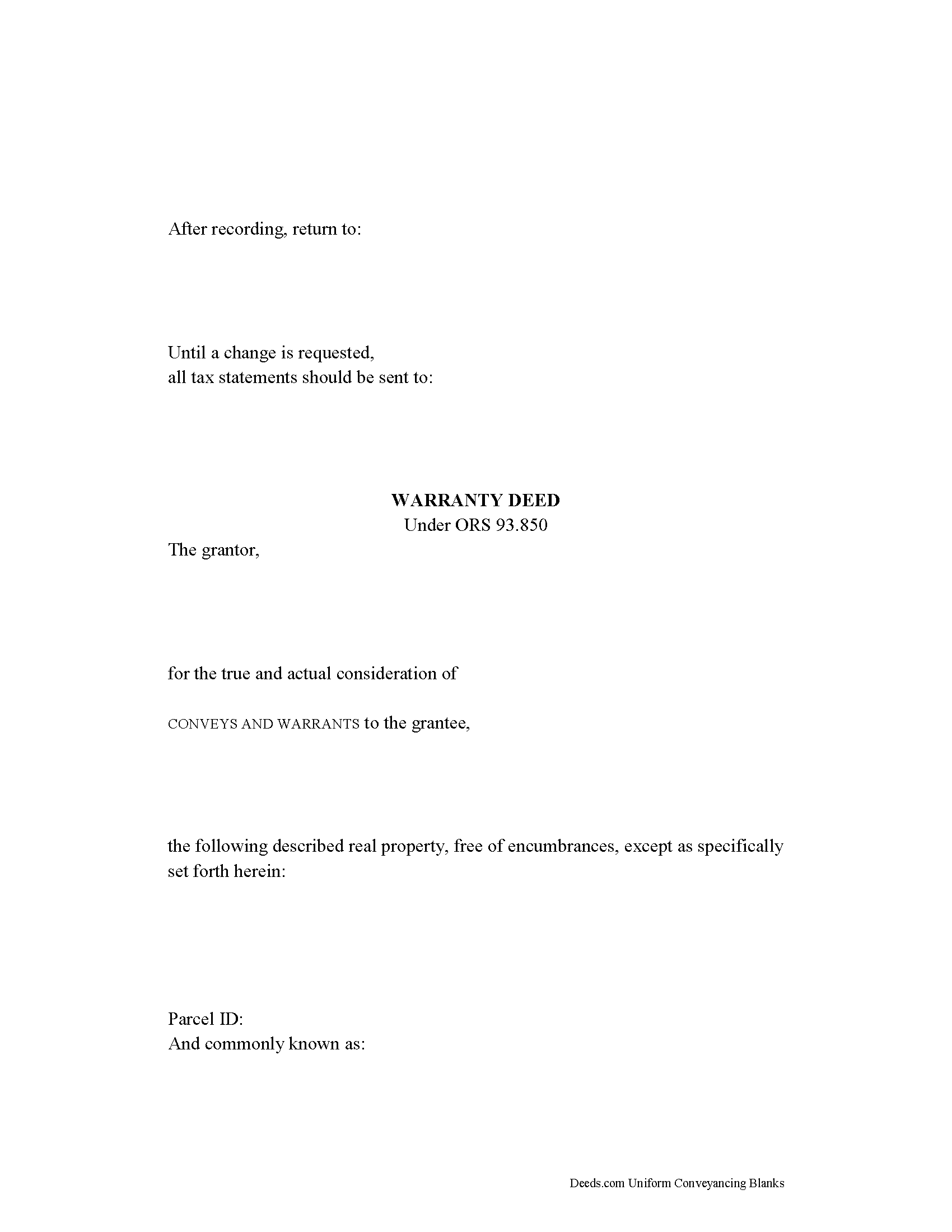
About the Oregon Warranty Deed
How to Use This Form
- Select your county from the list
- Download the county-specific form
- Fill in the required information
- Have the document notarized if required
- Record with your county recorder's office
What Others Like You Are Saying
"My needs were met quickly and efficiently with very little wait. Deeds.com made it easy to understan…"
"Quick, easy way to get the forms I needed"
"Fairly easy to use. Need to be able to find platts easy."
"site is very helpful and easy to use."
"Very easy very clear very informative of direct information stating the obvious and the underlining …"
4.8/5 from 4,823 reviews. Read all
Title in Oregon rarely arrives in a standard shape: sometimes one owner signs the property away, sometimes two, and sometimes two people take it. This Oregon warranty deed absorbs that variation in one document. The grantor block accepts one name or two, the grantee block accepts one name or two plus the words describing how the new owners hold, the second signature block and certificate left blank when one owner conveys alone. It is the statutory warranty deed of ORS 93.850, for individuals signing in their own names.
One form, one or two names on each side
The party blocks preprint nothing about marital status, capacity, or co-ownership, so each entry says what the record says: the name as it reads on the current vesting deed, any status recital, and on the receiving side the vesting words that follow the names. Blocks headed GRANTOR and SECOND GRANTOR (if applicable) each carry a certificate, so owners signing in different places on different dates each have one of their own. Patterns needing language this form does not recite belong elsewhere: an entity conveying through an officer, a fiduciary acting as trustee or personal representative, an attorney in fact under a power of attorney, and three or more owners on one side.
What conveys and warrants commits the grantor to
Oregon assigns deed consequences by operative words. ORS 93.850 keys its consequences to a deed reciting that the grantor conveys and warrants the described property free of encumbrances except as specifically set forth. Such a deed passes the entire interest held at its date, carries after acquired title, and supplies covenants of seizin and good right to convey, of freedom from listed encumbrances only, and of warranty and defense against all persons who may lawfully claim the property. That warranty answers for the full history of the title, not one owner's tenure, which is where this deed parts from the special warranty, bargain and sale, and quitclaim forms of ORS 93.855 through 93.865. Under ORS 93.850(3) an interest escapes the covenants only if the deed sets it out expressly, so the exceptions entry marks the promise's outer edge.
Who takes, and how they take it
Oregon default rules make the grantee entry consequential. ORS 93.180(1)(a) reads a conveyance to two or more persons as a tenancy in common unless the instrument clearly and expressly declares survivorship, and because ORS 93.180(3) abolished common law joint tenancy in real property, the label joint tenants by itself yields a tenancy in common anyway. Grantees who are spouses married to each other are the exception, taking by the entirety under ORS 93.180(1)(b) unless the deed clearly declares another estate. Survivorship among people who are not spouses runs through the construction in ORS 93.180(2), a tenancy in common in the life estate with cross contingent remainders in fee simple. The form leaves the entry open; the guide sets out each recognized form and the language creating it.
The statements Oregon prints on the face
Three statutes write text into an Oregon fee title deed; a fourth arranges page one. Consideration is stated in dollars under ORS 93.030; the ORS 93.040 land use and property rights statement prints in the body in its current wording; ORS 93.260 supplies the sentence routing future property tax statements. ORS 205.234 assigns five items to page one, and this form seats all five there, holding the top two inches clear for the recording label. A deed departing from ORS 205.232 or ORS 205.234 is still recorded under ORS 205.327, with a twenty dollar nonstandard charge added.
Getting the deed on record
The signed, notarized deed goes to the clerk of the county containing the land. ORS 93.640 resolves contests between deeds by recording order and good faith, so recording secures the interest conveyed. Fees follow each county schedule under ORS 205.320, several having raised a public land corner fee effective July 1, 2026. No transfer tax applies statewide; only Washington County levies one, under a grandfathered exception.
The download holds three items: this fillable general warranty deed form, a completed example filled at full capacity from a Lane County fact pattern, and a guide covering the sections, the vesting choices, the signing formalities, and recording. The materials are informational and are not legal advice; an Oregon attorney can address a particular title or transaction.
Important: County-Specific Forms
Our warranty deed forms are specifically formatted for each of the 36 counties in Oregon.
After selecting your county, you'll receive forms that meet all local recording requirements, ensuring your documents will be accepted without delays or rejection fees.