Mifflin County Quitclaim Deed (Corrective) Form
Last validated August 26, 2026 by our Forms Development TeamFormatted for recording in Mifflin County, for property anywhere in the county: rural and unincorporated areas as well as Allensville, Belleville, Burnham, Granville, Lewistown, Mattawana, Mc Clure, Mc Veytown and 4 more.
- 3 documents included
- Immediate PDF download
- Formatting guarantee
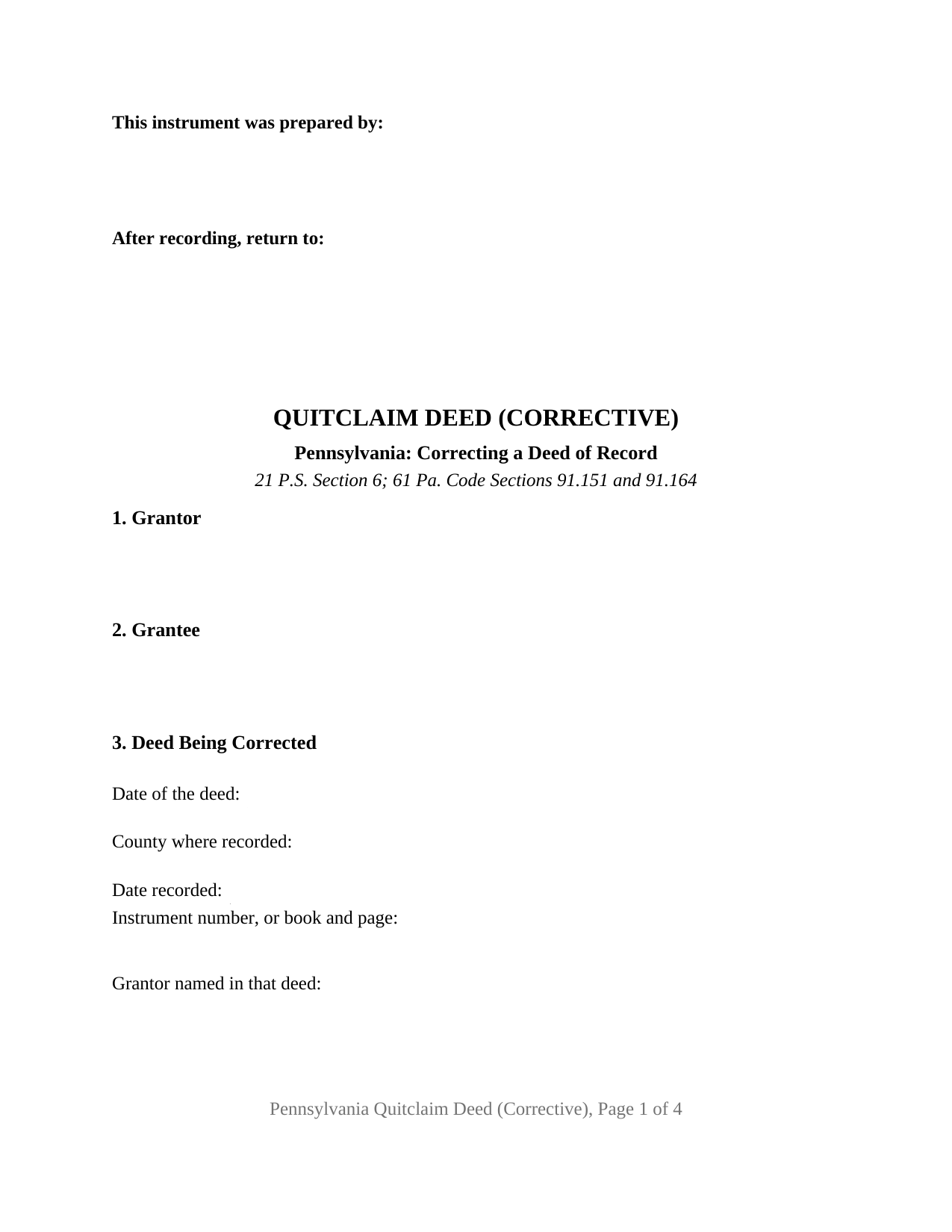
Mifflin County Quitclaim Deed (Corrective) Form
Fill in the blank Quitclaim Deed (Corrective) form formatted to comply with all Pennsylvania recording and content requirements.
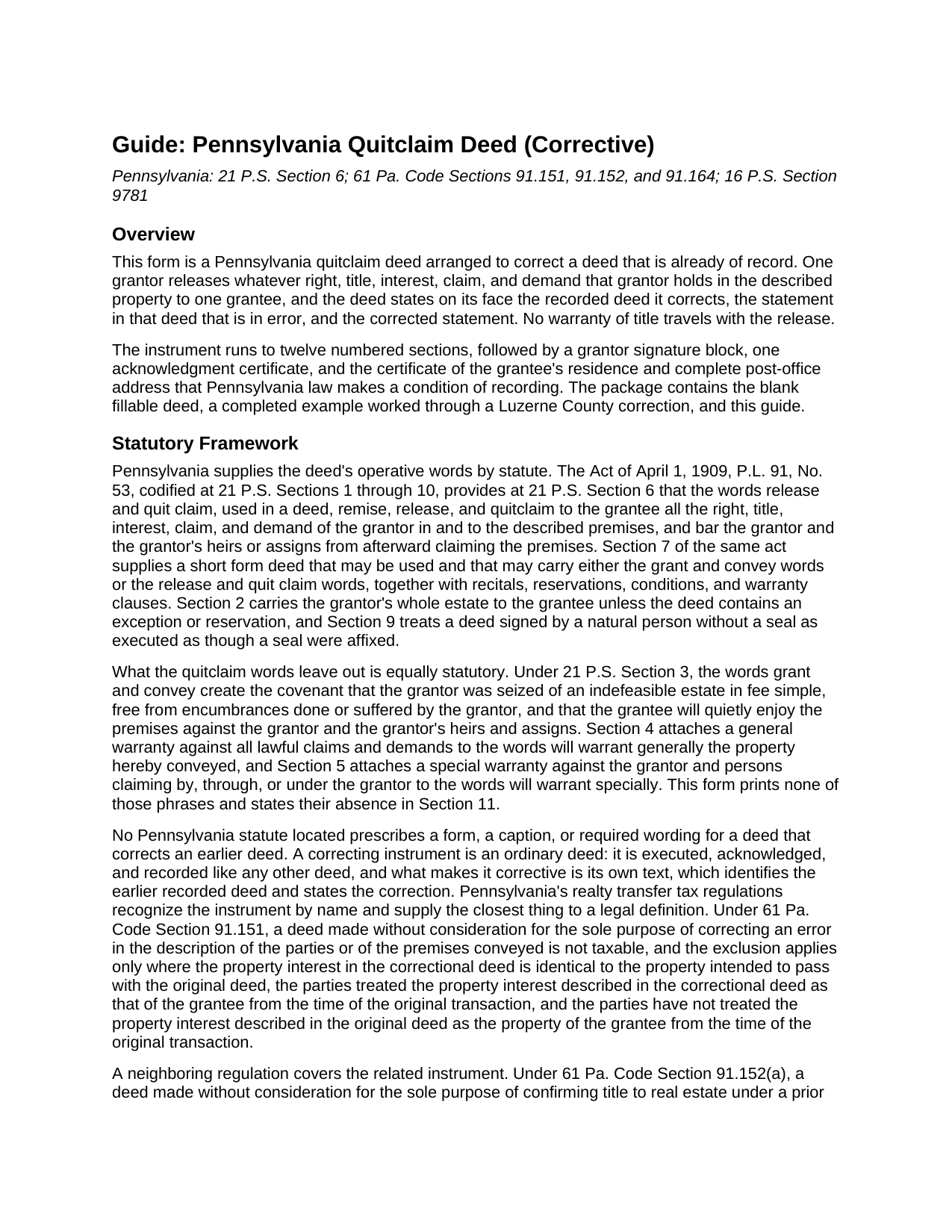
Mifflin County Quitclaim Deed (Corrective) Guide
Line by line guide explaining every blank on the Quitclaim Deed (Corrective) form.
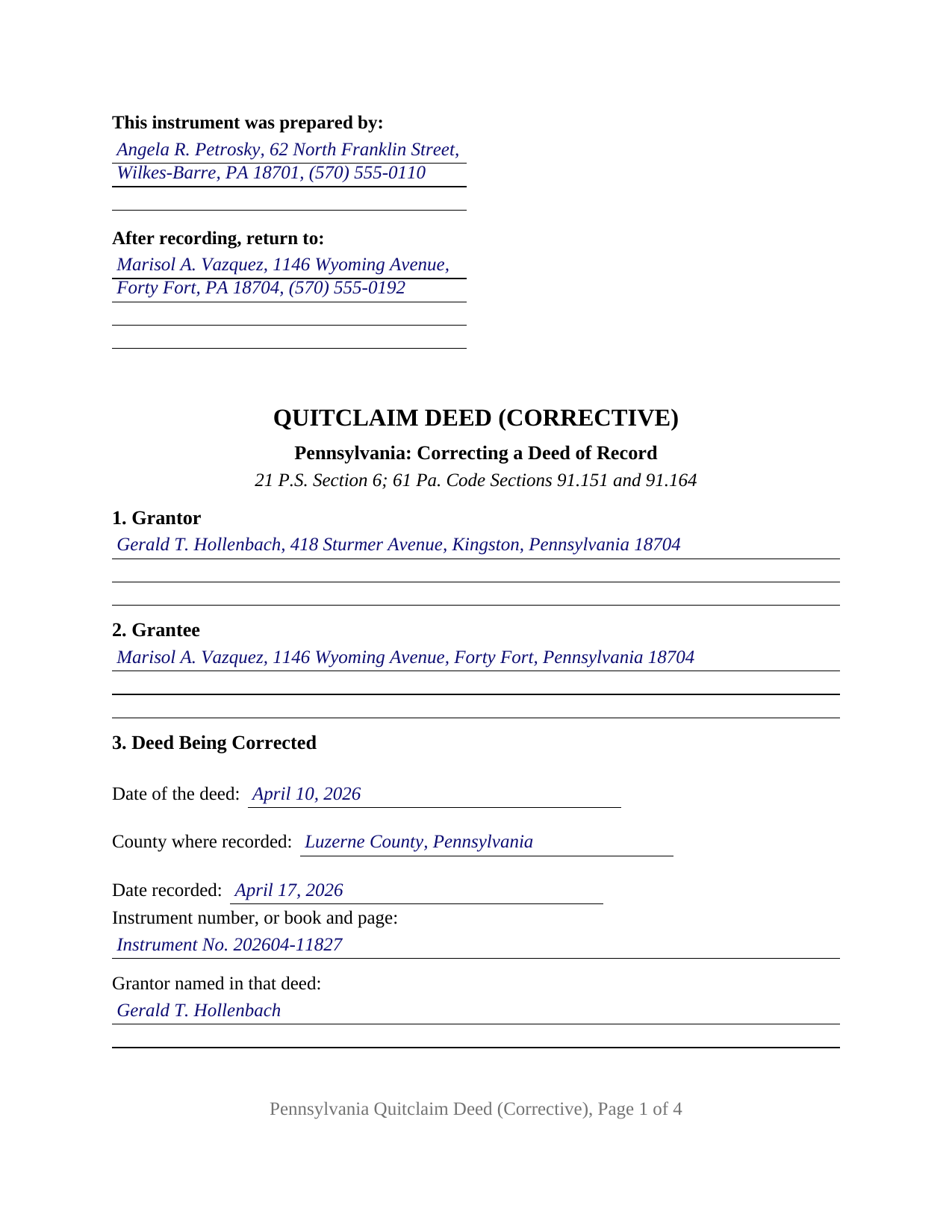
Mifflin County Completed Example of the Quitclaim Deed (Corrective) Document
Example of a properly completed Pennsylvania Quitclaim Deed (Corrective) document for reference.
All 3 documents above included • One-time purchase • No recurring fees
Immediate Download • Secure Checkout
Additional Pennsylvania and Mifflin County documents included at no extra charge:
Where to Record Your Documents
Recorder of Deeds/Register of Wills - Courthouse
Lewistown, Pennsylvania 17044
Hours: 8:00am to 4:30pm Monday through Friday
Phone: (717) 242-1449
Recording Tips for Mifflin County:
- Bring your driver's license or state-issued photo ID
- Ensure all signatures are in blue or black ink
- Recorded documents become public record - avoid including SSNs
- Recording fees may differ from what's posted online - verify current rates
- Request a receipt showing your recording numbers
Cities and Jurisdictions in Mifflin County
Properties in any of these areas use Mifflin County forms:
- Allensville
- Belleville
- Burnham
- Granville
- Lewistown
- Mattawana
- Mc Clure
- Mc Veytown
- Milroy
- Newton Hamilton
- Reedsville
- Yeagertown
Hours, fees, requirements, and more for Mifflin County
How do I get my forms?
Forms are available for immediate download after payment. The Mifflin County forms will be in your account ready to download to your computer. An account is created for you during checkout if you don't have one. Forms are NOT emailed.
Are these forms guaranteed to be recordable in Mifflin County?
Yes. Our form blanks are guaranteed to meet or exceed the applicable formatting requirements used for recording in Mifflin County, including margin requirements, font requirements, and other layout standards. This guarantee applies to formatting, not to the legal sufficiency of information entered by the user or the suitability of a form for a particular transaction.
Can I reuse these forms?
Yes. You can reuse the forms for your personal use. For example, if you have multiple properties in Mifflin County you only need to order once.
What do I need to use these forms?
The forms are PDFs that you fill out on your computer. The free Adobe Acrobat Reader is recommended, and most PDF apps also work. You do NOT enter your property information online - you download the blank forms and complete them privately on your own computer.
Are there any recurring fees?
No. This is a one-time purchase. Nothing to cancel, no memberships, no recurring fees.
How much does it cost to record in Mifflin County?
Recording fees in Mifflin County vary. Contact the recorder's office at (717) 242-1449 for current fees.
Questions answered? Let's get started!
A correcting quitclaim deed is one of the few Pennsylvania instruments whose subject is another instrument. Three numbered sections do that work: one identifies the recorded deed being corrected by date, county, and instrument number or book and page; the next sets out the statement in it that is wrong; the third states it as it belongs. Underneath sits an ordinary quitclaim, passing to one grantee whatever the single grantor holds, with no warranty of title.
The regulation that names this deed
Pennsylvania statutes prescribe no form, caption, or wording for a deed that fixes an earlier one. The instrument is an ordinary deed whose own text makes it corrective, and the nearest thing to a definition sits in the realty transfer tax regulations. Under 61 Pa. Code Section 91.151, a deed made without consideration for the sole purpose of correcting an error in the description of the parties or of the premises conveyed is not taxable, on three stated conditions, among them that the property interest in the correctional deed is identical to the property intended to pass with the original deed. Section 91.193(b)(4) carries both the correctional deed and the confirmatory deed into the list of excluded transactions, and Section 91.152 supplies separate conditions for a deed made solely to render a grantee's record title sure and unavoidable. Because an exclusion is claimed, a REV-183 Statement of Value goes to the counter under Section 91.112.
What the three correction sections collect
Section 3 takes six entries: the date of the deed being corrected, the county and date of recording, the instrument number or book and page, and the grantor and grantee as named there. Holding those names apart from the current party blocks is what lets a misspelled name be fixed without ambiguity: Section 3 preserves the name the county index carries, and Sections 1, 2, and 5 carry the corrected one. Section 11 then performs the release in the words 21 P.S. Section 6 supplies and adds the sentence a title examiner reads first: the property interest described here is the interest the earlier deed was made to pass, and no other term of that deed is changed.
One grantor, one grantee, one certificate
The architecture is narrow: one grantor block, one grantee block, one signature line with a printed name and date, and one acknowledgment certificate printing the short form wording of 57 Pa.C.S. Section 316, so the grantor may appear before a notarial officer in any state, or remotely under 57 Pa.C.S. Section 306.1. Corrections of this shape reach Pennsylvania record rooms constantly: a surname misspelled in the earlier deed and caught when the next transaction is searched, a transposed lot number in a platted description, and an identifier carried over from the adjoining lot. The form recites one grantor releasing to one grantee; entireties property is a single indivisible estate that both spouses convey together, and a signature made for a company, a trustee, or an agent rests on capacity and authority entries this quit claim deed does not print.
Where correcting stops and reforming begins
A correcting deed is a consensual instrument, and it settles nothing that is contested. Where the parties disagree about what the earlier deed was meant to say, the question goes to court: the Supreme Court in Regions Mortgage, Inc. v. Muthler, 889 A.2d 39 (Pa. 2005), traced the rule that equity reforms a written instrument for fraud, accident, or mistake, the mistake ordinarily required to be mutual. The later deed also leaves the earlier record standing: both instruments sit in the chain under their own recording dates, and 21 P.S. Section 351 protects anyone who acquired an interest for value between the two filings without notice.
At the county recorder of deeds
The correcting deed goes back to the office that recorded the first one. It closes with the certificate of the grantee's precise residence and complete post-office address that 16 P.S. Section 9781 makes a condition of recording, and carries a parcel identifier entry for the ordinance counties. Counties differ on whether a correction travels as a newly recorded deed or as the earlier deed re-recorded; this form takes the first route.
The download holds the blank corrective quitclaim deed as a fillable PDF, a completed example worked through a Luzerne County correction of a misspelled grantee name, and a guide covering the twelve sections, notarization, the transfer tax regulations, and county recording. These materials describe Pennsylvania law in general terms and are not legal advice.
Important: Your property must be located in Mifflin County to use these forms. Documents should be recorded at the county recording office listed above.
This Quitclaim Deed (Corrective) meets all recording requirements specific to Mifflin County.
Our Promise
The documents you receive here are guaranteed to meet or exceed the applicable Mifflin County recording format requirements. If there is a rejection caused by our formatting, we will correct the issue or refund your payment. This guarantee applies to document formatting only and does not extend to information entered by the user, the selection of the form, or the legal effect of the completed document.
Save Time and Money
Get your Mifflin County Quitclaim Deed (Corrective) form done right the first time with Deeds.com Uniform Conveyancing Blanks. At Deeds.com, we understand that your time and money are valuable resources, and we don't want you to face a penalty fee or rejection imposed by a county recorder for submitting nonstandard documents. We constantly review and update our forms to meet rapidly changing state and county recording requirements for roughly 3,500 counties and local jurisdictions.
4.8 out of 5 - ( 4,819 Reviews )
Larry G. 5 out of 5 stars
After purchasing the Quit Claim Deed, I felt I had purchased something I could have gotten free somewhere else. But after reviewing all the other information Deed.com provided, I realized you saved me a lot of time that would have been wasted on research. Money well spent.
Thank you for your feedback. We really appreciate it. Have a great day!
Lisa G. 5 out of 5 stars
Form and info was good
We appreciate your business and value your feedback. Thank you. Have a wonderful day!
Philip C. 5 out of 5 stars
The product I purchased looks great and I added Adobe to be able to copy it, but for some reason I can't,so I will delete Adobe and then try again to copy what i paid for. I have all the PDFS' and my computer and printer are fairly new (windows 10),I should have tried to copy it first, I'll get it! Thanks
Thank you for your feedback. We really appreciate it. Have a great day!
Jamie P. 5 out of 5 stars
The forms are easy to download. Easy to fill out. The information on the site and on the web provided by Deeds.com have been immensely helpful.
Thank you!
Jane N. 5 out of 5 stars
Good morning, It seems to be easy to navigate and print out the form I needed. Great!!! Jane
We appreciate your business and value your feedback. Thank you. Have a wonderful day!
Karen L. 5 out of 5 stars
My card was charged twice in error, I contacted deeds.com and within minutes, the error was corrected! Fast service, thank you deed.com
Thank you!
Annette L. 5 out of 5 stars
Wow -- amazingly fast turnaround and excellent customer service and communication. Thank you for saving me hours of time and effort!
We appreciate your business and value your feedback. Thank you. Have a wonderful day!
Steve R. 5 out of 5 stars
Hopefully filling out and filing the paperwork is as easy as this was.
Thank you for your feedback. We really appreciate it. Have a great day!
Melanie N. 5 out of 5 stars
I'm happy with the forms, thank you.
Thank you!
Darrell P. 5 out of 5 stars
My legal description exceeds the avaiable space in the one page Exhibit A...any way to add a second page as 'Exhibit A (continued)'?
It is not required to use the included exhibit page. Simply label your printed legal description as the appropriate exhibit.
Elizabth T. 5 out of 5 stars
Deed instructions were easy to follow & understand. Deed was exactly what I needed at a fair price.
Great to hear — thank you for taking the time to write a review.
Khadija K. 5 out of 5 stars
Great Service. Not only the required form, but also the state guidelines. Thank you for making it easy.
We appreciate your business and value your feedback. Thank you. Have a wonderful day!
Thomas D. 5 out of 5 stars
Can I use this for easement in gross ? Like to grant cousins easement to use river front property with riparian rights ?
Sorry, we are unable to give advice on specific legal situations.
Cynthia M. 5 out of 5 stars
I wanted the Lady Bird Deed for my estate, and it was very easy to download, fill out and file. My county records department accepted it with no issue. Thank you Deeds.com! You saved me over $500.00!
We appreciate your business and value your feedback. Thank you. Have a wonderful day!
Pauline G. 5 out of 5 stars
Found just what I needed!!! Instructions were easy to follow and I accomplished the task like a professional. Thank you Deeds.com!!!!
We appreciate your business and value your feedback. Thank you. Have a wonderful day!