Rhode Island Warranty Deed
County Specific Legal Forms Validated as recently as October 20, 2026 by our Forms Development Team
About the Rhode Island Warranty Deed
How to Use This Form
- Select your county from the list
- Download the county-specific form
- Fill in the required information
- Have the document notarized if required
- Record with your county recorder's office
What Others Like You Are Saying
"Very convenient and great tool for my real estate business. I'm a fan and will be a repeat customer."
"Love this site. It has been truly helpful and easy to navigate."
"Easy to use & got my one question answered in less than 5 minutes! Excellence."
"This service is amazing! We have tried several other online recording services which all disappointe…"
"Very good experience."
4.8/5 from 4,832 reviews. Read all
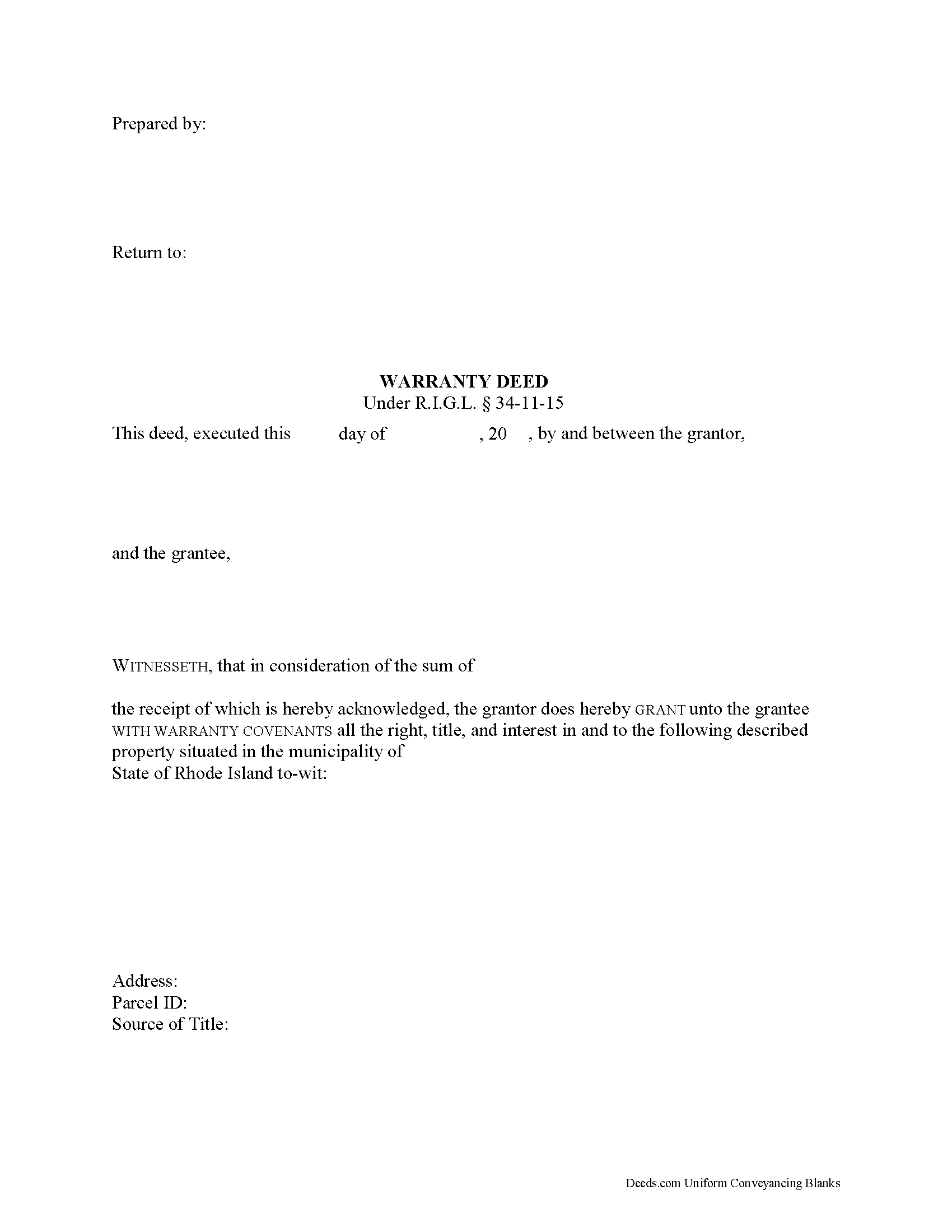
Rhode Island writes its deeds short. The warranty deed set out in Rhode Island General Laws Section 34-11-12 is one sentence long, and Section 34-11-11 adds that the statutory forms may be altered as circumstances require and do not shut out other lawful forms. This fillable general warranty deed is that sentence opened into numbered blanks, so the parties, the money, the land, and the exceptions each take their own line while the operative words stay where the statute puts them.
A One-Sentence Form the Statute Invites Adapting
The statutory model reads: the grantor, for consideration paid, grants to the grantee with warranty covenants, then the description and encumbrances if any. Section 34-11-15 measures the warranty by resemblance rather than ritual, giving a deed that substantially follows that form the force of a conveyance in fee simple together with the grantor's promises of seisin, freedom from encumbrances, authority to convey, quiet enjoyment, and defense of the title against lawful claims. What triggers all of it is the phrase, not the caption: Section 34-11-26 states that grant, grantor, and grantee imply no warranty at all, and Section 34-11-7 says as much of bargain, sell, release, and confirm. So the conveyance sentence on this form prints the words WITH WARRANTY COVENANTS, and the exceptions live in a numbered encumbrances section, which is where the covenant against encumbrances draws its line.
One or Two Names on Either Side
This is the base configuration of the Rhode Island warranty deed. The grantor block and the grantee block are open multi-line entries that hold one or two natural persons apiece, along with whatever status or ownership wording the parties state, and nothing about marriage, capacity, or co-ownership is preprinted anywhere on the instrument. Execution takes the same shape: blocks headed GRANTOR and SECOND GRANTOR (if applicable), each with the printed name Section 34-11-1.1 places beneath a signature, and one acknowledgment certificate per block, the second of each left blank where a single owner conveys. Because the grantee entry is open, the words that fix co-ownership go in beside the names, and they carry weight: Section 34-3-1 reads a deed to two or more grantees as a tenancy in common unless the instrument declares otherwise. A closing that puts buyers on the record together, a conveyance out of a couple's own names, and a family transfer at a stated price all present count patterns this deed accommodates. It is not set up as an entity deed, as the fiduciary deed for which Section 34-11-12 supplies its own form, as a conveyance under a power of attorney, or as a deed from three or more owners.
What the Municipal Clerk Reads
Rhode Island's content rules sit in small subsections and reach the counter directly. Section 34-11-1.2 looks for the grantee's name with a residence or post office address, and Section 34-11-1.4 for the total dollar amount of the actual sale on a deed given because of one; a clerk may decline a deed missing either, although neither omission unsettles a deed already delivered. Section 34-11-1.1 asks that the name of each signer and each notary be typed or printed by the signature, on pain of two dollars more at recording. Rarer and easy to overlook: Sections 34-11-1.5 and 23-18-10.1 call for a notation in capital letters where a registered historical cemetery sits on the land, which the additional provisions section carries. Where nothing at all is paid, Section 44-25-1(c) looks for a statement in the instrument that the consideration is such that no documentary stamps are required.
Recording City by City
Rhode Island has no county recorders. The signed deed goes to the clerk or recorder of deeds of the city or town where the land lies, at the statewide fee of Section 34-13-7, and a sale brings conveyance tax paid through stamps affixed to the instrument itself. A 2026 act signed on June 10 added a fraud layer: a felony offense for real estate title fraud, plus authority for a recorder with reasonable cause to treat a filing as suspicious, hold it briefly, report it, and give notice.
The package holds three pieces: the blank warranty deed as a fillable PDF, a completed example worked through a Pawtucket sale from the platted description to the notary blocks, and a plain language guide covering every numbered section, the vesting words a grantee entry can carry, execution, and municipal recording. These materials describe Rhode Island law in general terms and are not legal advice.
Important: County-Specific Forms
Our warranty deed forms are specifically formatted for each of the 5 counties in Rhode Island.
After selecting your county, you'll receive forms that meet all local recording requirements, ensuring your documents will be accepted without delays or rejection fees.