South Carolina Easement Deed
County Specific Legal Forms Validated as recently as October 2, 2026 by our Forms Development Team
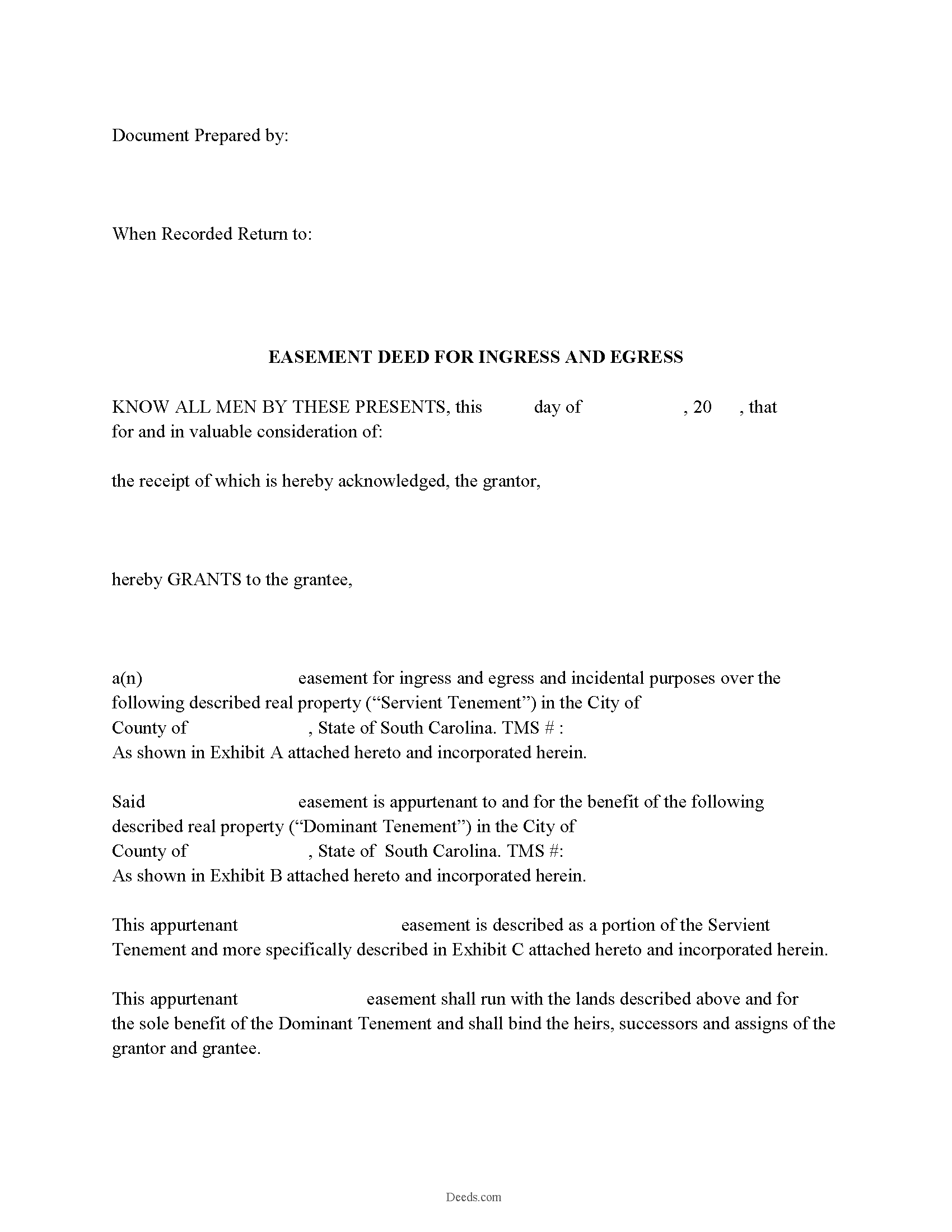
About the South Carolina Easement Deed
How to Use This Form
- Select your county from the list
- Download the county-specific form
- Fill in the required information
- Have the document notarized if required
- Record with your county recorder's office
What Others Like You Are Saying
"Very good, and easy and fast to use."
"OK service"
"Forms were quick to receive and appear to be what I need to complete our task."
"Quick download, hassle-free, no forced membership-just a straight-forward transaction. Thank you!"
"Much easier than going to the courthouse!"
4.8/5 from 4,819 reviews. Read all
An easement is a non-possessory right of use over another's land that allows the holder to use another's property for a specific purpose. Easements may be express or implied. An express easement can be created by deed, contract, or other written instrument. An express easement must describe the scope of the interest being conveyed, along with the location and dimensions of the easement. An implied easement can be created by pre-existing use, when it is evident that the parties involved intended to create an easement.
Before a deed or other instrument of writing can be recorded in South Carolina, it must be acknowledged or proved by either of the following methods: (A) the execution of the deed must be proved by the affidavit of a subscribing witness to the instrument, taken before an officer in the state competent to administer oaths or (B) a deed or other instrument must be signed by the grantor in the presence of two witnesses, taken before an officer in the state competent to administer oaths (30-5-30A, B). A notary public may be one of the witnesses to an easement deed. Acknowledgments taken out of state must comply with the Uniform Recognition of Acknowledgments Act (30-5-30.2). A derivation clause is required to be on most real estate deeds presented for recording, but is not required for a deed devoted to a utility or railroad purpose of any private or public utility or railroad. A derivation clause is also not required on any non-warranty or quitclaim deed in South Carolina (30-5-35).
An easement deed will be valid so as to affect the rights of subsequent purchasers or purchasers for valuable consideration without notice only from the time it is recorded with the register of deeds in the county where the property subject to the easement is located. The priority of instruments is determined by the time of filing for record (30-7-10). The recording of documents serves to establish a priority of claims against a specific property.
(South Carolina ED Package includes form, guidelines, and completed example)
Important: County-Specific Forms
Our easement deed forms are specifically formatted for each of the 46 counties in South Carolina.
After selecting your county, you'll receive forms that meet all local recording requirements, ensuring your documents will be accepted without delays or rejection fees.