Texas Executor Deed (Independent Executor)
County Specific Legal Forms Validated as recently as October 22, 2026 by our Forms Development Team
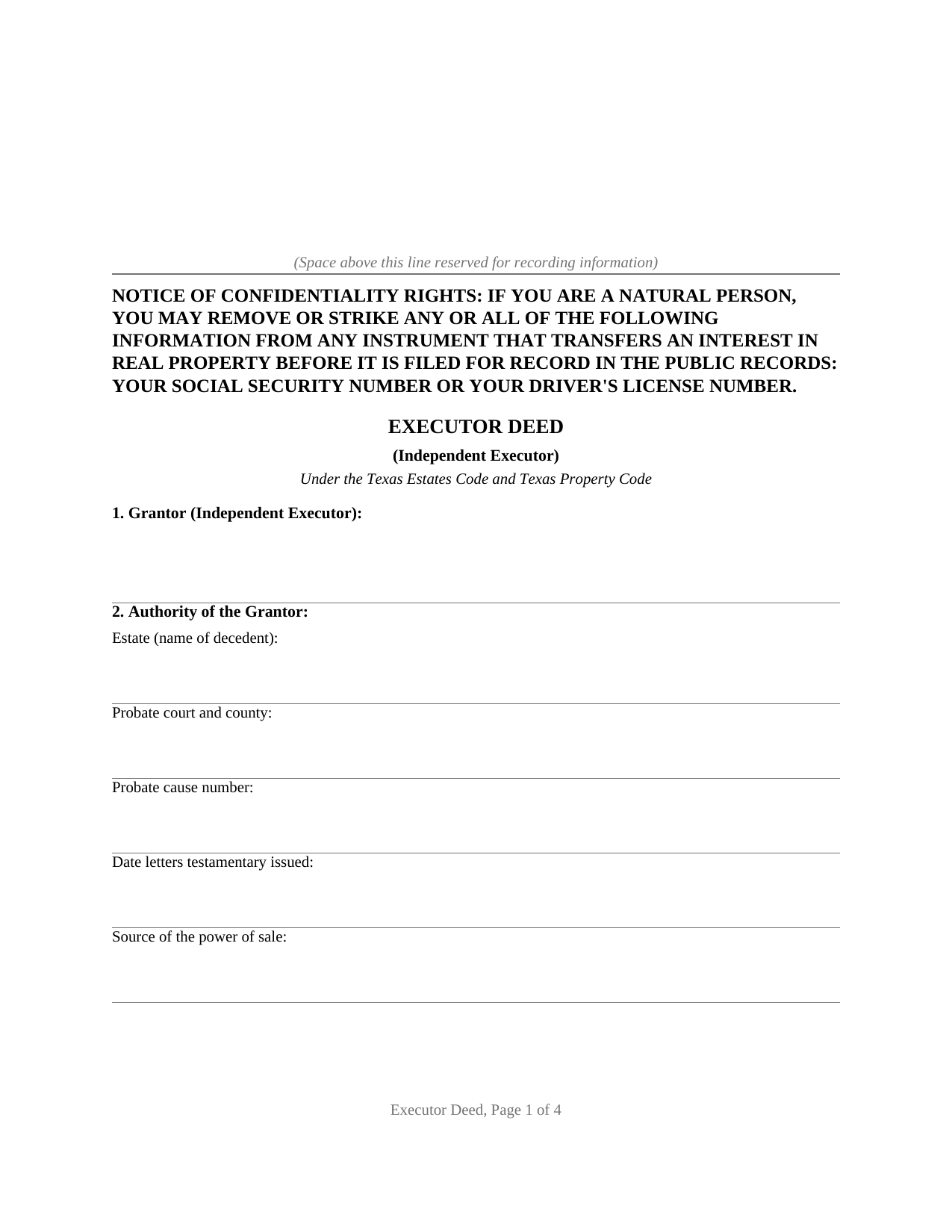
About the Texas Executor Deed (Independent Executor)
How to Use This Form
- Select your county from the list
- Download the county-specific form
- Fill in the required information
- Have the document notarized if required
- Record with your county recorder's office
What Others Like You Are Saying
"Got the quit claim forms, amazing really. Easy to understand, looked great when completed, accepted …"
"Slick"
"Great service, quick and easy!"
"Easy and fast!"
"No review provided."
4.8/5 from 4,830 reviews. Read all
When a Texas estate is administered independently, the executor named in the will does not need the probate court's permission to sell the decedent's real property. The executor deed carries out that sale, conveying the estate's interest to a buyer and recording, on the face of the document, where the executor's authority comes from. This form prepares that deed for a court-appointed independent executor of a testate Texas estate.
Where the Executor's Authority Comes From
Title to a decedent's real property does not sit unowned. Under Estates Code Section 101.001, property devised by a will vests in the devisees the moment the owner dies, subject to administration. For an independent executor the power to convey runs along one of two tracks. Section 356.002 provides that where the will authorizes the executor to sell the testator's property, no court order is needed. Section 402.052 adds that unless the will limits it, an independent executor has the same power of sale a representative would have in a supervised administration, but without court approval. This form records which track the executor relies on, and the completed example cites both the power in the will and Section 402.052.
A Deed a Buyer Can Rely On
Estates Code Section 402.053 is what makes the deed workable in the market. A buyer who is not a devisee or heir and deals in good faith need not investigate the power of sale where the will grants it, the appointing order grants it under Section 401.006, or the executor records a sworn affidavit that the sale is necessary or advisable for a purpose listed in Section 356.251. No devisee or heir has to join the deed for the buyer to take all right, title, and interest of the estate.
Why the Warranty Is Limited
An executor conveys property the executor never owned personally, so a full general warranty would have the executor guaranteeing a chain of title the executor was never part of. Texas executor deeds instead carry a special warranty, stated expressly here: the grantor, as independent executor, defends title only against claims arising by, through, or under the grantor in that capacity. The form then expressly excludes the implied covenants of Property Code Section 5.023, the covenants the words of grant would otherwise carry, so the warranty is the stated special warranty and nothing broader.
Signing, Capacity, and Recording
The grantor signs in the fiduciary capacity, not individually, and the acknowledgment certificate names the grantor as independent executor of the named estate. A spouse of the executor does not join, because the executor conveys estate property rather than the executor's own homestead. The signed deed is recorded with the county clerk of the county where the property is located, carrying the confidentiality notice required by Property Code Section 11.008 at the top of the first page.
The package includes the blank deed as a fillable PDF, a completed example on a realistic Travis County fact pattern, and a plain language guide that walks through every section. The materials are informational and are not legal advice. An intestate estate, where the court issues letters of administration instead, is conveyed with an administrator's deed; a living owner selling property held in the owner's own name uses one of the warranty, no-warranty, or quitclaim deed forms.
Important: County-Specific Forms
Our executor deed (independent executor) forms are specifically formatted for each of the 254 counties in Texas.
After selecting your county, you'll receive forms that meet all local recording requirements, ensuring your documents will be accepted without delays or rejection fees.