Texas Heirship Deed (Special Warranty by Heirs)
County Specific Legal Forms Validated as recently as September 16, 2026 by our Forms Development Team
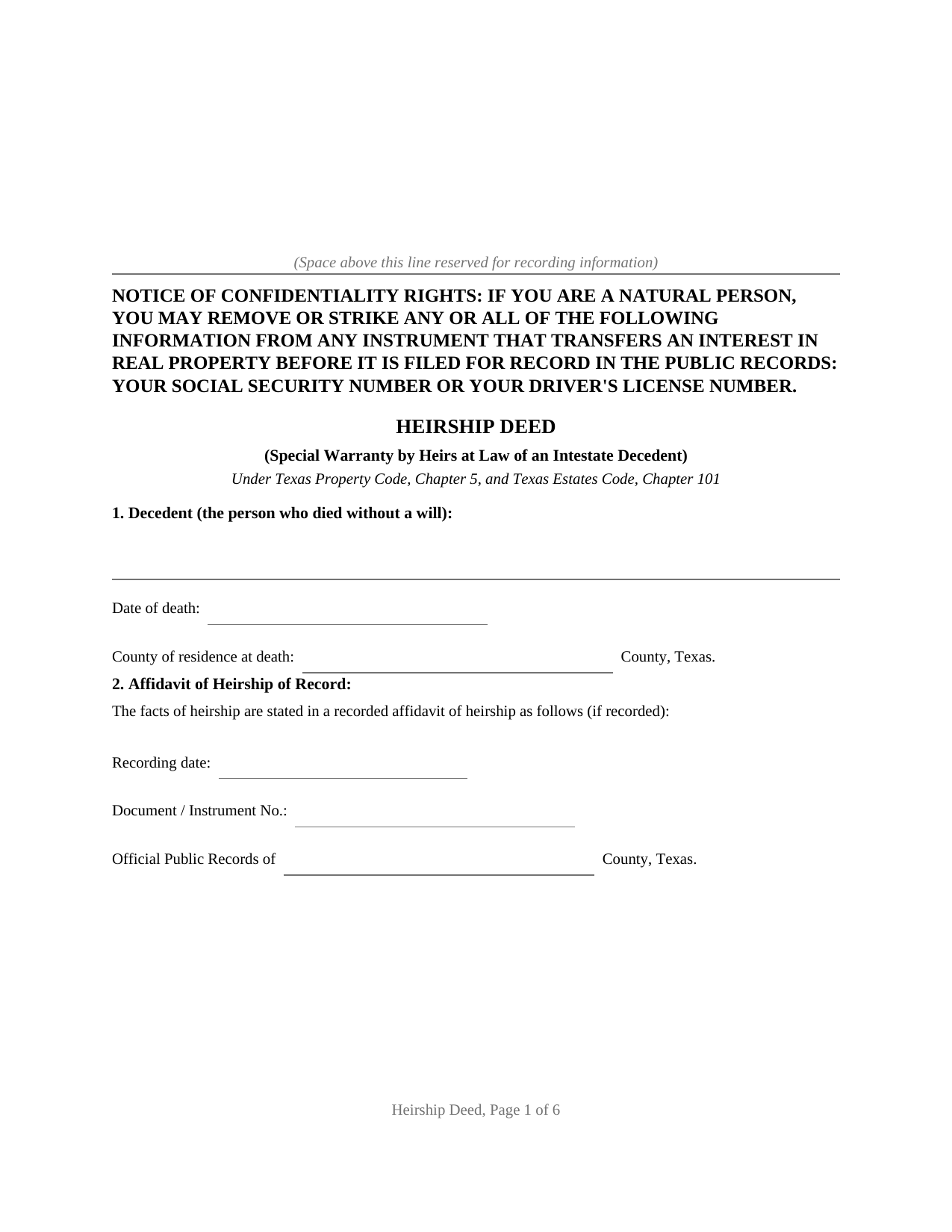
About the Texas Heirship Deed (Special Warranty by Heirs)
How to Use This Form
- Select your county from the list
- Download the county-specific form
- Fill in the required information
- Have the document notarized if required
- Record with your county recorder's office
What Others Like You Are Saying
"Looks good. We will see how it goes."
"Professional"
"You form was good the only thing that did not work was the download to fill it out !!! I use a Mac s…"
"EVERYTHING WENT WELL, HAD NO PROBLEMS DOWNLOADING MY FORMS. THE ORDER QUICK AND EASY. THANKS IF I EV…"
"Thanks"
4.8/5 from 4,818 reviews. Read all
When a Texas owner dies without a will, title to that owner's real estate does not wait on a courthouse. Under Texas Estates Code Section 101.001(b), the estate of a person who dies intestate vests immediately in the heirs at law, so the moment the owner dies the heirs already own the inherited interest. A Texas heirship deed is how those heirs put that ownership to work: it is a special warranty deed by which one or two heirs convey the property they inherited, to a buyer, to one another, or to another transferee.
Vesting at death, subject to the decedent's debts
The automatic vesting is the feature that makes this deed possible, and Section 101.051 is the string attached to it. The estate vests subject to the payment of the decedent's debts, which means a mortgage or other lien the decedent owed rides along with the property into the heirs' hands and stays on the land. A grantee who takes under a heirship deed takes subject to those matters. That reality is one reason heirs rarely give a full general warranty: they are passing along property whose earlier history they did not control.
Why heirs convey by special warranty
This form conveys with the words grant, sell, and convey, then limits its promise. The grantor binds the grantor to warrant and defend the property only against claims arising by, through, or under the grantor, and not otherwise. Texas Property Code Section 5.023 says the words grant and convey carry implied covenants unless the deed expressly provides otherwise, so the deed expressly ties those implied covenants to the same by, through, or under limit. The result is a clean conveyance that defends the grantor's own conduct as an heir without warranting the entire chain of title back through prior owners, the posture that fits someone selling property inherited from a parent or relative.
The affidavit identifies the heirs; the deed conveys
A heirship deed usually travels with a recorded affidavit of heirship under Texas Estates Code Chapter 203. The two instruments do different jobs. The affidavit states the decedent's family history and identifies the heirs, and it becomes prima facie evidence of those facts once it has been of record for five years; it does not transfer title. The deed is the instrument that transfers. Section 2 of the form records the affidavit's recording date, document number, and county, so the deed and the evidence of heirship point to each other in the chain of title. Where heirs are numerous or in disagreement, a probate court determination of heirship does the identifying instead, and a title company examining a later sale decides what it needs to insure.
Two heirs, homestead, and recording
The form carries signature lines for up to two grantors; a single heir signs on the first line and leaves the second blank. Because a heirship deed conveys during the grantors' lives, the homestead joinder rule applies: where a grantor is married and the property is that couple's homestead, Texas Family Code Section 5.001 brings the grantor's spouse onto a joinder line to release homestead rights. The deed is effective between the parties when signed and delivered, but it is recorded with the county clerk of the county where the property sits, because Section 13.001 leaves an unrecorded conveyance void as to a later good faith purchaser for value. The confidentiality notice required by Property Code Section 11.008 appears at the top of the first page, and a person filing in person on or after December 4, 2025 shows a photo identification at the recording counter.
The package includes the blank deed as a fillable PDF, a completed example built on a realistic Travis County fact pattern, and a plain language guide that walks through every section, names the source of each entry, and describes how the heirship affidavit and the intestate succession rules fit around the deed. The materials are informational and are not legal advice.
Important: County-Specific Forms
Our heirship deed (special warranty by heirs) forms are specifically formatted for each of the 254 counties in Texas.
After selecting your county, you'll receive forms that meet all local recording requirements, ensuring your documents will be accepted without delays or rejection fees.