Texas Administrator Deed (Independent Administrator)
County Specific Legal Forms Validated as recently as September 7, 2026 by our Forms Development Team
About the Texas Administrator Deed (Independent Administrator)
How to Use This Form
- Select your county from the list
- Download the county-specific form
- Fill in the required information
- Have the document notarized if required
- Record with your county recorder's office
What Others Like You Are Saying
"Used a form from this service. Best part about these forms is that they don't let you get in trouble…"
"Very easy to use. Straightforward and informative"
"Your site was very informative and I was able to instantly and easily download the documents that I …"
"Really solid system for determining what may prevent your documents from being accepted. I love the …"
"Forget what I just wrote! I found it. Thank You! This is a very convenient service."
4.8/5 from 4,817 reviews. Read all
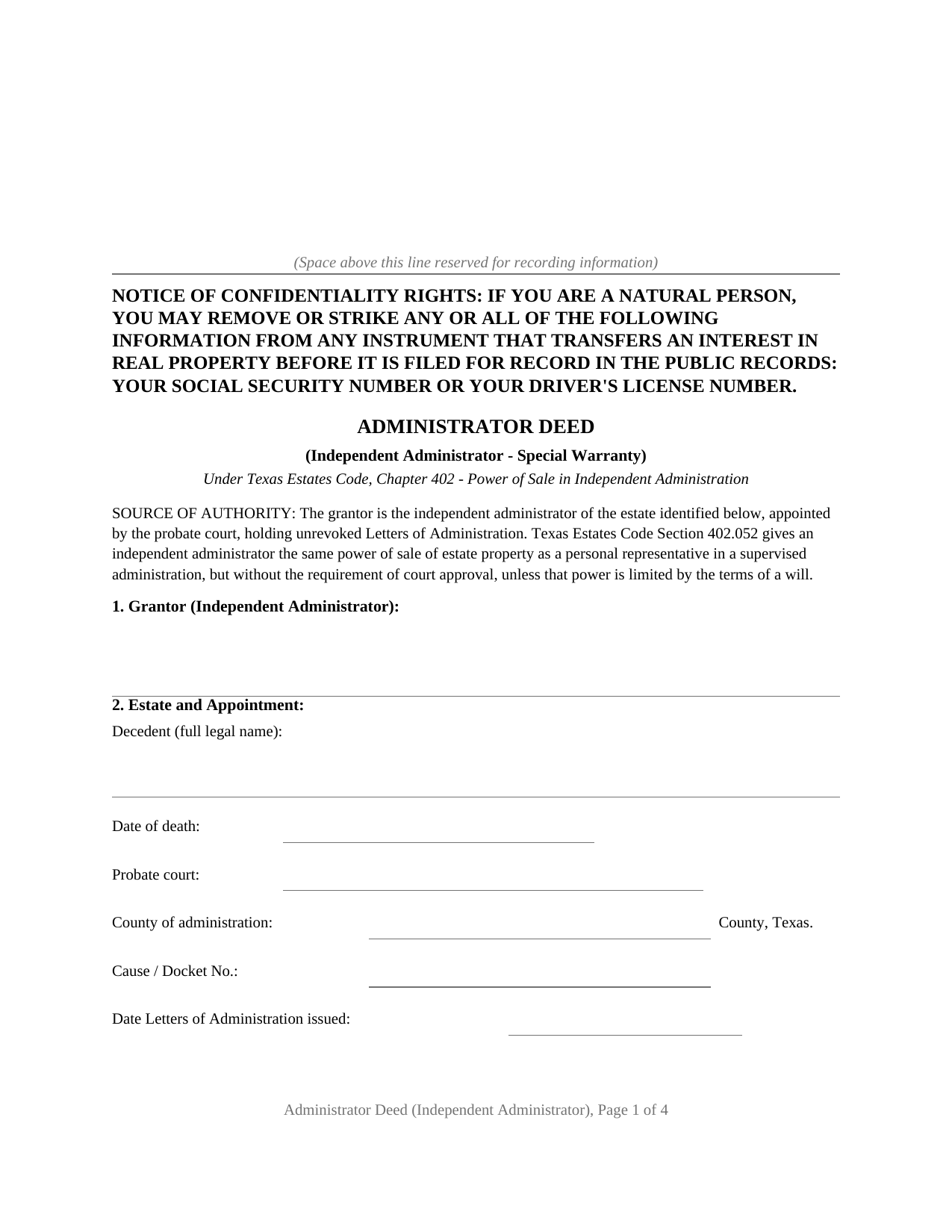
When a Texas probate court appoints an independent administrator over a deceased person's estate, that administrator can sell the estate's real property and convey it to a buyer without returning to court for approval of each sale. This form prepares the deed that carries out such a sale: an administrator deed conveying estate property under the power of sale in Chapter 402 of the Texas Estates Code, with a special warranty of title.
Authority That Comes From the Court, Not From Ownership
The administrator does not own the property and does not convey it personally. Title to a decedent's real property vests in the heirs or devisees at death, subject to administration, and the administrator conveys the estate's interest in a representative capacity. The authority rests on the probate court's appointment and the Letters of Administration the court issues. Section 402.052 of the Estates Code gives an independent administrator the same power of sale a supervised personal representative has, for the same purposes, but without the requirement of court approval, unless a will limits it.
How a Buyer Is Protected
Section 402.053 lets a buyer who is not a devisee or heir, and who deals with the administrator in good faith, rely on the sale without investigating the power of sale when one of three things is true: a will grants a power of sale, the appointment order grants one under Section 401.006, or the administrator records a sworn affidavit that the sale is necessary for a purpose listed in Section 356.251(1). The same section provides that no heir or devisee needs to sign or join the deed for the buyer to receive all right, title, and interest of the estate. Because an intestate estate has no will, the appointment-order power of sale and the recorded affidavit are the practical sources of recordable authority, and the form's source-of-power section recites them.
Why the Warranty Is a Special Warranty
The deed conveys with a special warranty: the administrator warrants title against claims arising by, through, or under the grantor and the estate, but not against earlier links in the chain of title that the administrator never controlled. This is the established posture for a fiduciary conveyance out of an estate. The operative language uses words of grant on the Property itself and then expressly excludes the covenants Texas Property Code Section 5.023 would otherwise imply from the words grant or convey, so the deed limits its covenant rather than leaving a court to imply a broader one.
A Fiduciary Deed in One Operative Section
The form gathers the administrator and the estate, the appointment details from the Letters of Administration, the source of the power to convey, the grantee, the consideration, the property, the decedent's vesting instrument, and the reservations and exceptions, then performs the conveyance in a single operative section. The administrator signs once, in the representative capacity, and acknowledges the deed before a notary, where the certificate names the signer as independent administrator of the named estate. A long legal description or any entry that outgrows its space continues on the Exhibit A page at the end of the deed, recorded with the instrument. The guide walks through every section and the statutory framework, and the completed example fills in the whole deed for a realistic Travis County estate. The deed carries the confidentiality notice required by Property Code Section 11.008 at the top of the first page and is recorded with the county clerk of the county where the property is located. The materials are informational and are not legal advice.
Important: County-Specific Forms
Our administrator deed (independent administrator) forms are specifically formatted for each of the 254 counties in Texas.
After selecting your county, you'll receive forms that meet all local recording requirements, ensuring your documents will be accepted without delays or rejection fees.