Howard County Transfer on Death Deed (Unmarried Sole Owner to Individual Beneficiaries) Form
Last validated October 15, 2026 by our Forms Development TeamFormatted for recording in Howard County, for property anywhere in the county: rural and unincorporated areas as well as Big Spring, Coahoma, Forsan, Knott.
- 3 documents included
- Immediate PDF download
- Formatting guarantee
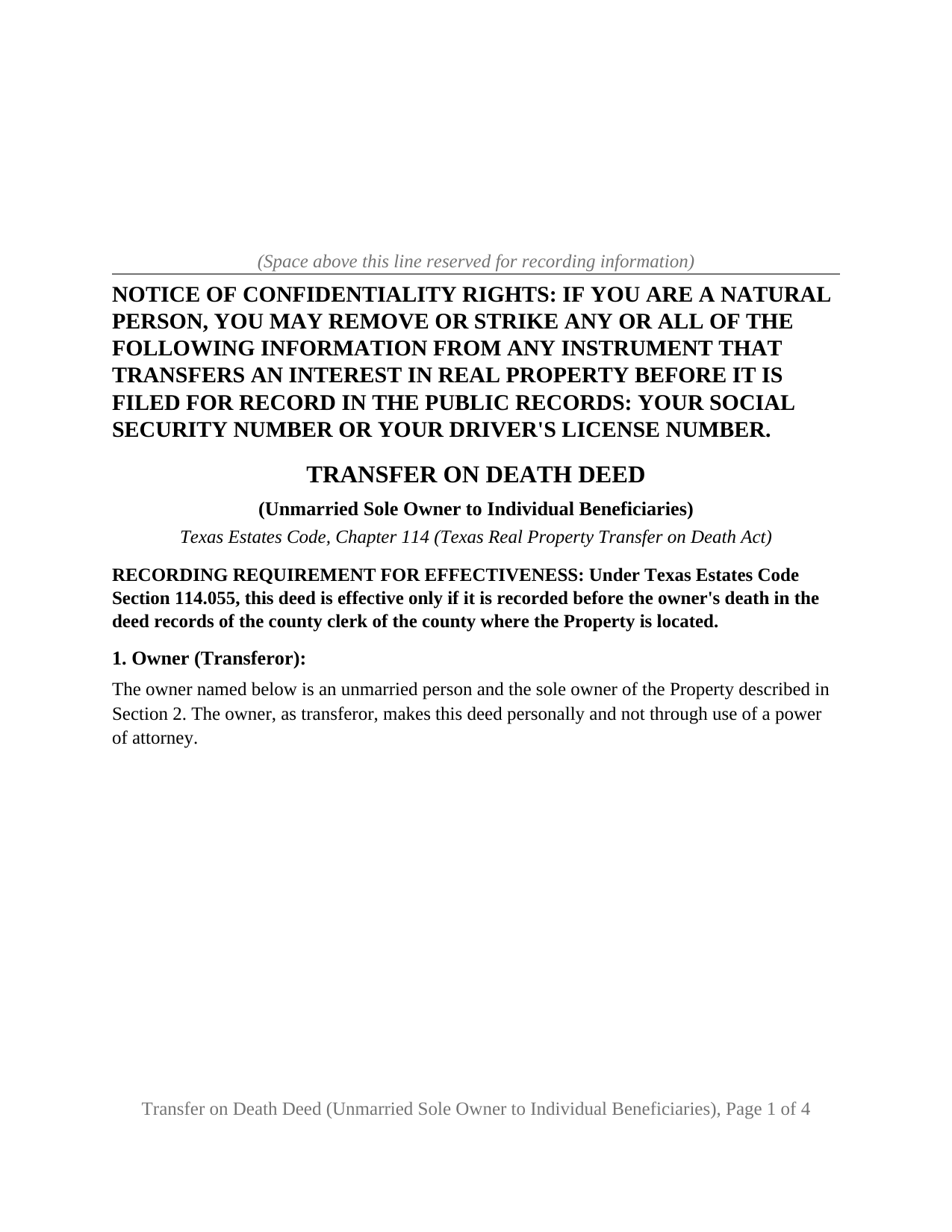
Howard County Transfer on Death Deed (Unmarried Sole Owner to Individual Beneficiaries) Form
Fill in the blank Transfer on Death Deed (Unmarried Sole Owner to Individual Beneficiaries) form formatted to comply with all Texas recording and content requirements.
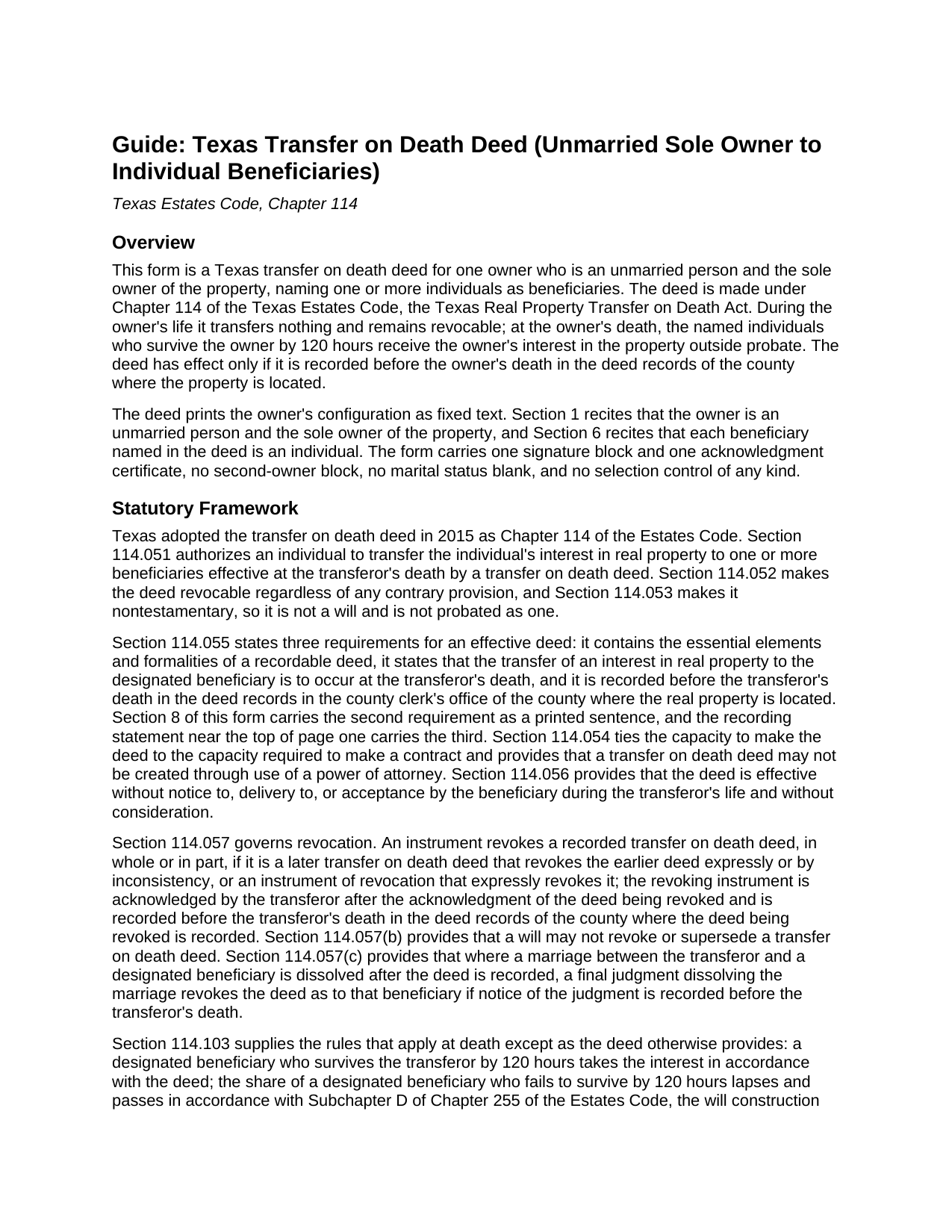
Howard County Transfer on Death Deed (Unmarried Sole Owner to Individual Beneficiaries) Guide
Line by line guide explaining every blank on the Transfer on Death Deed (Unmarried Sole Owner to Individual Beneficiaries) form.
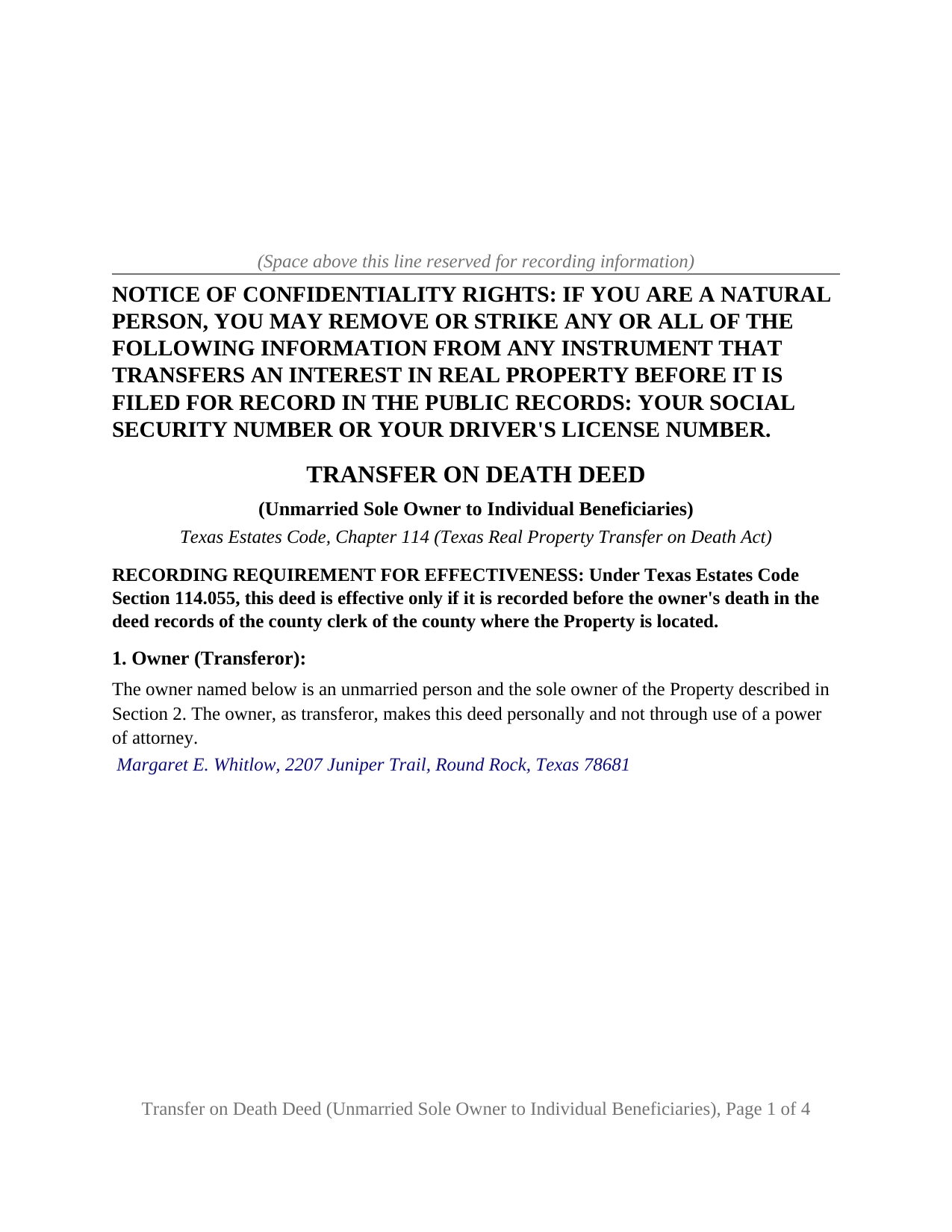
Howard County Completed Example of the Transfer on Death Deed (Unmarried Sole Owner to Individual Beneficiaries) Document
Example of a properly completed Texas Transfer on Death Deed (Unmarried Sole Owner to Individual Beneficiaries) document for reference.
All 3 documents above included • One-time purchase • No recurring fees
Immediate Download • Secure Checkout
Additional Texas and Howard County documents included at no extra charge:
Where to Record Your Documents
Howard County Clerk
Big Spring, Texas 79721
Hours: Monday - Friday 8:00am - 5:00pm
Phone: 432-264-2213
Recording Tips for Howard County:
- Bring your driver's license or state-issued photo ID
- Ensure all signatures are in blue or black ink
- Double-check legal descriptions match your existing deed
- Verify all names are spelled correctly before recording
- White-out or correction fluid may cause rejection
Cities and Jurisdictions in Howard County
Properties in any of these areas use Howard County forms:
- Big Spring
- Coahoma
- Forsan
- Knott
Hours, fees, requirements, and more for Howard County
How do I get my forms?
Forms are available for immediate download after payment. The Howard County forms will be in your account ready to download to your computer. An account is created for you during checkout if you don't have one. Forms are NOT emailed.
Are these forms guaranteed to be recordable in Howard County?
Yes. Our form blanks are guaranteed to meet or exceed the applicable formatting requirements used for recording in Howard County, including margin requirements, font requirements, and other layout standards. This guarantee applies to formatting, not to the legal sufficiency of information entered by the user or the suitability of a form for a particular transaction.
Can I reuse these forms?
Yes. You can reuse the forms for your personal use. For example, if you have multiple properties in Howard County you only need to order once.
What do I need to use these forms?
The forms are PDFs that you fill out on your computer. The free Adobe Acrobat Reader is recommended, and most PDF apps also work. You do NOT enter your property information online - you download the blank forms and complete them privately on your own computer.
Are there any recurring fees?
No. This is a one-time purchase. Nothing to cancel, no memberships, no recurring fees.
How much does it cost to record in Howard County?
Recording fees in Howard County vary. Contact the recorder's office at 432-264-2213 for current fees.
Questions answered? Let's get started!
This Texas transfer on death deed is built for one owner who is an unmarried person and holds the property alone, naming one or more individuals to receive it at death. The deed prints that configuration as its own text: Section 1 recites that the owner is an unmarried person and the sole owner of the property, Section 6 recites that each beneficiary is an individual, and the instrument carries one signature block and one acknowledgment certificate under Chapter 114 of the Texas Estates Code.
One owner, one death, no spouse to account for
Most of the complexity in a Texas transfer on death deed comes from the people around the owner: a spouse with a community property interest, a co-owner whose survivorship right postpones the deed to a second death. The configuration this deed recites has neither, so there is no community property presumption to work through, no joinder question under Family Code Section 5.001, and no survivorship arrangement that delays the transfer. The deed waits for a single event, the owner's death, and the individuals named in it who survive the owner by 120 hours take the owner's interest outside probate. The ownership patterns that present this shape appear in the record as one name on the vesting deed: a person who never married and bought alone, a widowed owner whose title now stands in one name, and a divorced owner whose decree or a later deed consolidated the property.
Why the deed prints the owner's status
This deed leaves nothing about status, ownership, or a second owner to a blank or a box: the recital in Section 1 is printed, the only entry in that section is the owner's name and mailing address, and there is no second signature block on the instrument. The recital states what the owner asserts on the date of signing; a later marriage is not among the events Chapter 114 lists as revoking a recorded deed, and the guide describes what it changes at death.
Beneficiaries who are people, not entities
Chapter 114 defines a beneficiary as a person and borrows the Government Code definition of that word, so the statute itself allows a trust or a corporation to be named. This deed fixes the beneficiary class to individuals, and Section 6 says so in print. Where more than one individual is named, Section 114.103 passes the property to them in equal and undivided shares with no right of survivorship among them. Section 7 is an optional alternate designation: the individuals named there take only if no primary beneficiary survives the owner by 120 hours, and they carry the same survival requirement. The form carries no share arrangement other than the statute's equal shares and no open drafting box.
What the operative section states
Section 114.055 requires a transfer on death deed to state that the transfer to the designated beneficiary is to occur at the transferor's death, and Section 8 of this deed carries that sentence in the statute's own words beside the transfer itself, effective at the death of the owner. The same section recites the owner's contractual capacity, restates the survival and lapse rules of Section 114.103, states that the deed transfers the property without covenant or warranty of title, and closes with the capitalized statement that the deed is revocable. Revocation during life takes a separately prepared and recorded instrument under Section 114.057, not included in this package; a will does not revoke a transfer on death deed in Texas.
Recording before death is the effectiveness condition
A Texas TOD deed, sometimes searched for as a beneficiary deed, is effective only if recorded before the owner's death in the deed records of the county where the property is located, and the recording statement near the top of page one says so. The deed is formatted for the county clerk: letter size pages within Local Government Code Section 191.007, 12 point body text, the Property Code Section 11.008 notice of confidentiality rights in 12 point boldfaced capitals at the top of the first page, and reserved space for the recording stamp.
The package contains the deed as a fillable PDF, completed on screen or printed and completed by hand; a completed example filled in for a realistic Williamson County fact pattern; and a plain language guide that walks through every numbered section, the acknowledgment, and recording. This description and the guide describe the form and the governing statutes in general terms; they are not legal advice.
Important: Your property must be located in Howard County to use these forms. Documents should be recorded at the county recording office listed above.
This Transfer on Death Deed (Unmarried Sole Owner to Individual Beneficiaries) meets all recording requirements specific to Howard County.
Our Promise
The documents you receive here are guaranteed to meet or exceed the applicable Howard County recording format requirements. If there is a rejection caused by our formatting, we will correct the issue or refund your payment. This guarantee applies to document formatting only and does not extend to information entered by the user, the selection of the form, or the legal effect of the completed document.
Save Time and Money
Get your Howard County Transfer on Death Deed (Unmarried Sole Owner to Individual Beneficiaries) form done right the first time with Deeds.com Uniform Conveyancing Blanks. At Deeds.com, we understand that your time and money are valuable resources, and we don't want you to face a penalty fee or rejection imposed by a county recorder for submitting nonstandard documents. We constantly review and update our forms to meet rapidly changing state and county recording requirements for roughly 3,500 counties and local jurisdictions.
4.8 out of 5 - ( 4,828 Reviews )
Eldridge S. 5 out of 5 stars
very pleased to attain this important document
We appreciate your business and value your feedback. Thank you. Have a wonderful day!
Christine W. 5 out of 5 stars
excellent
Thank you!
Christine D. 5 out of 5 stars
Very easy to use and very fast. I was very happy with your service and will definitely use it again in the future!
We appreciate your business and value your feedback. Thank you. Have a wonderful day!
Quinn R. 5 out of 5 stars
DEEDS.COM IS THE BEST WAY TO E-RECORD DEEDS. THEY ARE FAST, POLITE AND A FANTASTIC DEAL FOR THE SERVICE THAT THEY OFFER!!!
Thank you!
John G. 5 out of 5 stars
I was actually quite pleased with the ease of use of this site. I really, really liked the step by step instructions and examples of the finished product !!
Thank you!
Charles S. 5 out of 5 stars
very happy with guidance and responses - thank you - not finished yet but confident
We are sincerely grateful for your feedback and are committed to providing the highest quality service. Thank you for your trust in us.
Ronald W. 5 out of 5 stars
User friendly, but couldn't find the information needed.
Thank you for your feedback. We really appreciate it. Have a great day!
ed c. 5 out of 5 stars
real easy and fast
Thank you!
Raad A. 3 out of 5 stars
Not easy to navigate
Thank you for your feedback.
Frank B. 5 out of 5 stars
Great website, super easy to use, user friendly to navigate. Will definitely use for future needs, and will definitely refer to other customers. F. Betancourt Texas
Thank you!
Angela D. 5 out of 5 stars
The only problem I had was that it doesn't let you create a file for all documents to go into as one. Mahalo Angie
Thank you for your feedback. We really appreciate it. Have a great day!
Gary R. 5 out of 5 stars
Very prompt response to my questions.
Thank you!
Robert D. 5 out of 5 stars
These forms made it so easy to update the property deed and the instructions and sample filled out form were most helpful. You might want to add some brief information on when or why to use the Acknowledgment in Individual Capacity notary form. In my case the notary was required to use it but also filled in the brief notarize section on the Affidavit as well. She said the one on the Affidavit had some value because it showed she had witnessed the my signature. But this was only after I suggested both be filled in as she initially thought to just strike through it and just use the Acknowledgment in Individual Capacity form.
Thank you for your feedback. We really appreciate it. Have a great day!
Sheri S. 5 out of 5 stars
So happy to have found this site. It’s just what I was looking for.
We are grateful for your feedback and looking forward to serving you again. Thank you!
Dan L. 4 out of 5 stars
The only suggestion I have is to include sample of putting quitclaim into a revocable trust.
Your insights are invaluable to us and help us strive for better service. Thank you for taking the time to share your thoughts.