Texas Transfer on Death Deed (Unmarried Sole Owner to Individual Beneficiaries)
County Specific Legal Forms Validated as recently as October 15, 2026 by our Forms Development Team
About the Texas Transfer on Death Deed (Unmarried Sole Owner to Individual Beneficiaries)
How to Use This Form
- Select your county from the list
- Download the county-specific form
- Fill in the required information
- Have the document notarized if required
- Record with your county recorder's office
What Others Like You Are Saying
"After a little glitch due to heavy volume at the County Recorder, my document was recorded. County R…"
"Couldn't be more simple. Good product"
"Great templates and very efficient"
"Great service they had what i need easy to use on printing as soon as you pay you can print also as …"
"Awesome thanks"
4.8/5 from 4,828 reviews. Read all
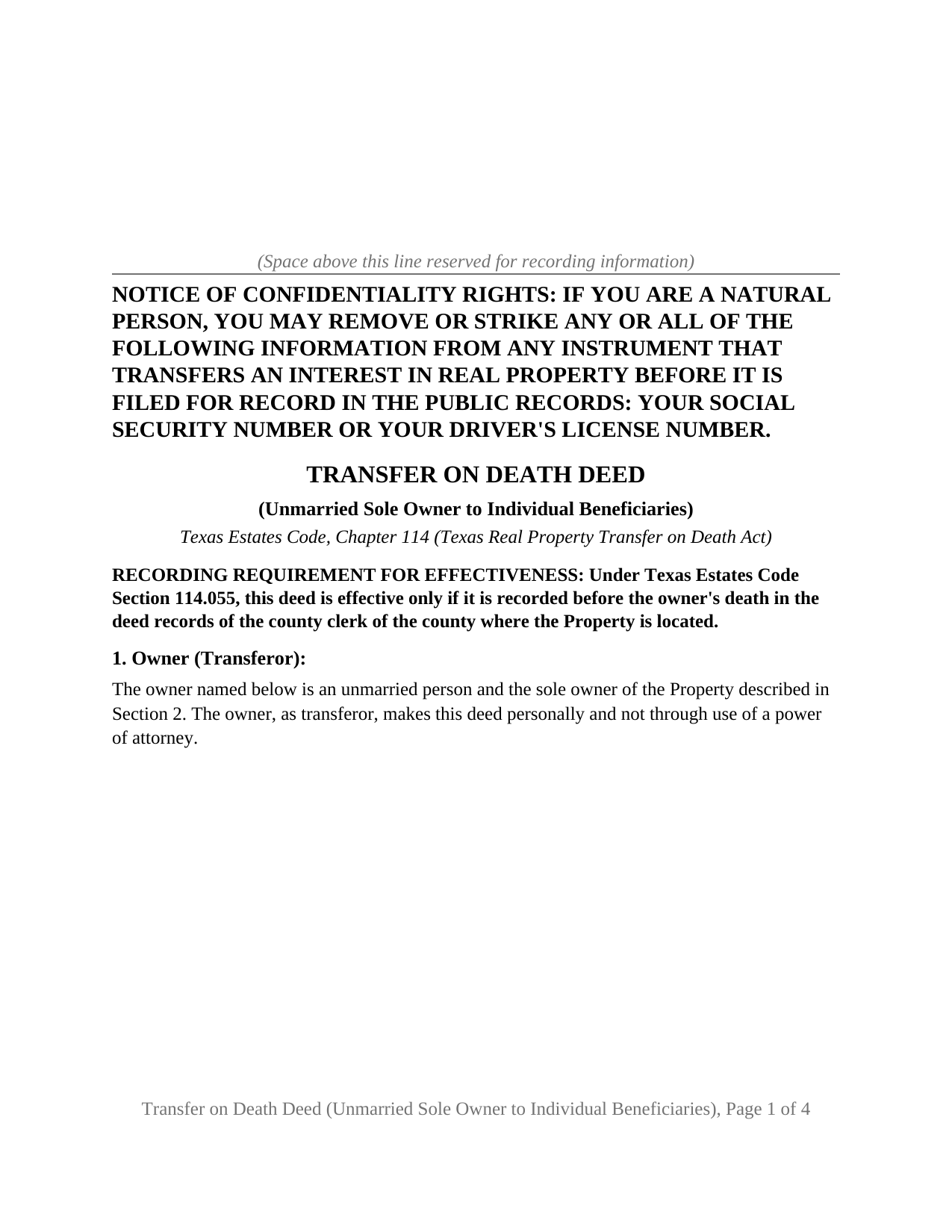
This Texas transfer on death deed is built for one owner who is an unmarried person and holds the property alone, naming one or more individuals to receive it at death. The deed prints that configuration as its own text: Section 1 recites that the owner is an unmarried person and the sole owner of the property, Section 6 recites that each beneficiary is an individual, and the instrument carries one signature block and one acknowledgment certificate under Chapter 114 of the Texas Estates Code.
One owner, one death, no spouse to account for
Most of the complexity in a Texas transfer on death deed comes from the people around the owner: a spouse with a community property interest, a co-owner whose survivorship right postpones the deed to a second death. The configuration this deed recites has neither, so there is no community property presumption to work through, no joinder question under Family Code Section 5.001, and no survivorship arrangement that delays the transfer. The deed waits for a single event, the owner's death, and the individuals named in it who survive the owner by 120 hours take the owner's interest outside probate. The ownership patterns that present this shape appear in the record as one name on the vesting deed: a person who never married and bought alone, a widowed owner whose title now stands in one name, and a divorced owner whose decree or a later deed consolidated the property.
Why the deed prints the owner's status
This deed leaves nothing about status, ownership, or a second owner to a blank or a box: the recital in Section 1 is printed, the only entry in that section is the owner's name and mailing address, and there is no second signature block on the instrument. The recital states what the owner asserts on the date of signing; a later marriage is not among the events Chapter 114 lists as revoking a recorded deed, and the guide describes what it changes at death.
Beneficiaries who are people, not entities
Chapter 114 defines a beneficiary as a person and borrows the Government Code definition of that word, so the statute itself allows a trust or a corporation to be named. This deed fixes the beneficiary class to individuals, and Section 6 says so in print. Where more than one individual is named, Section 114.103 passes the property to them in equal and undivided shares with no right of survivorship among them. Section 7 is an optional alternate designation: the individuals named there take only if no primary beneficiary survives the owner by 120 hours, and they carry the same survival requirement. The form carries no share arrangement other than the statute's equal shares and no open drafting box.
What the operative section states
Section 114.055 requires a transfer on death deed to state that the transfer to the designated beneficiary is to occur at the transferor's death, and Section 8 of this deed carries that sentence in the statute's own words beside the transfer itself, effective at the death of the owner. The same section recites the owner's contractual capacity, restates the survival and lapse rules of Section 114.103, states that the deed transfers the property without covenant or warranty of title, and closes with the capitalized statement that the deed is revocable. Revocation during life takes a separately prepared and recorded instrument under Section 114.057, not included in this package; a will does not revoke a transfer on death deed in Texas.
Recording before death is the effectiveness condition
A Texas TOD deed, sometimes searched for as a beneficiary deed, is effective only if recorded before the owner's death in the deed records of the county where the property is located, and the recording statement near the top of page one says so. The deed is formatted for the county clerk: letter size pages within Local Government Code Section 191.007, 12 point body text, the Property Code Section 11.008 notice of confidentiality rights in 12 point boldfaced capitals at the top of the first page, and reserved space for the recording stamp.
The package contains the deed as a fillable PDF, completed on screen or printed and completed by hand; a completed example filled in for a realistic Williamson County fact pattern; and a plain language guide that walks through every numbered section, the acknowledgment, and recording. This description and the guide describe the form and the governing statutes in general terms; they are not legal advice.
Important: County-Specific Forms
Our transfer on death deed (unmarried sole owner to individual beneficiaries) forms are specifically formatted for each of the 254 counties in Texas.
After selecting your county, you'll receive forms that meet all local recording requirements, ensuring your documents will be accepted without delays or rejection fees.