Vermont Enhanced Life Estate Deed (Individual)
County Specific Legal Forms Validated as recently as October 20, 2026 by our Forms Development Team
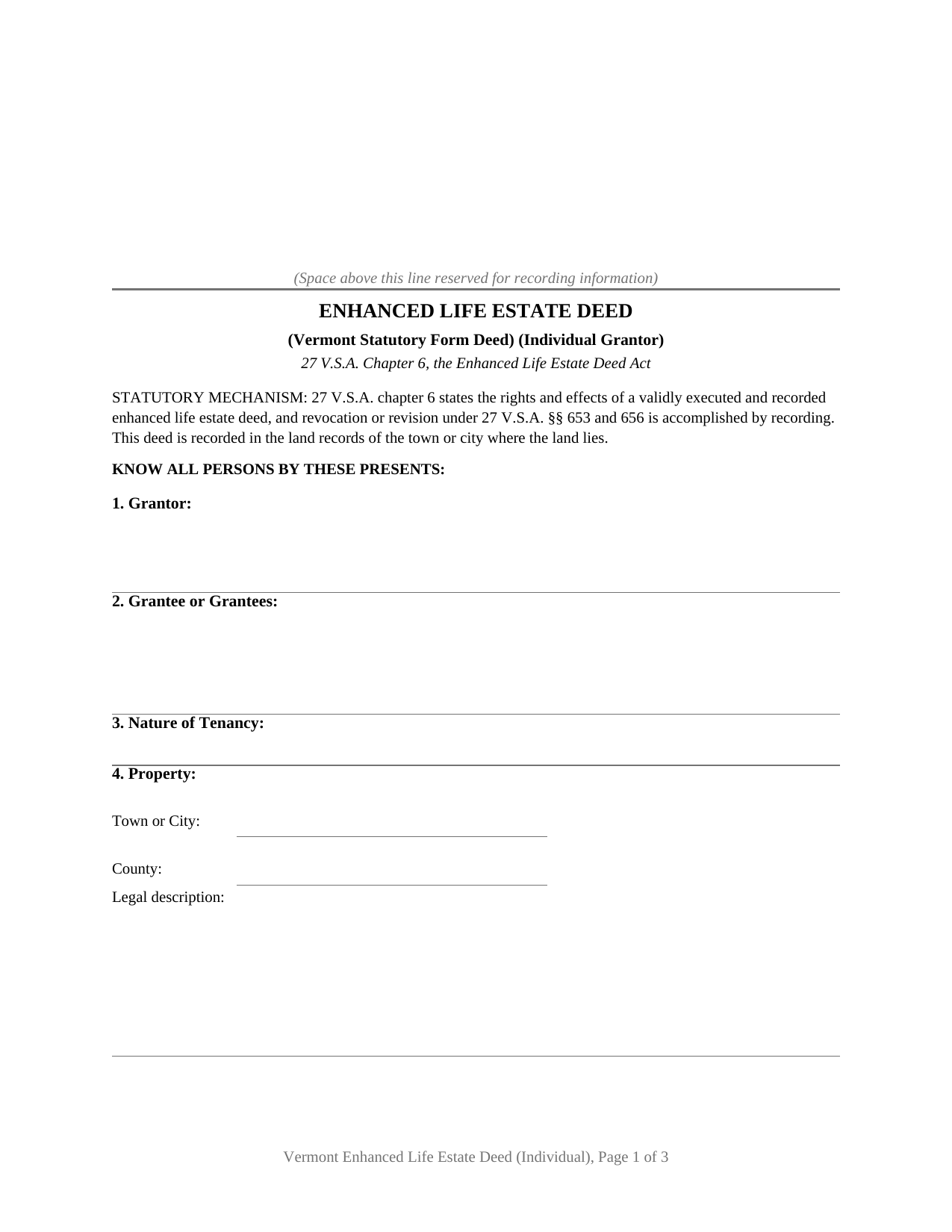
About the Vermont Enhanced Life Estate Deed (Individual)
How to Use This Form
- Select your county from the list
- Download the county-specific form
- Fill in the required information
- Have the document notarized if required
- Record with your county recorder's office
What Others Like You Are Saying
"Very helpful forms and guide. Would use again if needed."
"Appreciate the help with DC's non-intuitive forms. Superb service."
"This was my first time using Deeds.com It was very easy to understand and use. I was pleasantly supr…"
"absolutely great"
"Great product delivered immediately at very reasonable price. Highly recommend !"
4.8/5 from 4,836 reviews. Read all
One Vermont owner, signing alone, can direct where real property goes at death without probate while keeping every element of lifetime ownership. This Vermont Enhanced Life Estate Deed is configured for a single individual grantor: one grantor recital, one signature line, and one acknowledgment certificate, built on the optional statutory form in 27 V.S.A. section 660. Vermont codified this instrument, long known as a lady bird deed and now formally the ELE deed, in 2020 as chapter 6 of Title 27, the Enhanced Life Estate Deed Act.
Lifetime Control the Grantor Keeps
The deed's operative section reserves two things to the grantor: a common law life estate with exclusive use, possession, and enjoyment of the property, and the right to convey the property. The statute defines convey broadly, reaching a sale, gift, lease, transfer, or mortgage, with or without consideration, and including revocation and revision of the deed itself. Under 27 V.S.A. section 656, the grantor revokes or revises without the grantee's joinder, consent, agreement, or even notice; revocation is a recorded deed from the grantor back to the grantor, and revision is a new recorded ELE deed naming the changed grantee list. Section 654 states that the recorded deed does not affect the grantor's ownership rights, transfers no present interest to the grantee, and does not expose the property to the grantee's creditors during the grantor's life. The grantee holds only a contingent remainder and cannot convey it; section 655(b) makes an attempted transfer void.
What the Individual Configuration Recites
The form recites exactly one grantor, a natural person as 27 V.S.A. section 653(4) requires, and carries a single signature block with one acknowledgment certificate in the Vermont short form. The grantee section accepts one or more grantees, and a nature of tenancy entry states how title stands among them when it vests. A widowed or unmarried owner naming an adult child, and a sole owner naming two relatives as tenants in common or joint tenants, present the single grantor pattern this deed recites. Property held by two owners, including spouses holding a Vermont tenancy by the entirety, presents a two grantor signing pattern that this form is not set up as; Vermont law requires spousal joinder for conveyances of homestead and entireties property, and the deed as configured recites one owner acting alone.
At the Grantor's Death
If the grantor still owns the property at death, title vests in the grantee under section 654(c), subject to encumbrances of record, with no probate administration of the parcel. A mortgage recorded during the grantor's life rides with the property; it encumbers the interest without disturbing the deed. Where a grantee dies first, section 658 supplies the default: a sole grantee's interest passes to that grantee's heirs or beneficiaries as the Probate Division directs, while a surviving joint tenant grantee takes by survivorship under the tenancy the deed recites.
Recording With the Town Clerk
Vermont records deeds by municipality, so this deed goes to the clerk of the town or city where the land lies, at the statewide fifteen dollar per page fee. The recording package includes a completed Property Transfer Tax Return, Form PTT-172; 32 V.S.A. section 9608 bars the clerk from recording without a complete return and the required Act 250 certificate. The ELED Act makes a recorded enhanced life estate deed subject to the transfer tax even as a family gift, and 32 V.S.A. section 9617(8)(B) supplies a refund petition route when tax was paid on an interest later revoked or revised.
What the Package Contains
The download includes the fillable deed form, a completed example showing a Washington County fact pattern, and a guide that walks through each section, the notary certificate, and the town recording process. The materials are informational and are not legal advice; a Vermont attorney can address how the Act operates on a specific title or estate plan.
Important: County-Specific Forms
Our enhanced life estate deed (individual) forms are specifically formatted for each of the 14 counties in Vermont.
After selecting your county, you'll receive forms that meet all local recording requirements, ensuring your documents will be accepted without delays or rejection fees.