Vermont Enhanced Life Estate Deed (Married Grantor with Non-Owner Spouse Joinder)
County Specific Legal Forms Validated as recently as September 3, 2026 by our Forms Development Team
About the Vermont Enhanced Life Estate Deed (Married Grantor with Non-Owner Spouse Joinder)
How to Use This Form
- Select your county from the list
- Download the county-specific form
- Fill in the required information
- Have the document notarized if required
- Record with your county recorder's office
What Others Like You Are Saying
"Easy download of correct fillable forms for specific State and County. The accompanying guides and e…"
"This site was easy to use with full instructions on how to fill out and file forms very good"
"Was quick and easy compared to visiting downtown where the recorders office is closed or just the th…"
"Very Pleased. Was so easy and No hidden cost. Second time I have used their services. Would not use …"
"The forms were easy to download and fill."
4.8/5 from 4,820 reviews. Read all
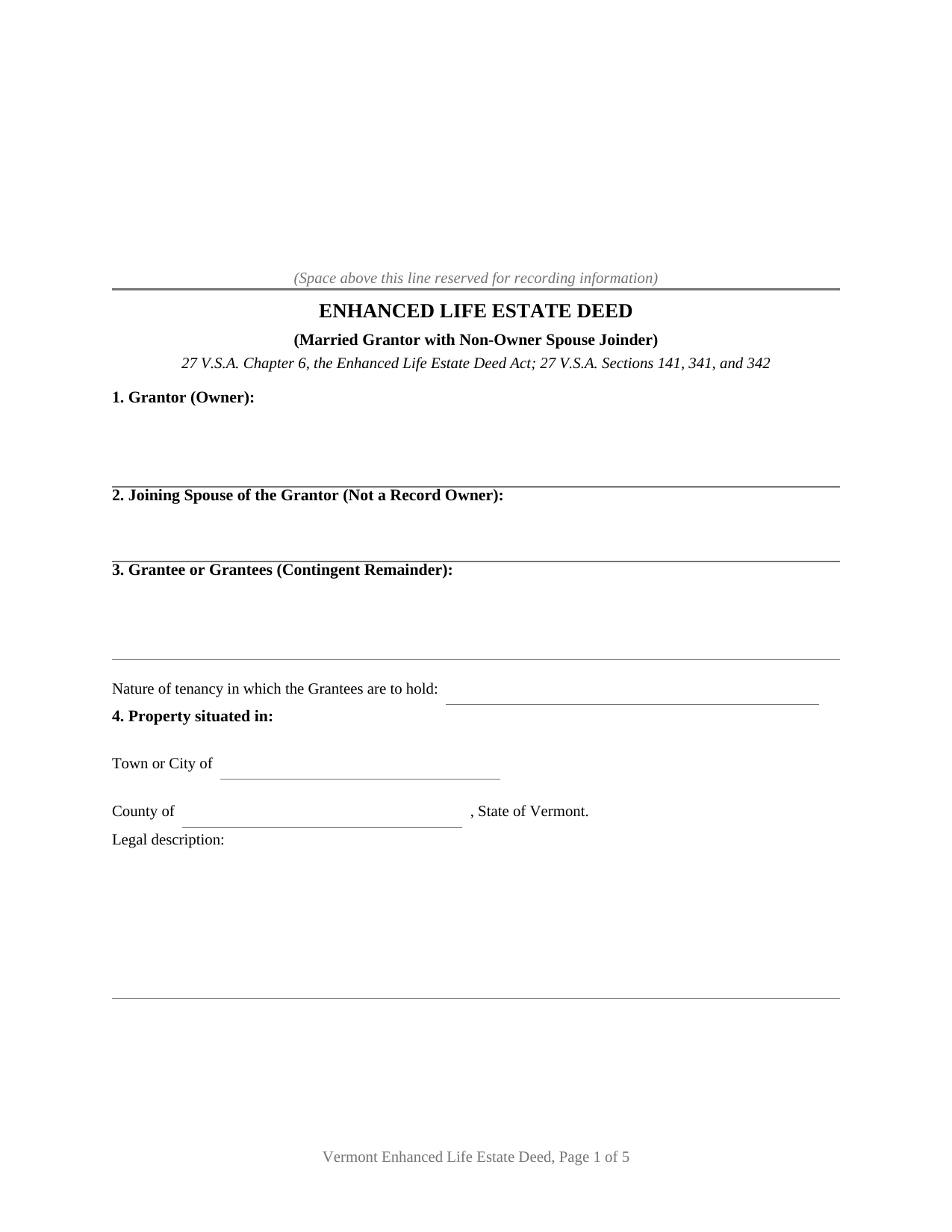
One signature would leave the homestead question open; this deed carries two. The Vermont Enhanced Life Estate Deed (Married Grantor with Non-Owner Spouse Joinder) prepares an enhanced life estate deed, the instrument also searched as a lady bird deed or Medicaid deed, for one married record owner of Vermont real property whose spouse does not appear on the title.
One record owner, two signatures
The form names a single Grantor, the spouse who holds record title, and a joining spouse who owns nothing of record. Vermont law makes a married owner's conveyance of the homestead inoperative as to the homestead unless the other spouse joins in the execution and acknowledgment, 27 V.S.A. Section 141, and no Vermont appellate decision yet says whether that rule reaches a deed in which the owner keeps a life estate and the right to convey. This deed answers the question on the face of the record instead of leaving it to argument: the non-owner spouse signs a labeled joinder block and acknowledges before a notary, and the joinder clause states that the spouse takes no interest under the deed and shares none of the reserved rights. Owners who took title before the marriage, and owners holding inherited property in one name, present the pattern this form describes.
A life estate the statute enhances
An ordinary life estate deed locks the owner in, because selling or mortgaging afterward takes the remainderman's signature. Vermont's Enhanced Life Estate Deed Act, 27 V.S.A. chapter 6, in effect since July 13, 2020, gives statutory footing to the alternative Vermont practitioners built for years under names like lady bird deed and Italian deed. The Grantor reserves a common law life estate together with the right to convey the property, and the named grantees receive only a contingent remainder. The recorded deed changes nothing during the Grantor's life: it does not affect the Grantor's ownership or the rights of the Grantor's creditors, it transfers no present interest, and it keeps the property clear of the grantees' creditors under 27 V.S.A. Section 654. The Grantor may sell, mortgage, revise, or revoke without the grantees' joinder, consent, or notice. At the Grantor's death, title vests in the surviving grantees outside probate, subject to encumbrances of record.
Grantees, tenancy, and later changes
The grantee section accepts one or more grantees and a nature of tenancy entry stating how several grantees hold once title vests: as tenants in common, the Vermont default under 27 V.S.A. Section 2, as joint tenants, or, for grantees married to each other, as tenants by the entirety. The statute also plans for change. The Grantor revokes by recording a deed back to the Grantor and revises by recording a new enhanced life estate deed naming all grantees; each is a separate recorded instrument, prepared apart from this package.
Recording with the town clerk
Vermont records land town by town, not by county, so the deed goes to the clerk of the town or city where the land lies, at $15.00 per page under 32 V.S.A. Section 1671. A completed Property Transfer Tax Return, Form PTT-172, travels with it; the clerk cannot record the deed without one under 32 V.S.A. Section 9608, and an executed and recorded enhanced life estate deed is subject to the property transfer tax. Where the deed is later revoked or revised, 32 V.S.A. Section 9617(8)(B) lets the person who paid the tax petition for a refund. The acknowledgment certificates follow the statutory short form wording, and the guide walks through the return, the rates, and the principal residence treatment at the moment they matter.
What the download includes
The package contains the blank deed as a fillable PDF, a completed example showing the whole document filled in for a realistic Chittenden County fact pattern, and a plain language guide covering every numbered section, the signing and notarization mechanics for both spouses, and the recording steps. The materials describe Vermont law in general terms and are not legal advice; a Vermont attorney can apply these rules to a particular title.
Important: County-Specific Forms
Our enhanced life estate deed (married grantor with non-owner spouse joinder) forms are specifically formatted for each of the 14 counties in Vermont.
After selecting your county, you'll receive forms that meet all local recording requirements, ensuring your documents will be accepted without delays or rejection fees.