Vermont Enhanced Life Estate Deed (Joint Owners with Right of Survivorship)
County Specific Legal Forms Validated as recently as October 1, 2026 by our Forms Development Team
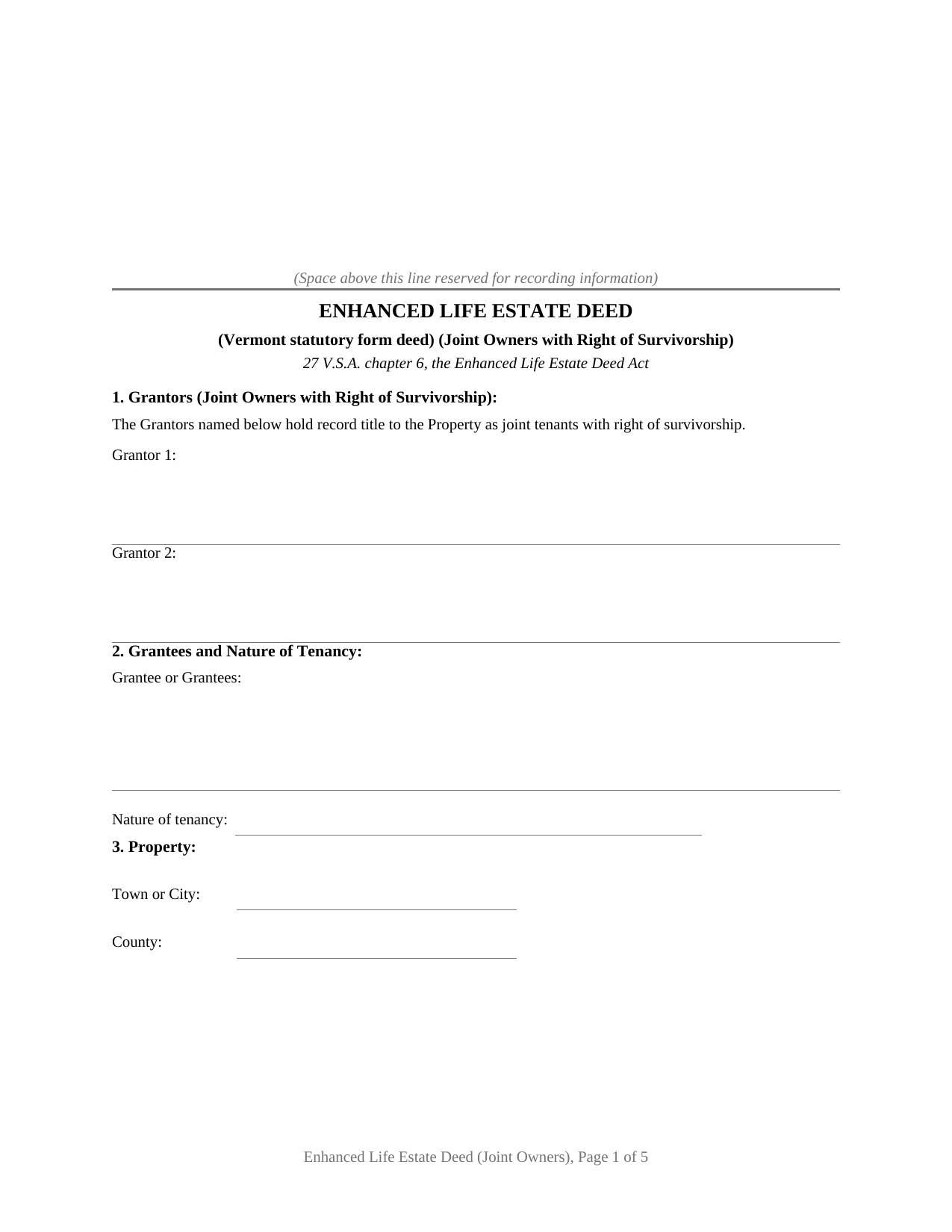
About the Vermont Enhanced Life Estate Deed (Joint Owners with Right of Survivorship)
How to Use This Form
- Select your county from the list
- Download the county-specific form
- Fill in the required information
- Have the document notarized if required
- Record with your county recorder's office
What Others Like You Are Saying
"easy to use to get copy of documents. given your website by recorder in the country offices."
"Good so far. Will be great if you get the deed recorded."
"I'd say 5 stars. Thank you."
"I am very happy with the service and would use again. Super fast, efficient, and very helpful friend…"
"Fabulous"
4.8/5 from 4,818 reviews. Read all
Two Vermont owners who already hold title as joint tenants with right of survivorship keep that survivorship working when they sign one enhanced life estate deed together. This fillable Vermont form names both owners as Grantors, reserves a common law life estate to them and to the survivor of them, and gives the named Grantees a contingent remainder that vests only at the death of the last surviving owner. Vermont practice also knows this instrument as a lady bird deed, a Medicaid deed, or an ELE deed.
A reservation that follows the survivor
The deed changes nothing while either owner lives. At the first death, the survivorship the owners already hold carries the property to the surviving Grantor, and the deed's reservation continues in that survivor by its own terms: the statutory reservation runs to the Grantors, or the survivor of them. The surviving owner keeps exclusive use, possession, and enjoyment of the property, together with the reserved right to sell, gift, lease, mortgage, revise, or revoke, all without joinder by, consent to, agreement of, or notice to the Grantees. At the second death, title vests in the Grantees by operation of the recorded deed, outside probate and subject to encumbrances of record.
Statutory language from the Enhanced Life Estate Deed Act
Vermont codified this instrument in 27 V.S.A. chapter 6, the Enhanced Life Estate Deed Act, effective July 13, 2020. The form follows the optional statutory form in 27 V.S.A. section 660, from the operative words GIVE, GRANT, SELL, CONVEY, AND CONFIRM through the statutory reservation of the life estate and the right to convey, to the warranty covenants that except the matters stated in the deed. The statute settles the questions that once surrounded reserved powers deeds: a validly executed and recorded enhanced life estate deed transfers no present interest, leaves the Grantors' ownership and creditor position untouched, and keeps the property clear of the Grantees' creditors during the Grantors' lives. A Grantee cannot convey the contingent remainder while a Grantor lives; the statute makes an attempted conveyance void. A later mortgage does not revoke the deed, and the Grantors may revise or revoke at any time by recorded deed.
The two owner configuration this deed carries
The form states that the two Grantors hold record title as joint tenants with right of survivorship, provides a separate signature line for each, and carries two acknowledgment certificates so the owners may acknowledge on different dates or before different notaries. The Grantee section takes one or more names with a nature of tenancy entry stating how title vests at the second death. Siblings holding an inherited camp together, a parent and an adult child placed in title together, and unmarried partners whose deed expressed survivorship present the two owner pattern this deed describes. The form is set up for exactly two Grantors whose existing title already carries survivorship as joint tenants; a sole owner, and spouses who hold as tenants by the entirety, hold title in patterns this form does not describe.
Recording at the town clerk's office
Vermont records deeds by town or city, not by county, and the completed deed goes to the clerk of the municipality where the land lies with a recording fee of fifteen dollars per page. A Vermont Property Transfer Tax Return accompanies the deed; by statute the clerk cannot record a deed evidencing a transfer without the completed return and the required Act 250 certificate, and an enhanced life estate deed is subject to the transfer tax even though the statutory form states a transfer without consideration. Vermont law softens that edge in a specific way: where the enhanced life estate interest is later revoked or revised, the person who paid the tax may petition for a refund under 32 V.S.A. section 9617(8)(B).
The download contains the fillable deed form, a completed example showing a two owner Colchester fact pattern, and a plain language guide that walks through every section, the notary formalities, and the transfer tax return. The materials are informational and are not legal advice; a Vermont attorney can address how the Act operates on a particular title.
Important: County-Specific Forms
Our enhanced life estate deed (joint owners with right of survivorship) forms are specifically formatted for each of the 14 counties in Vermont.
After selecting your county, you'll receive forms that meet all local recording requirements, ensuring your documents will be accepted without delays or rejection fees.