Vermont Enhanced Life Estate Deed (Two Grantors)
County Specific Legal Forms Validated as recently as October 6, 2026 by our Forms Development Team
About the Vermont Enhanced Life Estate Deed (Two Grantors)
How to Use This Form
- Select your county from the list
- Download the county-specific form
- Fill in the required information
- Have the document notarized if required
- Record with your county recorder's office
What Others Like You Are Saying
"Great job with these forms. Super easy and up to date, a rare find online these days. Thank you."
"I thought it was fine, but I would like to have the option to download Word versions of each form, f…"
"Great service! I downloaded the Quit Claim Deed package and I'm so grateful I did. It contained deta…"
"Looks like all forms are available. Hope they are as easy to use as it was to obtain. Thank you."
"what do you do with it once filled out. doesn't tell you"
4.8/5 from 4,836 reviews. Read all
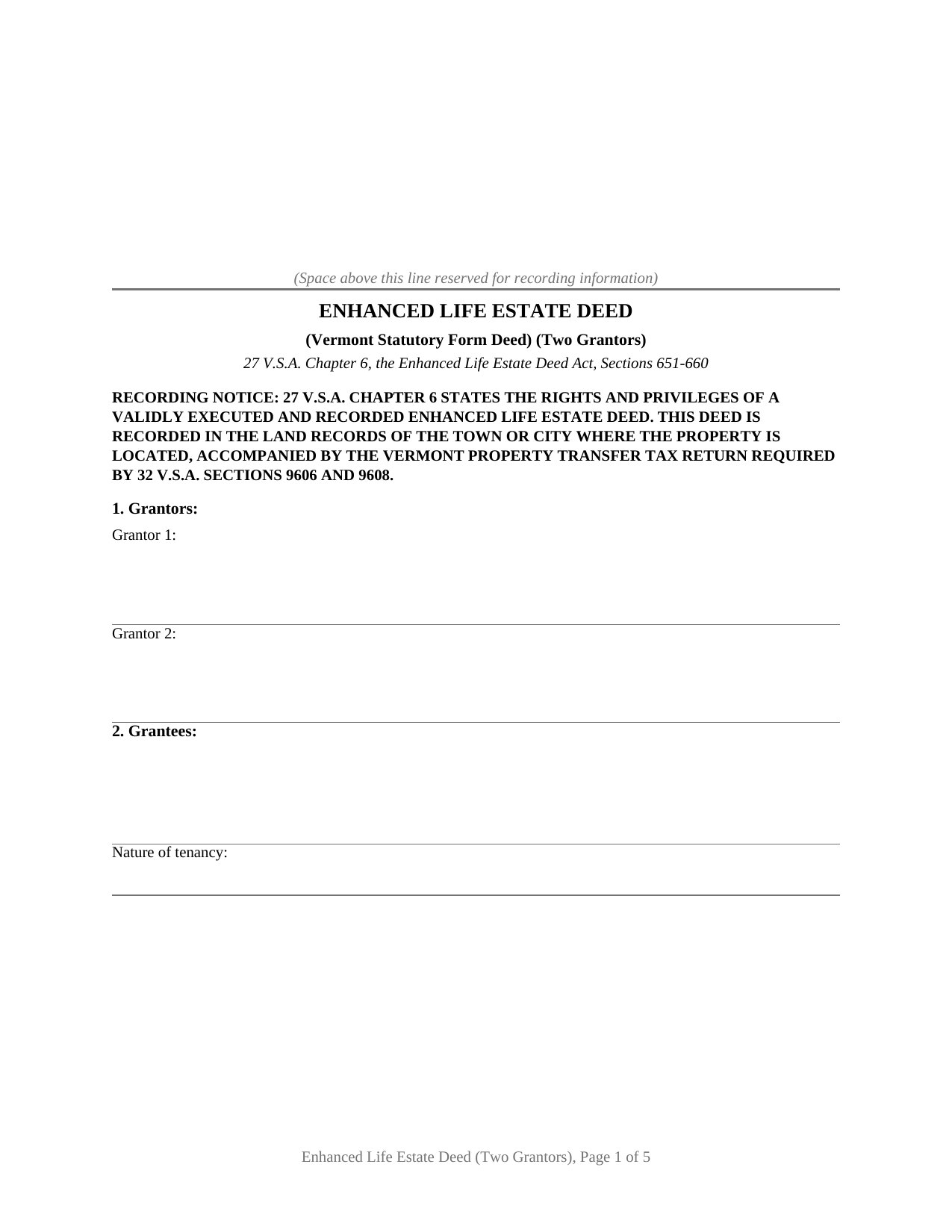
Two Vermont owners can sign one enhanced life estate deed that reserves, to themselves and to the survivor of them, a life estate and the full right to convey, while naming who takes the property when the second of them dies. This form prepares that two-grantor deed under 27 V.S.A. chapter 6, the Enhanced Life Estate Deed Act, using the operative language of the optional statutory form in section 660.
A reservation that runs to the survivor
The statutory reserved rights clause on this deed reads in the plural: the Grantors, or the survivor of them, reserve a common law life estate with the exclusive use, possession, and enjoyment of the property, together with the right to convey it. That wording is what carries the arrangement across the first death. When one grantor dies, nothing changes hands and nothing is filed in probate; the surviving grantor holds the same reserved life estate and the same unrestricted power to sell, mortgage, lease, gift, revise, or revoke, all without the grantees' signature, consent, or knowledge. Only at the death of the last surviving grantor does title vest in the grantees, outside probate and subject to encumbrances then of record.
Lifetime control with statutory certainty
Vermont wrote this instrument into statute in 2020, replacing a common law practice known locally as the lady bird deed, the Medicaid deed, or the life estate deed with reserved powers; the statute calls it an enhanced life estate deed, or ELE Deed. Section 654 states the lifetime effect directly: a recorded ELE deed does not affect the ownership rights of the grantors or their creditors, transfers no present interest to the grantees, and does not expose the property to the grantees' creditors. Section 655 adds that a grantee cannot sell or encumber the contingent remainder while a grantor lives; an attempt is void. The grantors revoke by recording a deed to themselves, or revise by recording a new deed that names all intended grantees, and a mortgage granted later encumbers the property without disturbing the deed. A revocation or revision instrument is prepared and recorded separately and is not included in this package.
The two-grantor configuration
The form recites exactly two record owners as grantors. Both sign, and the deed carries an acknowledgment certificate for each signer, so the two grantors may acknowledge on different dates, before different notaries, or in different states. The grantee section names one or more remainder takers and states the nature of tenancy in which they will hold when title vests: fee simple for a single grantee, or tenants in common, joint tenants with right of survivorship, or another recognized Vermont form for several. The statute supplies its own defaults when a grantee dies first, including a survivorship default for joint tenant grantees. Spouses holding a Vermont home as tenants by the entirety and planning for it to pass to their children present the pattern this deed recites, and two co-owners of a family camp consolidating its succession present another; where the grantors are married and the property is a homestead, the two signatures also carry the spousal joinder that 27 V.S.A. sections 141 and 349 describe. A sole owner's enhanced life estate deed follows a different single-grantor pattern than the two-grantor architecture this form recites.
Recording at the town clerk
Vermont records deeds by town or city, not by county, so this deed goes to the clerk of the municipality where the land lies, at fifteen dollars per page. The clerk cannot record it without a completed Vermont Property Transfer Tax Return, filed with its own fifteen dollar fee, and the statute makes a recorded enhanced life estate deed expressly subject to the property transfer tax. Where the deed is later revoked or revised, Vermont law supplies a petition route for refunding tax paid on the enhanced life estate interest. The deed is formatted for Vermont town land records, with the first page reserving space for the clerk's recording information.
The download includes the two-grantor deed as a fillable PDF, a completed example showing the entire document filled in for a realistic Chittenden County fact pattern, and a plain language guide that walks through every numbered section, the notarization, and the transfer tax return that accompanies recording. The materials are informational and are not legal advice.
Important: County-Specific Forms
Our enhanced life estate deed (two grantors) forms are specifically formatted for each of the 14 counties in Vermont.
After selecting your county, you'll receive forms that meet all local recording requirements, ensuring your documents will be accepted without delays or rejection fees.